Zoric Mate, Nilsson Ebba, Lundeheim Nils, Wallgren Per
National Veterinary Institute, SVA, 75189 Uppsala, Sweden.
Acta Vet Scand. 2009 May 23;51(1):23. doi: 10.1186/1751-0147-51-23.
Lameness in piglets is a major animal welfare issue. Floor abrasiveness is a common cause of superficial injury in piglets in farrowing pens. The abrasion achieved may act as a gate for infections, which in turn may induce development of infectious arthritis. In this study, the influence of improvements of the floor quality and of increased ratios of straw in identical farrowing pens was measured.
The study was carried out at a herd with four identical farrowing units with solid concrete floor bedded with 1 kg chopped straw per sow and 1 hg per piglet and day. Nothing was changed in the management of the four identical farrowing units, but four experimental groups were created: Group I--control, Group II--the amount of bedding was doubled. The surface of the floor was repaired in two units, Group III--Piglet Floor, Flowcrete Sweden AB, Perstorp, Sweden and Group IV--Thorocrete SL, Växa Halland, Sweden. Three farrowing batches were studies in each unit. In total, 93 litters (1,073 piglets) were examined for foot and skin lesions until the age of 3 weeks. The occurrence of lameness was registered until weaning at an average age of 4.5 weeks. Twenty seven lame piglets were culled instead of medicinally treated and subjected to necropsy including histopathological and microbiological examinations. Isolates of streptococci, staphylococci and E. coli were tested with respect to antimicrobial resistance.
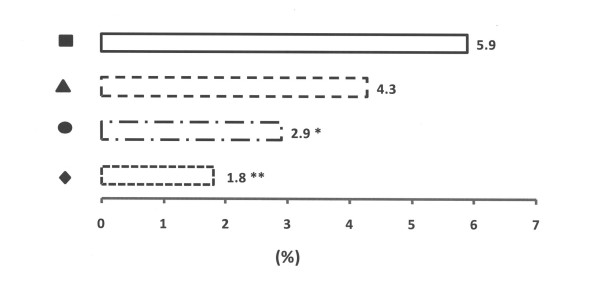
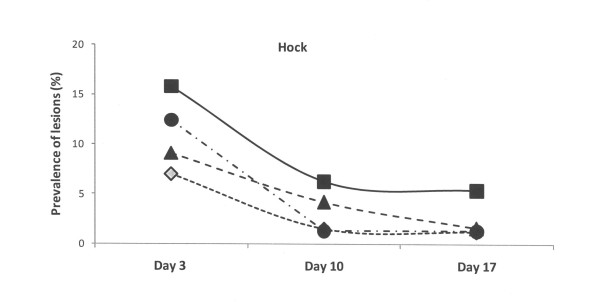
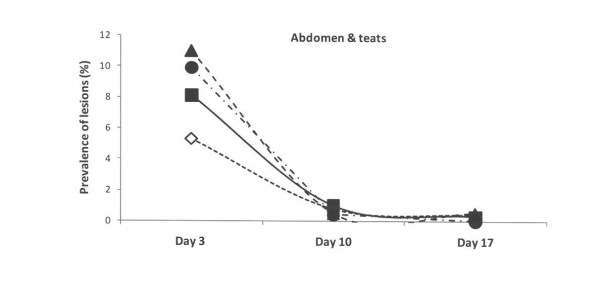
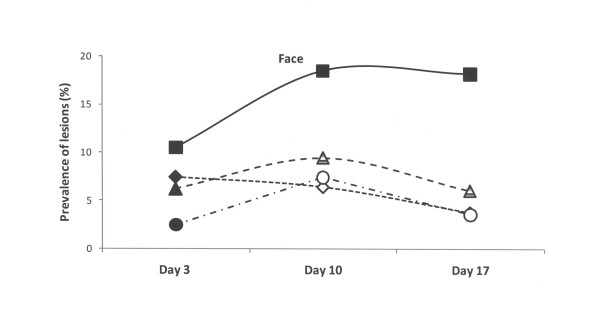
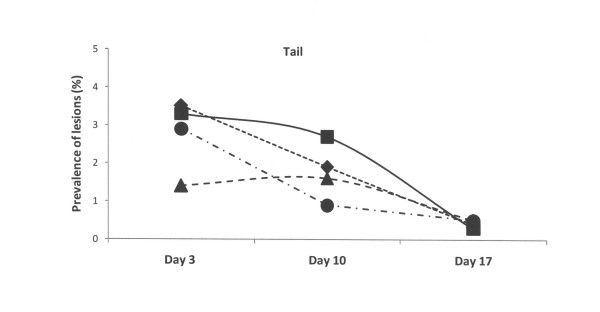
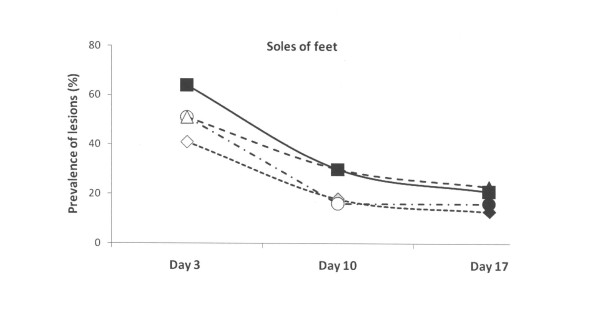
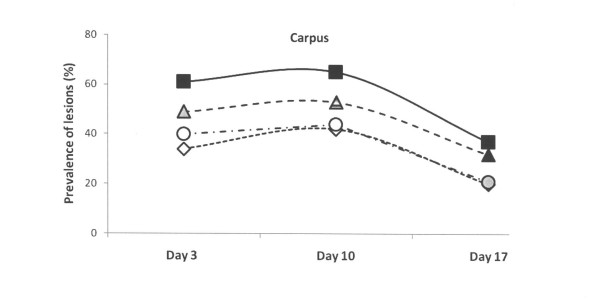
Piglet born on the repaired floors had the lowest prevalences of abrasions at carpus. Also the doubled straw ration decreased the abrasions. Skin lesions at carpus decreased significantly in magnitude in all four systems from day 10. At day 3, the sole bruising scores of the control unit were greater than the other three units (p < 0.001). At day 10 and 17, sole bruising was less common in the units with repaired floors than in the control group and the group with doubled straw ration. In total 41 piglets were diagnosed as lame, corresponding to 3.8% of all live-born piglets (n = 1,073). Around 85% of these diagnoses took place during the first 3 weeks of life and the risk incidence of lameness decreased from 1.5% during the first week of life to 0.5% during the fourth week. The incidence of lameness was highest in the control unit and lowest in the units with repaired floors. Twenty lame piglets were confirmed to have bacterial growth in the joint. The causative agents were Streptococcus dysgalactiae subsp. equisimilis (60%), Staphylococcus hyicus subsp. hyicus (35%) and Escherichia coli (5%). These isolates were sensitive to all antibiotics included in the antimicrobial panels.
The results suggest that proper maintenance of the floor can prevent the degree of roughness and abrasiveness of the floors, which in turn can contribute significantly to prevention of abrasions, sole bruising and lameness in piglets. Maintaining the surface of concrete floors with two different commercially available solutions both decreased the incidence of abrasions and sole bruisings and thereby also of arthritis significantly. Also doubling the amount of chopped straw turned out to prevent development of skin lesions and sole bruisings to some extent, and subsequently also the incidence of arthritis.
仔猪跛行是一个主要的动物福利问题。地面粗糙度是产仔栏中仔猪体表损伤的常见原因。造成的擦伤可能成为感染的入口,进而可能引发感染性关节炎。在本研究中,测量了在相同产仔栏中改善地面质量和增加稻草比例的影响。
该研究在一个有四个相同产仔单元的猪群中进行,产仔单元的地面为实心混凝土,每头母猪铺垫1千克切碎的稻草,每头仔猪每天铺垫100克。四个相同产仔单元的管理方式没有改变,但创建了四个实验组:第一组——对照组,第二组——垫料量加倍。在两个单元中修复了地面,第三组——仔猪地面,瑞典佩尔什托普的Flowcrete Sweden AB公司产品,第四组——瑞典哈兰省韦克萨的Thorocrete SL公司产品。每个单元研究了三批产仔情况。总共检查了93窝(1073头仔猪)直至3周龄时的足部和皮肤损伤情况。记录跛行的发生情况直至平均4.5周龄断奶。27头跛行仔猪被淘汰而非进行药物治疗,并进行了尸检,包括组织病理学和微生物学检查。对分离出的链球菌、葡萄球菌和大肠杆菌进行了抗菌药物敏感性测试。
在修复后的地面出生仔猪腕关节处擦伤的发生率最低。稻草比例加倍也减少了擦伤。从第10天起,所有四个系统中腕关节处的皮肤损伤程度均显著降低。在第3天,对照组的蹄底瘀伤评分高于其他三个单元(p < 0.001)。在第10天和第17天,修复地面的单元中蹄底瘀伤比对照组和稻草比例加倍的组更少见。总共41头仔猪被诊断为跛行,占所有活产仔猪的3.8%(n = 1073)。这些诊断中约85%发生在出生后的前3周,跛行的风险发生率从出生后第一周的1.5%降至第四周的0.5%。跛行发生率在对照组最高,在修复地面的单元最低。20头跛行仔猪被证实关节中有细菌生长。病原体为马链球菌兽疫亚种(60%)、猪葡萄球菌猪亚种(35%)和大肠杆菌(5%)。这些分离株对抗菌药物面板中的所有抗生素敏感。
结果表明,对地面进行适当维护可防止地面的粗糙度和擦伤程度,进而可显著有助于预防仔猪的擦伤、蹄底瘀伤和跛行。用两种不同的市售产品维护混凝土地面表面均降低了擦伤和蹄底瘀伤的发生率,从而也显著降低了关节炎的发生率。将切碎稻草的量加倍在一定程度上也可防止皮肤损伤和蹄底瘀伤的发生,进而也降低了关节炎的发生率。