Rooijakkers Eveline F, Kaminski Juliane, Call Josep
Max Planck Institute for Evolutionary Anthropology, Deutscher Platz 6, Leipzig, Germany.
Anim Cogn. 2009 Nov;12(6):789-96. doi: 10.1007/s10071-009-0238-8. Epub 2009 May 27.
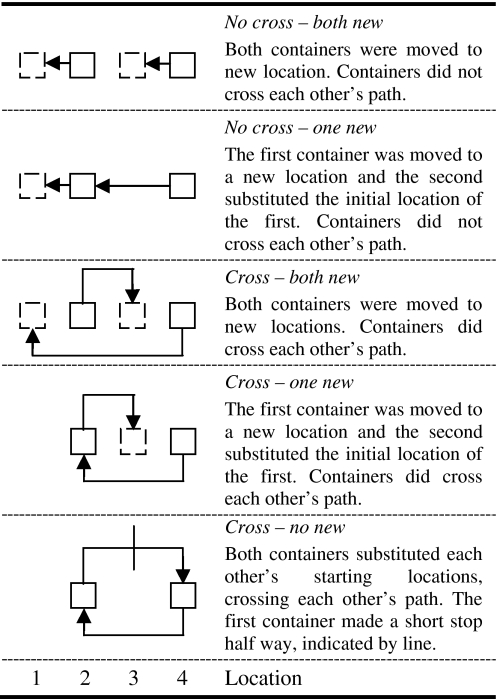
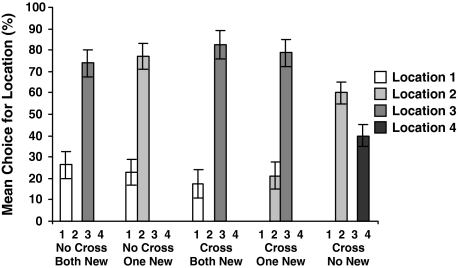
Knowing that objects continue to exist after disappearing from sight and tracking invisible object displacements are two basic elements of spatial cognition. The current study compares dogs and apes in an invisible transposition task. Food was hidden under one of two cups in full view of the subject. After that both cups were displaced, systematically varying two main factors, whether cups were crossed during displacement and whether the cups were substituted by the other cup or instead cups were moved to new locations. While the apes were successful in all conditions, the dogs had a strong preference to approach the location where they last saw the reward, especially if this location remained filled. In addition, dogs seem to have special difficulties to track the reward when both containers crossed their path during displacement. These results confirm the substantial difference that exists between great apes and dogs with regard to mental representation abilities required to track the invisible displacements of objects.
知道物体在视线中消失后仍然存在以及追踪看不见的物体位移是空间认知的两个基本要素。当前的研究在一项看不见的换位任务中比较了狗和猿类。在受试者完全可见的情况下,食物被藏在两个杯子中的一个下面。之后,两个杯子都被移动,系统地改变两个主要因素,即杯子在移动过程中是否交叉以及杯子是被另一个杯子替换还是被移动到新的位置。虽然猿类在所有条件下都成功了,但狗强烈倾向于接近它们最后看到奖励的位置,特别是如果这个位置仍然有东西。此外,当两个容器在移动过程中交叉路径时,狗似乎在追踪奖励方面有特殊困难。这些结果证实了在追踪物体看不见的位移所需的心理表征能力方面,大猩猩和狗之间存在着巨大差异。