Rogers Bonnie, McCurdy Leyla Erk, Slavin Katie, Grubb Kimberly, Roberts James R
School of Public Health, University of North Carolina at Chapel Hill, Chapel Hill, North Carolina, USA.
Environ Health Perspect. 2009 May;117(5):850-5. doi: 10.1289/ehp.0800203. Epub 2008 Dec 5.
Pediatric medical and nursing education lack the environmental health content needed to properly prepare health care professionals to prevent, recognize, manage, and treat environmental exposure-related diseases. The need for improvements in health care professionals' environmental health knowledge has been expressed by leading institutions. However, few studies have evaluated the effectiveness of programs that incorporate pediatric environmental health (PEH) into curricula and practice.
We evaluated the effectiveness of the National Environmental Education Foundation's (NEEF) Children's Environmental Health Faculty Champions Initiative, which is designed to build environmental health capacity among pediatric health care professionals.
Twenty-eight pediatric health care professionals participated in a train-the-trainer workshop, in which they were educated to train other health care professionals in PEH and integrate identified PEH competencies into medical and nursing practice and curricula. We evaluated the program using a workshop evaluation tool, action plan, pre- and posttests, baseline and progress assessments, and telephone interviews.
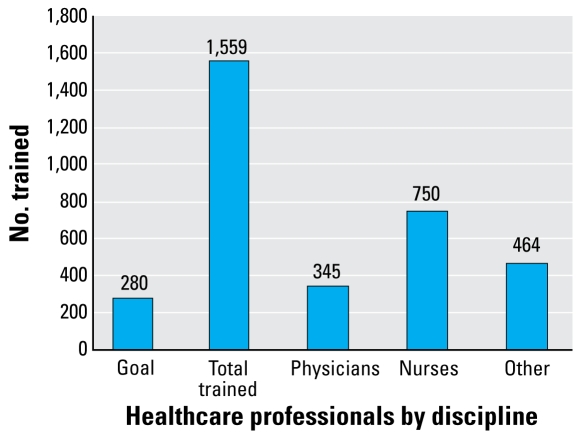
During the 12 months following the workshop, the faculty champions' average pretest score of 52% was significantly elevated (p < 0.0001) to 65.5% on the first posttest and to 71.5% on the second posttest, showing an increase and retention of environmental health knowledge. Faculty champions trained 1,559 health care professionals in PEH, exceeding the goal of 280 health care professionals trained. Ninety percent of faculty champions reported that PEH had been integrated into the curricula at their institution.
The initiative was highly effective in achieving its goal of building environmental health capacity among health care professionals. The faculty champions model is a successful method and can be replicated in other arenas.
儿科医学和护理教育缺乏必要的环境卫生内容,无法让医护人员做好预防、识别、管理和治疗与环境暴露相关疾病的准备。一些领先机构已经表达了改善医护人员环境卫生知识的需求。然而,很少有研究评估将儿科环境卫生(PEH)纳入课程和实践的项目的有效性。
我们评估了国家环境教育基金会(NEEF)的儿童环境卫生教师倡导者倡议的有效性,该倡议旨在增强儿科医护人员的环境卫生能力。
28名儿科医护人员参加了一个培训培训师的工作坊,在这个工作坊中,他们接受培训,以便能够培训其他医护人员的儿科环境卫生知识,并将确定的儿科环境卫生能力整合到医学和护理实践及课程中。我们使用工作坊评估工具、行动计划、前后测试、基线和进展评估以及电话访谈来评估该项目。
在工作坊后的12个月里,教师倡导者的平均预测试分数为52%,在第一次后测试中显著提高(p < 0.0001)至65.5%,在第二次后测试中提高到71.5%,表明环境卫生知识有所增加且得以保留。教师倡导者培训了1559名医护人员的儿科环境卫生知识,超过了培训280名医护人员的目标。90%的教师倡导者报告称,儿科环境卫生已被纳入其所在机构的课程。
该倡议在实现增强医护人员环境卫生能力的目标方面非常有效。教师倡导者模式是一种成功的方法,可以在其他领域推广。