Tediosi Fabrizio, Maire Nicolas, Penny Melissa, Studer Alain, Smith Thomas A
Department of Public Health & Epidemiology, Swiss Tropical Institute, Basel, Switzerland.
Malar J. 2009 Jun 8;8:127. doi: 10.1186/1475-2875-8-127.
A wide range of possible malaria vaccines is being considered and there is a need to identify which vaccines should be prioritized for clinical development. An important element of the information needed for this prioritization is a prediction of the cost-effectiveness of potential vaccines in the transmission settings in which they are likely to be deployed. This analysis needs to consider a range of delivery modalities to ensure that clinical development plans can be aligned with the most appropriate deployment strategies.
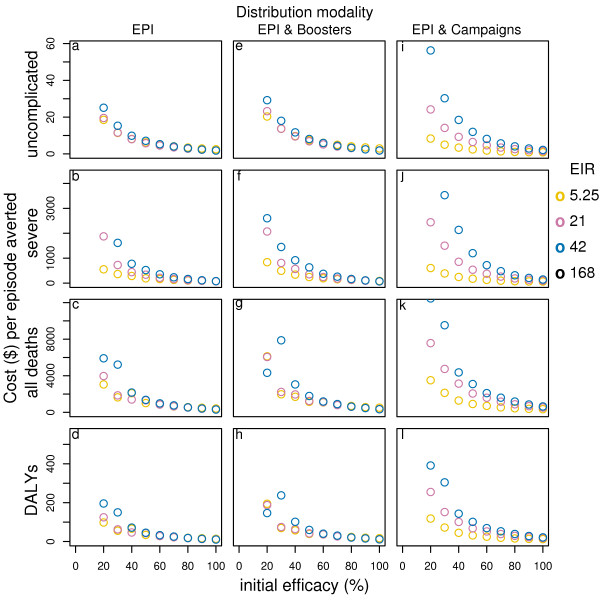
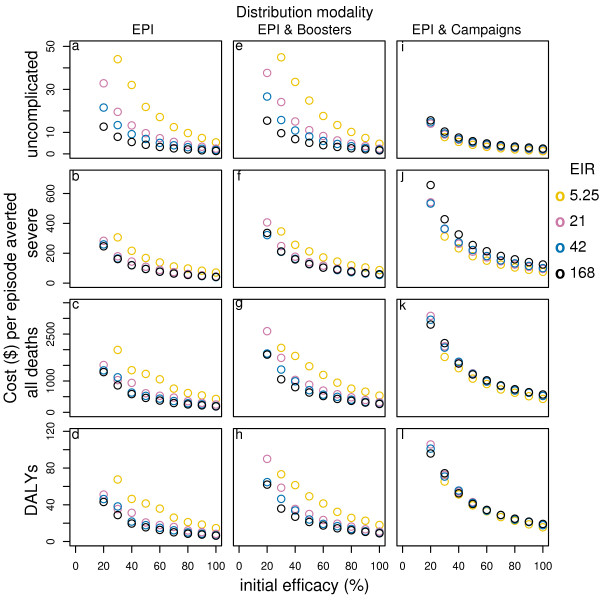
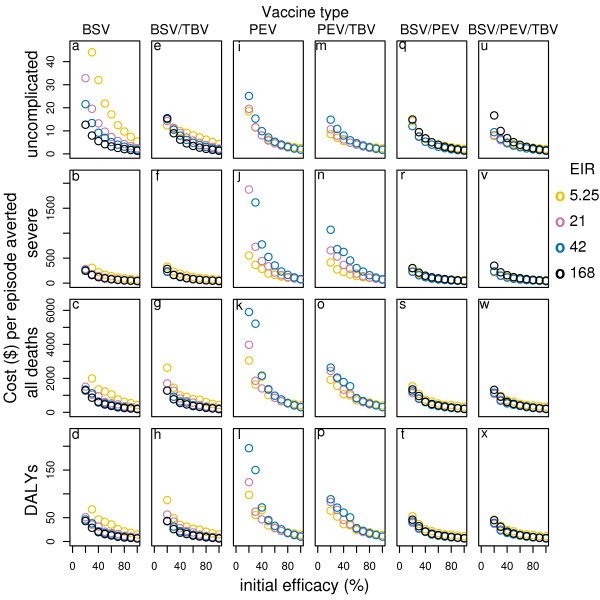
The simulations are based on a previously published individual-based stochastic model for the natural history and epidemiology of Plasmodium falciparum malaria. Three different vaccine types: pre-erythrocytic vaccines (PEV), blood stage vaccines (BSV), mosquito-stage transmission-blocking vaccines (MSTBV), and combinations of these, are considered each delivered via a range of delivery modalities (Expanded Programme of Immunization - EPI-, EPI with booster, and mass vaccination combined with EPI). The cost-effectiveness ratios presented are calculated for four health outcomes, for assumed vaccine prices of US$ 2 or US$ 10 per dose, projected over a 10-year period.
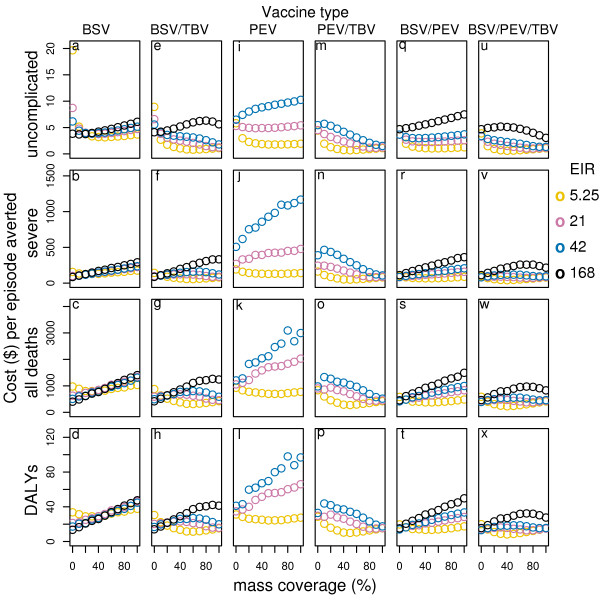
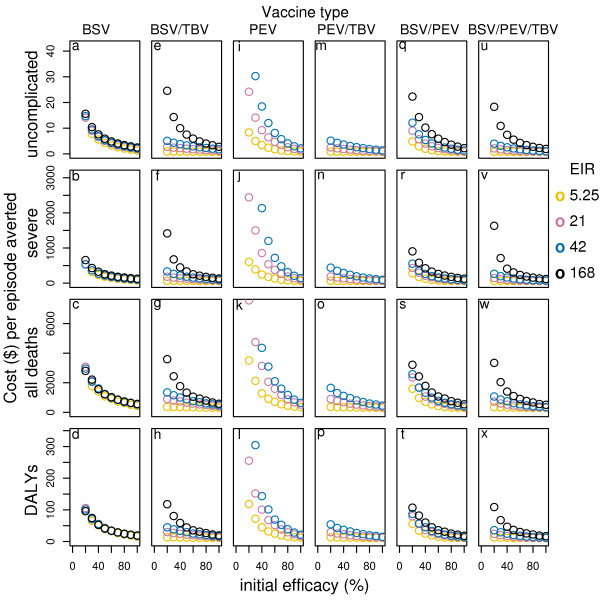
The simulations suggest that PEV will be more cost-effective in low transmission settings, while BSV at higher transmission settings. Combinations of BSV and PEV are more efficient than PEV, especially in moderate to high transmission settings, while compared to BSV they are more cost-effective in moderate to low transmission settings. Combinations of MSTBV and PEV or PEV and BSV improve the effectiveness and the cost-effectiveness compared to PEV and BSV alone only when applied with EPI and mass vaccinations. Adding booster doses to the EPI is unlikely to be a cost-effective alternative to delivering vaccines via the EPI for any vaccine, while mass vaccination improves effectiveness, especially in low transmission settings, and is often a more efficient alternative to the EPI. However, the costs of increasing the coverage of mass vaccination over 50% often exceed the benefits.
The simulations indicate malaria vaccines might be efficient malaria control interventions, and that both transmission setting and vaccine delivery modality are important to their cost-effectiveness. Alternative vaccine delivery modalities to the EPI may be more efficient than the EPI. Mass vaccination is predicted to provide substantial health benefits at low additional costs, although achieving high coverage rates can lead to substantial incremental costs.
正在考虑多种可能的疟疾疫苗,有必要确定哪些疫苗应优先进行临床开发。这种优先级确定所需信息的一个重要要素是预测潜在疫苗在其可能部署的传播环境中的成本效益。该分析需要考虑一系列的接种方式,以确保临床开发计划能够与最合适的部署策略保持一致。
模拟基于先前发表的关于恶性疟原虫疟疾自然史和流行病学的个体随机模型。考虑三种不同类型的疫苗:红细胞前期疫苗(PEV)、血期疫苗(BSV)、蚊期传播阻断疫苗(MSTBV)以及它们的组合,每种疫苗都通过一系列接种方式(扩大免疫规划 - EPI -、带加强针的EPI以及与EPI相结合的大规模接种)进行接种。给出的成本效益比是针对四种健康结果计算得出的,假设每剂疫苗价格为2美元或10美元,预测期为10年。
模拟结果表明,PEV在低传播环境中更具成本效益,而BSV在高传播环境中更具成本效益。BSV和PEV的组合比PEV更有效,尤其是在中高传播环境中,而与BSV相比,它们在中低传播环境中更具成本效益。MSTBV与PEV或PEV与BSV的组合仅在与EPI和大规模接种一起应用时,与单独的PEV和BSV相比,能提高有效性和成本效益。在EPI中添加加强针对于任何疫苗而言,不太可能成为通过EPI接种疫苗的具有成本效益的替代方式,而大规模接种可提高有效性,尤其是在低传播环境中,并且通常是比EPI更有效的替代方式。然而,将大规模接种覆盖率提高到50%以上的成本通常会超过其收益。
模拟表明疟疾疫苗可能是有效的疟疾控制干预措施,并且传播环境和疫苗接种方式对其成本效益都很重要。EPI之外的替代疫苗接种方式可能比EPI更有效。预计大规模接种以较低的额外成本可带来显著的健康益处,尽管实现高覆盖率可能会导致大量的增量成本。