Lechner Stefan G, Lewin Gary R
Department of Neuroscience, Max-Delbrück-Center for Molecular Medicine, Robert Rössle Str. 10, 3125 Berlin, Germany.
J Physiol. 2009 Jul 15;587(Pt 14):3493-503. doi: 10.1113/jphysiol.2009.175059. Epub 2009 Jun 8.
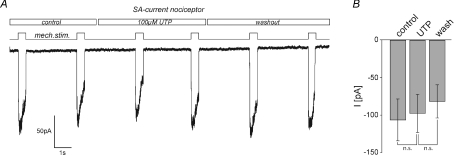
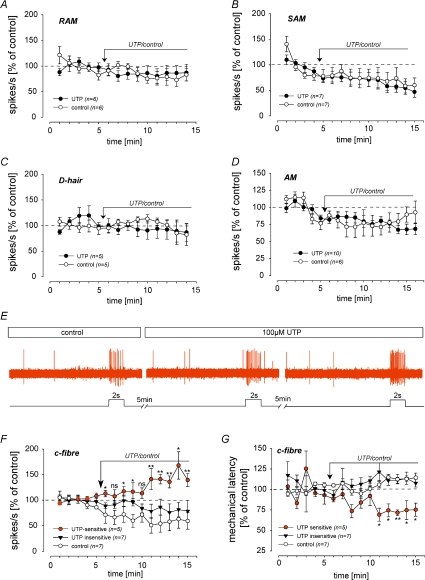
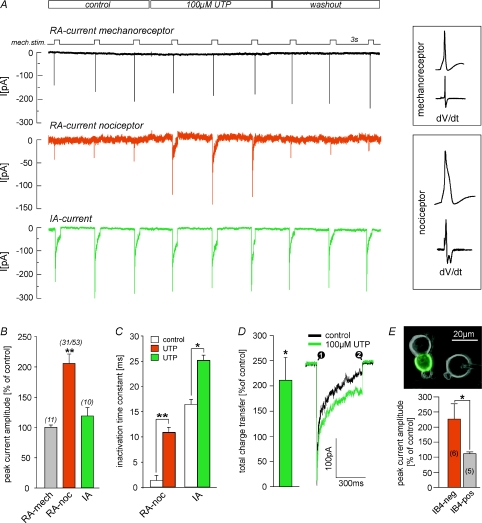
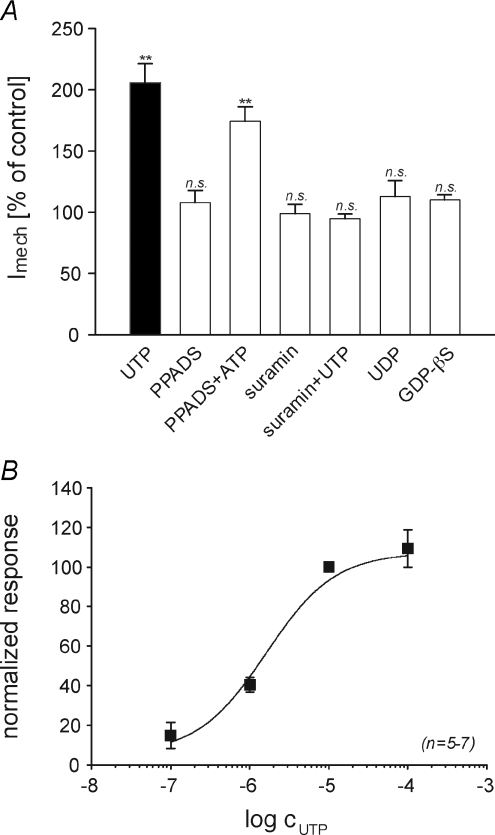
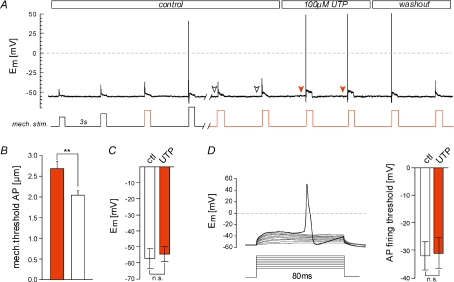
Mechanical stimuli impinging on the skin are converted into electrical signals by mechanically gated ion channels located at the peripheral nerve endings of dorsal root ganglion (DRG) neurons. Under inflammatory conditions sensory neurons are commonly sensitised to mechanical stimuli; a putative mechanism that may contribute to such sensitisation of sensory neurons is enhanced responsiveness of mechanotransduction ion channels. Here we show that the algogens UTP and ATP potentiate mechanosensitive RA currents in peptidergic nociceptive DRG neurons and reduce thresholds for mechanically induced action potential firing in these neurones. Pharmacological characterisation suggests that this effect is mediated by the Gq-coupled P2Y(2) nucleotide receptor. Moreover, using the in vitro skin nerve technique, we show that UTP also increases action potential firing rates in response to mechanical stimuli in a subpopulation of skin C-fibre nociceptors. Together our findings suggest that UTP sensitises a subpopulation of cutaneous C-fibre nociceptors via a previously undescribed G-protein-dependent potentiation of mechanically activated RA-type currents.
作用于皮肤的机械刺激通过位于背根神经节(DRG)神经元外周神经末梢的机械门控离子通道转化为电信号。在炎症条件下,感觉神经元通常会对机械刺激敏感;一种可能导致感觉神经元这种敏感化的假定机制是机械转导离子通道的反应性增强。在此我们表明,致炎剂UTP和ATP增强了肽能伤害性DRG神经元中的机械敏感性RA电流,并降低了这些神经元中机械诱导动作电位发放的阈值。药理学特征表明,这种效应是由Gq偶联的P2Y(2)核苷酸受体介导的。此外,使用体外皮肤神经技术,我们表明UTP还能增加皮肤C纤维伤害感受器亚群中对机械刺激的动作电位发放率。我们的研究结果共同表明,UTP通过一种先前未描述的G蛋白依赖性增强机械激活的RA型电流,使皮肤C纤维伤害感受器亚群敏感化。