Bajorek Monika, Schubert Heidi L, McCullough John, Langelier Charles, Eckert Debra M, Stubblefield William-May B, Uter Nathan T, Myszka David G, Hill Christopher P, Sundquist Wesley I
Department of Biochemistry, University of Utah, Salt Lake City, Utah, USA.
Nat Struct Mol Biol. 2009 Jul;16(7):754-62. doi: 10.1038/nsmb.1621. Epub 2009 Jun 14.
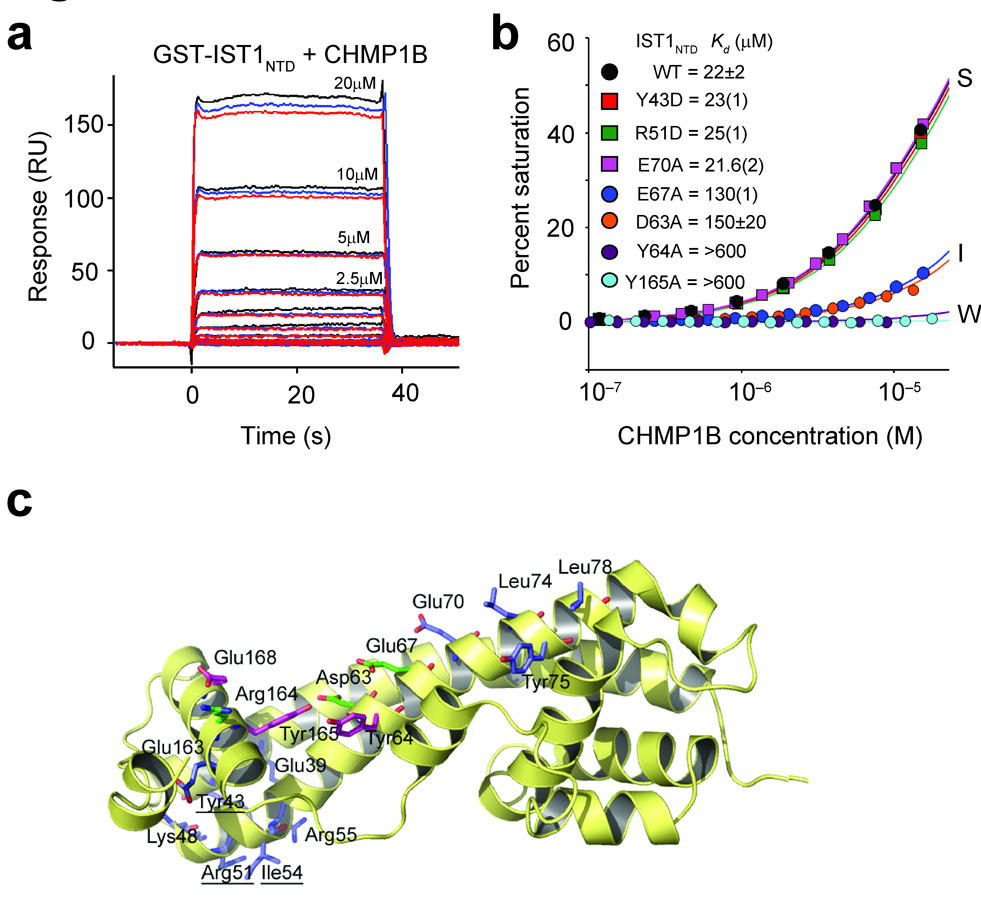
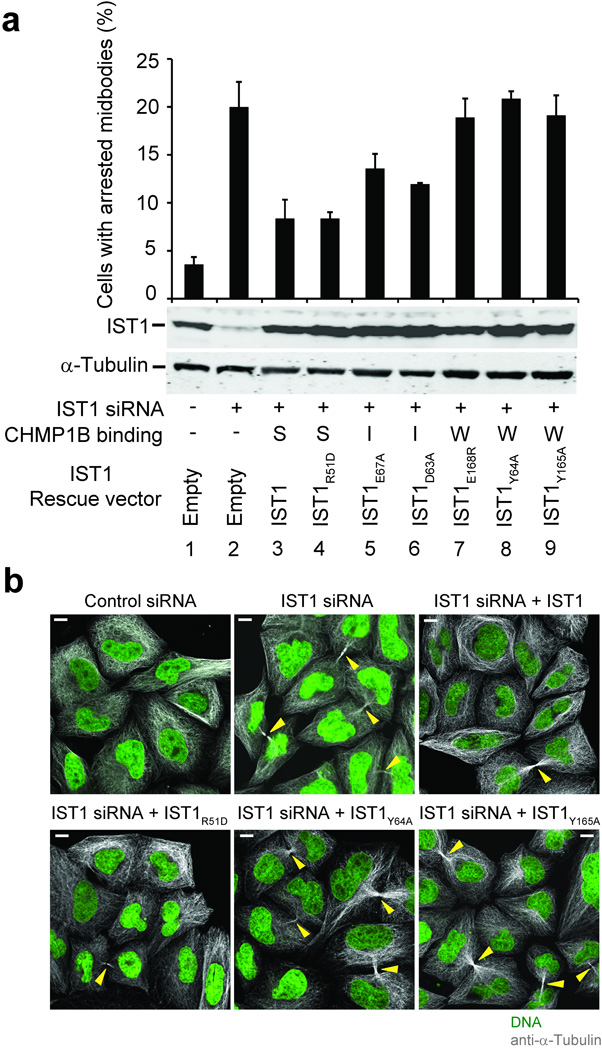
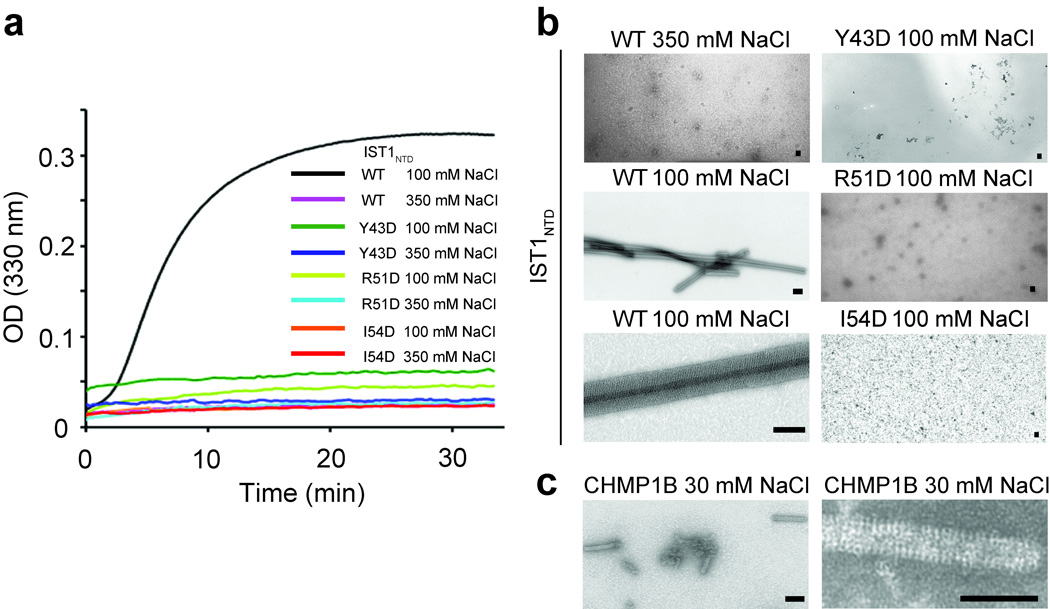
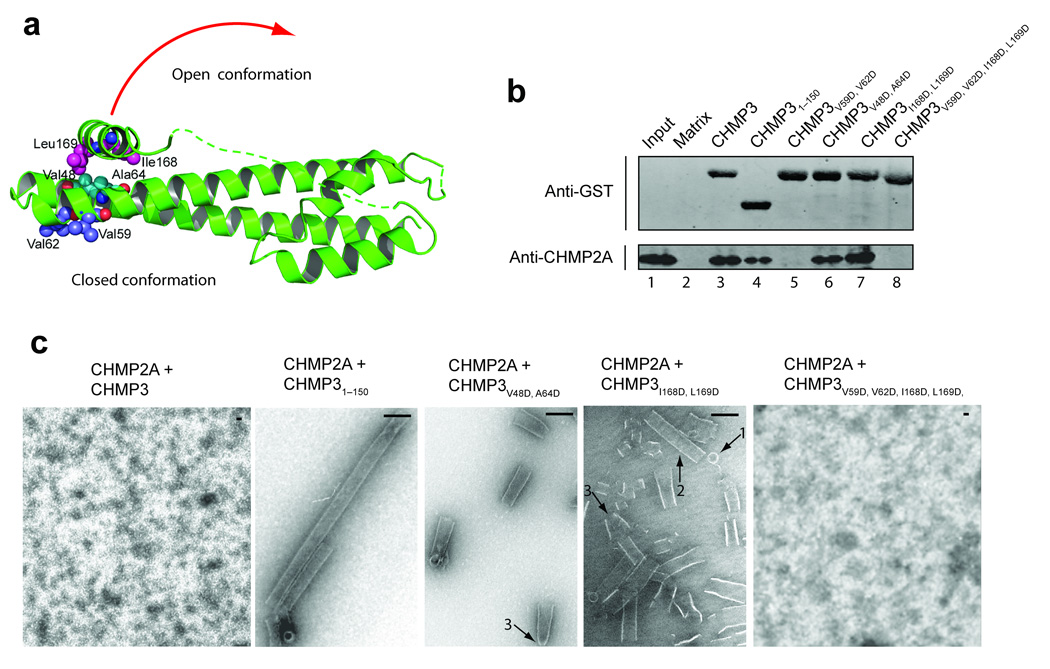
Endosomal sorting complexes required for transport-III (ESCRT-III) subunits cycle between two states: soluble monomers and higher-order assemblies that bind and remodel membranes during endosomal vesicle formation, midbody abscission and enveloped virus budding. Here we show that the N-terminal core domains of increased sodium tolerance-1 (IST1) and charged multivesicular body protein-3 (CHMP3) form equivalent four-helix bundles, revealing that IST1 is a previously unrecognized ESCRT-III family member. IST1 and its ESCRT-III binding partner, CHMP1B, both form higher-order helical structures in vitro, and IST1-CHMP1 interactions are required for abscission. The IST1 and CHMP3 structures also reveal that equivalent downstream alpha5 helices can fold back against the core domains. Mutations within the CHMP3 core-alpha5 interface stimulate the protein's in vitro assembly and HIV-inhibition activities, indicating that dissociation of the autoinhibitory alpha5 helix from the core activates ESCRT-III proteins for assembly at membranes.
转运所需内体分选复合体III(ESCRT-III)亚基在两种状态之间循环:可溶性单体和高阶组装体,后者在内体小泡形成、中体脱离和包膜病毒出芽过程中结合并重塑膜。我们在此表明,耐钠性增强蛋白1(IST1)和带电荷多囊泡体蛋白3(CHMP3)的N端核心结构域形成等效的四螺旋束,这表明IST1是一个先前未被识别的ESCRT-III家族成员。IST1及其ESCRT-III结合伴侣CHMP1B在体外均形成高阶螺旋结构,且IST1与CHMP1的相互作用是脱离所必需的。IST1和CHMP3的结构还表明,等效的下游α5螺旋可以折回并与核心结构域相对。CHMP3核心-α5界面内的突变刺激了该蛋白的体外组装和HIV抑制活性,这表明自抑制性α5螺旋与核心结构域的解离激活了ESCRT-III蛋白以在膜上进行组装。