De Trez Carl, Magez Stefan, Akira Shizuo, Ryffel Bernhard, Carlier Yves, Muraille Eric
Laboratoire de Parasitologie, Université Libre de Bruxelles, Brussels, Belgium.
PLoS Pathog. 2009 Jun;5(6):e1000494. doi: 10.1371/journal.ppat.1000494. Epub 2009 Jun 26.
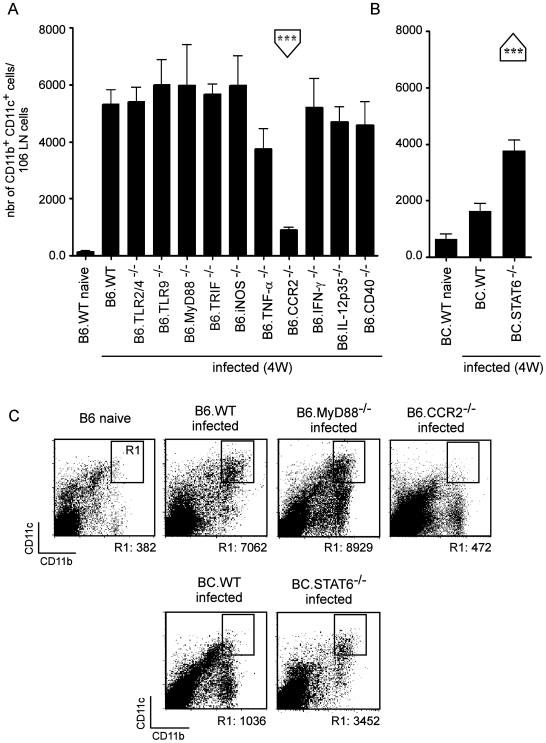
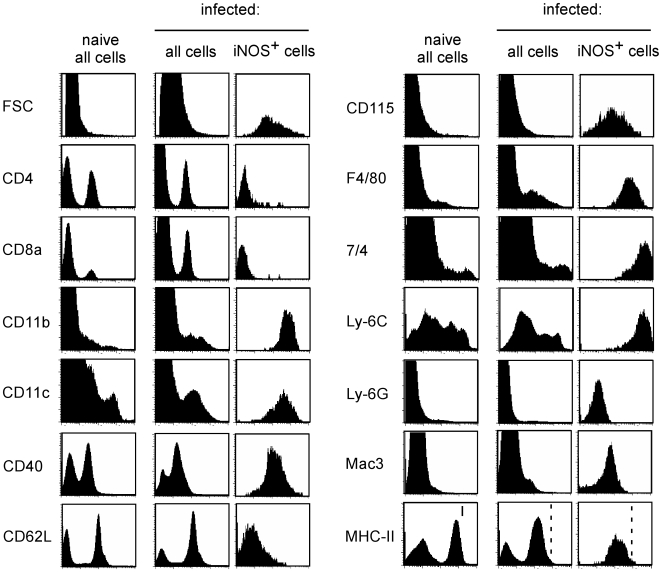
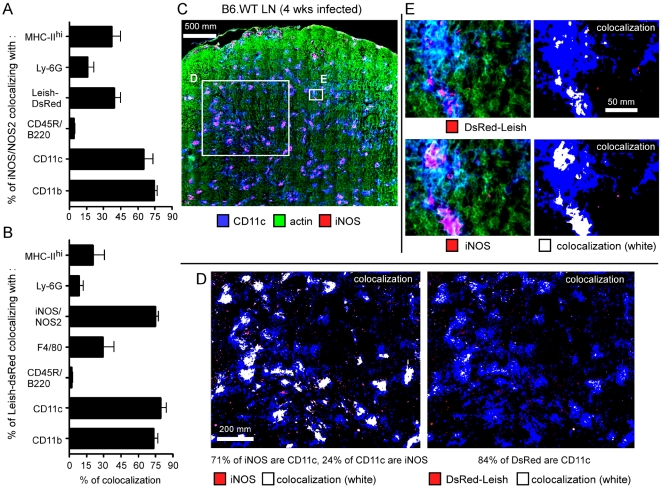
Leishmania major parasites reside and multiply in late endosomal compartments of host phagocytic cells. Immune control of Leishmania growth absolutely requires expression of inducible Nitric Oxide Synthase (iNOS/NOS2) and subsequent production of NO. Here, we show that CD11b+ CD11c+ Ly-6C+ MHC-II+ cells are the main iNOS-producing cells in the footpad lesion and in the draining lymph node of Leishmania major-infected C57BL/6 mice. These cells are phenotypically similar to iNOS-producing inflammatory DC (iNOS-DC) observed in the mouse models of Listeria monocytogenes and Brucella melitensis infection. The use of DsRed-expressing parasites demonstrated that these iNOS-producing cells are the major infected population in the lesions and the draining lymph nodes. Analysis of various genetically deficient mouse strains revealed the requirement of CCR2 expression for the recruitment of iNOS-DC in the draining lymph nodes, whereas their activation is strongly dependent on CD40, IL-12, IFN-gamma and MyD88 molecules with a partial contribution of TNF-alpha and TLR9. In contrast, STAT-6 deficiency enhanced iNOS-DC recruitment and activation in susceptible BALB/c mice, demonstrating a key role for IL-4 and IL-13 as negative regulators. Taken together, our results suggest that iNOS-DC represent a major class of Th1-regulated effector cell population and constitute the most frequent infected cell type during chronic Leishmania major infection phase of C57BL/6 resistant mice.
硕大利什曼原虫寄生于宿主吞噬细胞的晚期内体区室并在其中增殖。对利什曼原虫生长的免疫控制绝对需要诱导型一氧化氮合酶(iNOS/NOS2)的表达以及随后一氧化氮的产生。在此,我们表明CD11b⁺ CD11c⁺ Ly-6C⁺ MHC-II⁺细胞是感染硕大利什曼原虫的C57BL/6小鼠足垫病变部位和引流淋巴结中主要的iNOS产生细胞。这些细胞在表型上与在单核细胞增生李斯特菌和布鲁氏菌感染小鼠模型中观察到的产生iNOS的炎性树突状细胞(iNOS-DC)相似。使用表达DsRed的寄生虫表明,这些产生iNOS的细胞是病变部位和引流淋巴结中主要的感染群体。对各种基因缺陷小鼠品系的分析揭示,CCR2表达对于引流淋巴结中iNOS-DC的募集是必需的,而它们的激活强烈依赖于CD40、IL-12、IFN-γ和MyD88分子,TNF-α和TLR9有部分作用。相比之下,STAT-6缺陷增强了易感BALB/c小鼠中iNOS-DC的募集和激活,表明IL-4和IL-13作为负调节因子发挥关键作用。综上所述,我们的结果表明,iNOS-DC代表一类主要的Th1调节效应细胞群体,并且是C57BL/6抗性小鼠慢性硕大利什曼原虫感染阶段最常见的感染细胞类型。