Carta Mauro Giovanni, Balestrieri Matteo, Murru Andrea, Hardoy Maria Carolina
Centro per la Ricerca e la Terapia in Salute Mentale, Department of Public Health, University of Cagliari, Italy.
Clin Pract Epidemiol Ment Health. 2009 Jun 26;5:15. doi: 10.1186/1745-0179-5-15.
Adjustment Disorder is a condition strongly tied to acute and chronic stress. Despite clinical suggestion of a large prevalence in the general population and the high frequency of its diagnosis in the clinical settings, there has been relatively little research reported and, consequently, very few hints about its treatments.
the authors gathered old and current information on the epidemiology, clinical features, comorbidity, treatment and outcome of adjustment disorder by a systematic review of essays published on PUBMED.
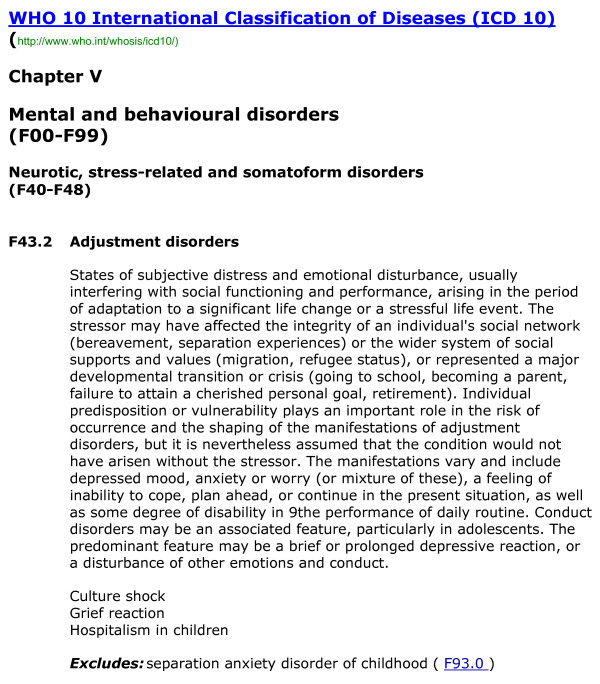
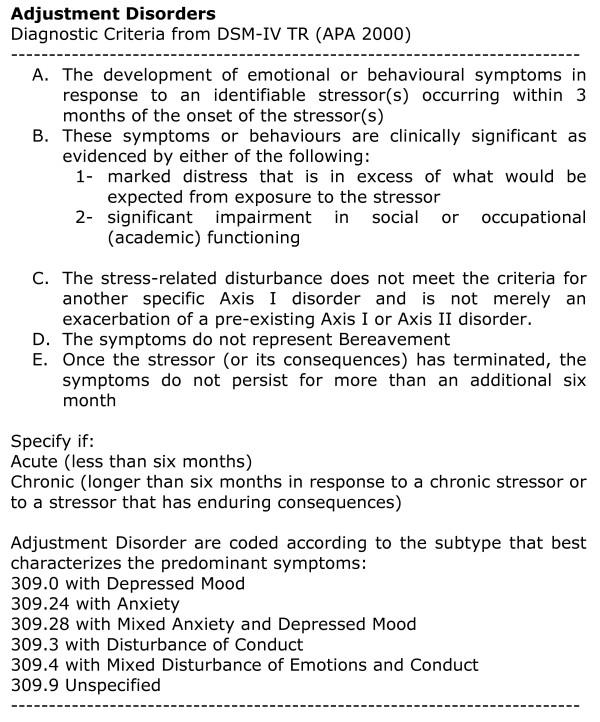
After a first glance at its historical definition and its definition in the DSM and ICD systems, the problem of distinguishing AD from other mood and anxiety disorders, the difficulty in the definition of stress and the implied concept of 'vulnerability' are considered. Comorbidity of AD with other conditions, and outcome of AD are then analyzed. This review also highlights recent data about trends in the use of antidepressant drugs, evidence on their efficacy and the use of psychotherapies.
AD is a very common diagnosis in clinical practice, but we still lack data about its rightful clinical entity. This may be caused by a difficulty in facing, with a purely descriptive methods, a "pathogenic label", based on a stressful event, for which a subjective impact has to be considered. We lack efficacy surveys concerning treatment. The use of psychotropic drugs such as antidepressants, in AD with anxious or depressed mood is not properly supported and should be avoided, while the usefulness of psychotherapies is more solidly supported by clinical evidence. To better determine the correct course of therapy, randomized-controlled trials, even for the combined use of drugs and psychotherapies, are needed vitally, especially for the resistant forms of AD.
适应障碍是一种与急慢性应激密切相关的疾病。尽管临床提示其在普通人群中患病率很高,且在临床环境中诊断频率也很高,但相关研究报道相对较少,因此关于其治疗的线索也很少。
作者通过系统回顾发表在PUBMED上的文章,收集了关于适应障碍的流行病学、临床特征、共病情况、治疗及预后的新旧信息。
在初步审视其历史定义以及在《精神疾病诊断与统计手册》(DSM)和《国际疾病分类》(ICD)系统中的定义后,考虑了将适应障碍与其他情绪和焦虑障碍区分开来的问题、压力定义的困难以及隐含的“易感性”概念。随后分析了适应障碍与其他病症的共病情况以及适应障碍的预后。本综述还强调了关于抗抑郁药物使用趋势的最新数据、其疗效证据以及心理治疗的使用情况。
适应障碍在临床实践中是一种非常常见的诊断,但我们仍然缺乏关于其确切临床实体的数据。这可能是由于难以用纯粹的描述性方法面对基于应激事件的“致病标签”,对此必须考虑主观影响。我们缺乏关于治疗的疗效调查。在伴有焦虑或抑郁情绪的适应障碍中使用抗抑郁药等精神药物缺乏充分支持,应避免使用,而心理治疗的有效性有更确凿的临床证据支持。为了更好地确定正确的治疗方案,至关重要的是需要进行随机对照试验,即使是针对药物和心理治疗的联合使用,尤其是针对难治性适应障碍形式。