Fornarino Simona, Pala Maria, Battaglia Vincenza, Maranta Ramona, Achilli Alessandro, Modiano Guido, Torroni Antonio, Semino Ornella, Santachiara-Benerecetti Silvana A
Dipartimento di Genetica e Microbiologia, Università di Pavia,Pavia, Italy.
BMC Evol Biol. 2009 Jul 2;9:154. doi: 10.1186/1471-2148-9-154.
Central Asia and the Indian subcontinent represent an area considered as a source and a reservoir for human genetic diversity, with many markers taking root here, most of which are the ancestral state of eastern and western haplogroups, while others are local. Between these two regions, Terai (Nepal) is a pivotal passageway allowing, in different times, multiple population interactions, although because of its highly malarial environment, it was scarcely inhabited until a few decades ago, when malaria was eradicated. One of the oldest and the largest indigenous people of Terai is represented by the malaria resistant Tharus, whose gene pool could still retain traces of ancient complex interactions. Until now, however, investigations on their genetic structure have been scarce mainly identifying East Asian signatures.
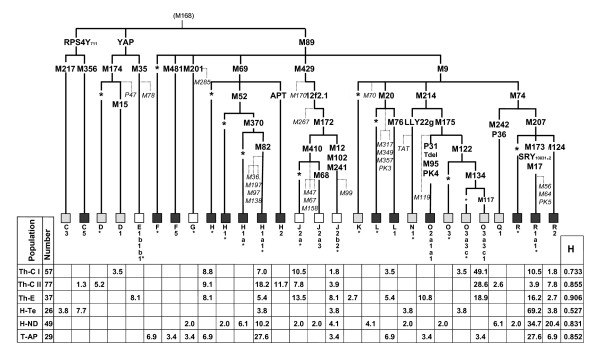
High-resolution analyses of mitochondrial-DNA (including 34 complete sequences) and Y-chromosome (67 SNPs and 12 STRs) variations carried out in 173 Tharus (two groups from Central and one from Eastern Terai), and 104 Indians (Hindus from Terai and New Delhi and tribals from Andhra Pradesh) allowed the identification of three principal components: East Asian, West Eurasian and Indian, the last including both local and inter-regional sub-components, at least for the Y chromosome.
Although remarkable quantitative and qualitative differences appear among the various population groups and also between sexes within the same group, many mitochondrial-DNA and Y-chromosome lineages are shared or derived from ancient Indian haplogroups, thus revealing a deep shared ancestry between Tharus and Indians. Interestingly, the local Y-chromosome Indian component observed in the Andhra-Pradesh tribals is present in all Tharu groups, whereas the inter-regional component strongly prevails in the two Hindu samples and other Nepalese populations.The complete sequencing of mtDNAs from unresolved haplogroups also provided informative markers that greatly improved the mtDNA phylogeny and allowed the identification of ancient relationships between Tharus and Malaysia, the Andaman Islands and Japan as well as between India and North and East Africa. Overall, this study gives a paradigmatic example of the importance of genetic isolates in revealing variants not easily detectable in the general population.
中亚和印度次大陆是一个被视为人类遗传多样性来源和储存库的地区,许多遗传标记在此扎根,其中大多数是东西方单倍群的祖先状态,而其他一些则是本地的。在这两个地区之间,特莱(尼泊尔)是一个关键通道,在不同时期允许多次人群互动,尽管由于其疟疾高发的环境,直到几十年前疟疾被根除之前,这里几乎无人居住。特莱最古老、最大的原住民之一是具有抗疟疾能力的塔鲁人,其基因库可能仍保留着古代复杂互动的痕迹。然而,到目前为止,对他们遗传结构的研究很少,主要是识别东亚特征。
对173名塔鲁人(两组来自中部特莱,一组来自东部特莱)和104名印度人(来自特莱和新德里的印度教徒以及来自安得拉邦的部落民)进行的线粒体DNA(包括34个完整序列)和Y染色体(67个单核苷酸多态性和12个短串联重复序列)变异的高分辨率分析,确定了三个主要成分:东亚、西欧亚和印度,最后一个成分至少对于Y染色体而言,包括本地和区域间的子成分。
尽管不同人群组之间以及同一组内的男女之间在数量和质量上存在显著差异,但许多线粒体DNA和Y染色体谱系是共享的或源自古代印度单倍群,从而揭示了塔鲁人和印度人之间深厚的共同祖先关系。有趣的是,在安得拉邦部落民中观察到的本地Y染色体印度成分在所有塔鲁人群体中都存在,而区域间成分在两个印度教样本和其他尼泊尔人群体中占主导地位。对未解析单倍群的线粒体DNA进行的全序列测定还提供了信息丰富的标记,极大地改进了线粒体DNA系统发育,并确定了塔鲁人与马来西亚、安达曼群岛和日本之间以及印度与北非和东非之间的古代关系。总体而言,这项研究给出了一个典型例子,说明遗传隔离群体在揭示普通人群中不易检测到的变异方面的重要性。