Vlisidou Isabella, Dowling Andrea J, Evans Iwan R, Waterfield Nicholas, ffrench-Constant Richard H, Wood Will
Department of Biology and Biochemistry, University of Bath, Bath, United Kingdom.
PLoS Pathog. 2009 Jul;5(7):e1000518. doi: 10.1371/journal.ppat.1000518. Epub 2009 Jul 17.
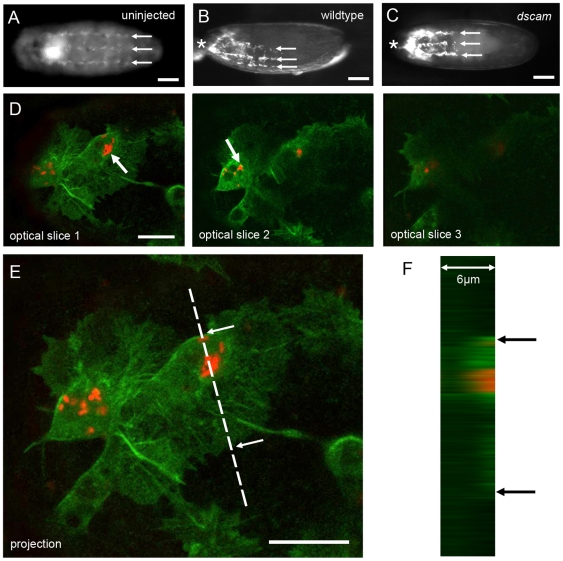
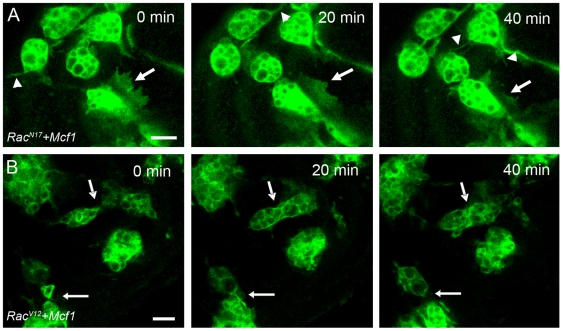
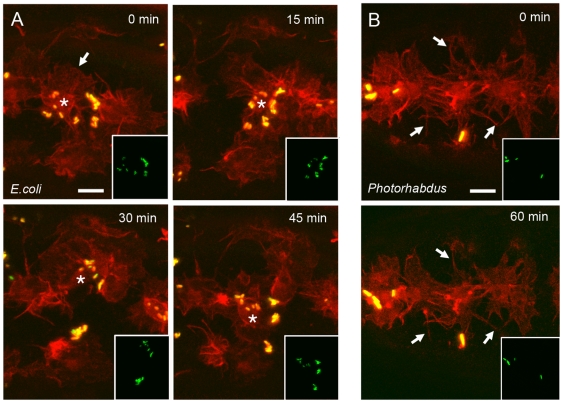
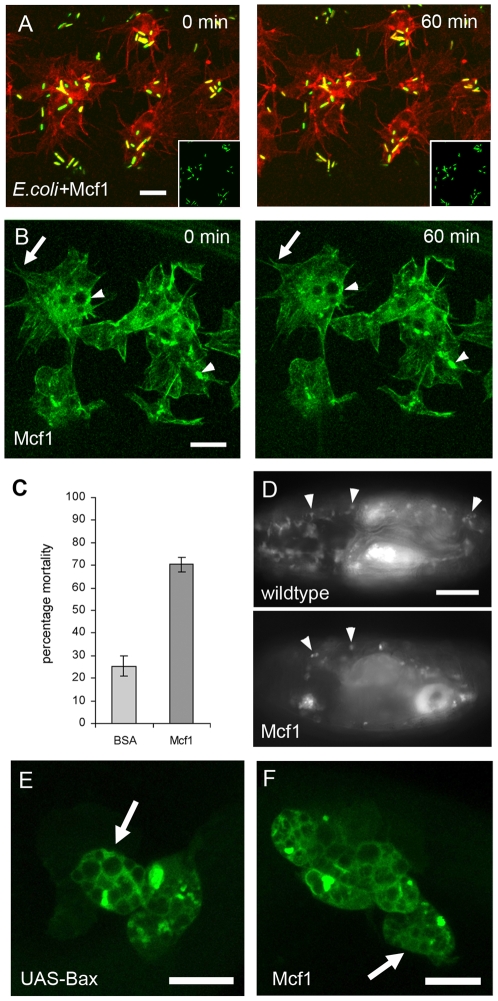
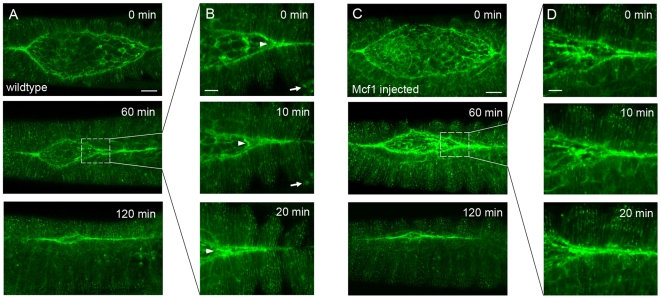
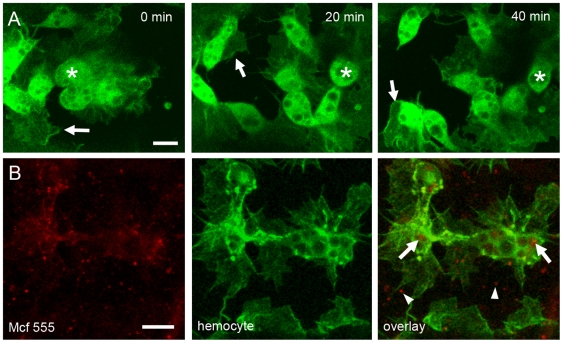
Drosophila embryos are well studied developmental microcosms that have been used extensively as models for early development and more recently wound repair. Here we extend this work by looking at embryos as model systems for following bacterial infection in real time. We examine the behaviour of injected pathogenic (Photorhabdus asymbiotica) and non-pathogenic (Escherichia coli) bacteria and their interaction with embryonic hemocytes using time-lapse confocal microscopy. We find that embryonic hemocytes both recognise and phagocytose injected wild type, non-pathogenic E. coli in a Dscam independent manner, proving that embryonic hemocytes are phagocytically competent. In contrast, injection of bacterial cells of the insect pathogen Photorhabdus leads to a rapid 'freezing' phenotype of the hemocytes associated with significant rearrangement of the actin cytoskeleton. This freezing phenotype can be phenocopied by either injection of the purified insecticidal toxin Makes Caterpillars Floppy 1 (Mcf1) or by recombinant E. coli expressing the mcf1 gene. Mcf1 mediated hemocyte freezing is shibire dependent, suggesting that endocytosis is required for Mcf1 toxicity and can be modulated by dominant negative or constitutively active Rac expression, suggesting early and unexpected effects of Mcf1 on the actin cytoskeleton. Together these data show how Drosophila embryos can be used to track bacterial infection in real time and how mutant analysis can be used to genetically dissect the effects of specific bacterial virulence factors.
果蝇胚胎是经过充分研究的发育微观世界,已被广泛用作早期发育模型,最近还被用作伤口修复模型。在这里,我们通过将胚胎视为实时追踪细菌感染的模型系统来拓展这项工作。我们使用延时共聚焦显微镜检查注射的致病性(共生光杆状菌)和非致病性(大肠杆菌)细菌的行为及其与胚胎血细胞的相互作用。我们发现胚胎血细胞以不依赖Dscam的方式识别并吞噬注射的野生型非致病性大肠杆菌,证明胚胎血细胞具有吞噬能力。相比之下,注射昆虫病原体共生光杆状菌的细菌细胞会导致血细胞出现快速“冻结”表型,这与肌动蛋白细胞骨架的显著重排有关。这种冻结表型可以通过注射纯化的杀虫毒素使毛虫变软1(Mcf1)或通过表达mcf1基因的重组大肠杆菌来模拟。Mcf1介导的血细胞冻结依赖于发动蛋白,这表明内吞作用是Mcf1毒性所必需的,并且可以通过显性负性或组成型活性Rac表达来调节,这表明Mcf1对肌动蛋白细胞骨架有早期且意想不到的影响。这些数据共同表明了果蝇胚胎如何可用于实时追踪细菌感染,以及突变分析如何可用于从基因层面剖析特定细菌毒力因子的作用。