
通过脑电图神经反馈优化显微外科技能。
Optimizing microsurgical skills with EEG neurofeedback.
作者信息
Ros Tomas, Moseley Merrick J, Bloom Philip A, Benjamin Larry, Parkinson Lesley A, Gruzelier John H
机构信息
Department of Psychology, Goldsmiths, University of London, London, UK.
出版信息
BMC Neurosci. 2009 Jul 24;10:87. doi: 10.1186/1471-2202-10-87.
BACKGROUND
By enabling individuals to self-regulate their brainwave activity in the field of optimal performance in healthy individuals, neurofeedback has been found to improve cognitive and artistic performance. Here we assessed whether two distinct EEG neurofeedback protocols could develop surgical skill, given the important role this skill plays in medicine.
RESULTS
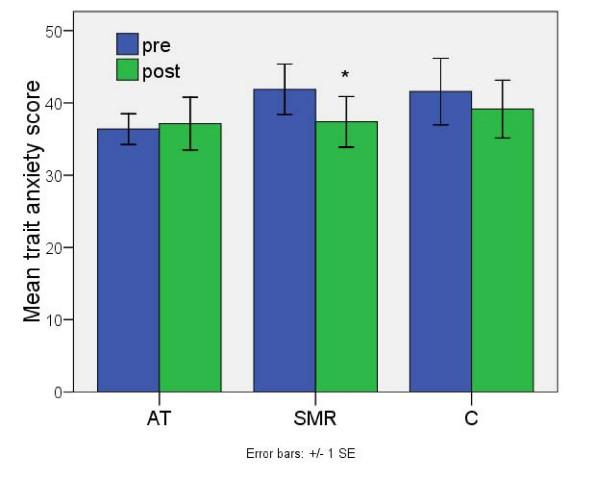
National Health Service trainee ophthalmic microsurgeons (N = 20) were randomly assigned to either Sensory Motor Rhythm-Theta (SMR) or Alpha-Theta (AT) groups, a randomized subset of which were also part of a wait-list 'no-treatment' control group (N = 8). Neurofeedback groups received eight 30-minute sessions of EEG training. Pre-post assessment included a skills lab surgical procedure with timed measures and expert ratings from video-recordings by consultant surgeons, together with state/trait anxiety self-reports. SMR training demonstrated advantages absent in the control group, with improvements in surgical skill according to 1) the expert ratings: overall technique (d = 0.6, p < 0.03) and suture task (d = 0.9, p < 0.02) (judges' intraclass correlation coefficient = 0.85); and 2) with overall time on task (d = 0.5, p = 0.02), while everyday anxiety (trait) decreased (d = 0.5, p < 0.02). Importantly the decrease in surgical task time was strongly associated with SMR EEG training changes (p < 0.01), especially with continued reduction of theta (4-7 Hz) power. AT training produced marginal improvements in technique and overall performance time, which were accompanied by a standard error indicative of large individual differences. Notwithstanding, successful within session elevation of the theta-alpha ratio correlated positively with improvements in overall technique (r = 0.64, p = 0.047).
CONCLUSION
SMR-Theta neurofeedback training provided significant improvement in surgical technique whilst considerably reducing time on task by 26%. There was also evidence that AT training marginally reduced total surgery time, despite suboptimal training efficacies. Overall, the data set provides encouraging evidence of optimised learning of a complex medical specialty via neurofeedback training.
背景
通过使个体能够在健康个体的最佳表现领域自我调节脑电波活动,神经反馈已被发现可提高认知和艺术表现。鉴于手术技能在医学中所起的重要作用,我们在此评估了两种不同的脑电图神经反馈方案是否能够提升手术技能。
结果
英国国家医疗服务体系(National Health Service)的实习眼科显微外科医生(N = 20)被随机分配到感觉运动节律 - 西塔波(SMR)组或阿尔法 - 西塔波(AT)组,其中一个随机子集还作为等待名单“无治疗”对照组的一部分(N = 8)。神经反馈组接受了八次每次30分钟的脑电图训练。前后评估包括一项技能实验室手术操作,带有计时测量以及由顾问外科医生对视频记录进行的专家评分,同时还有状态/特质焦虑的自我报告。SMR训练显示出对照组所没有的优势,手术技能有以下改善:1)根据专家评分:整体技术(d = 0.6,p < 0.03)和缝合任务(d = 0.9,p < 0.02)(评判者组内相关系数 = 0.85);2)任务总时间(d = 0.5,p = 0.02),同时日常焦虑(特质)降低(d = 0.5,p < 0.02)。重要的是,手术任务时间的减少与SMR脑电图训练变化密切相关(p < 0.01),特别是与西塔波(4 - 7Hz)功率的持续降低有关。AT训练在技术和整体表现时间上有微小改善,同时伴有表明个体差异较大的标准误差。尽管如此,训练期间西塔 - 阿尔法比率的成功升高与整体技术的改善呈正相关(r = 0.64,p = 0.047)。
结论
SMR - 西塔波神经反馈训练显著提高了手术技术,同时将任务时间大幅减少了26%。也有证据表明,尽管训练效果欠佳,但AT训练略微减少了总手术时间。总体而言,该数据集提供了令人鼓舞的证据,证明通过神经反馈训练可以优化复杂医学专业的学习。


 Zotero 插件