Takahashi Yoshimitsu, Uchida Chiyoko, Miyaki Koichi, Sakai Michi, Shimbo Takuro, Nakayama Takeo
Department of Health Informatics, Kyoto University School of Public Health, Yoshida Konoe Sakyo, Kyoto 606-8501, Japan.
J Med Internet Res. 2009 Jul 23;11(3):e29. doi: 10.2196/jmir.1142.
Internet peer support groups for depression are becoming popular and could be affected by an increasing number of social network services (SNSs). However, little is known about participant characteristics, social relationships in SNSs, and the reasons for usage. In addition, the effects of SNS participation on people with depression are rather unknown.
The aim was to explore the potential benefits and harms of an SNS for depression based on a concurrent triangulation design of mixed methods strategy, including qualitative content analysis and social network analysis.
A cross-sectional Internet survey of participants, which involved the collection of SNS log files and a questionnaire, was conducted in an SNS for people with self-reported depressive tendencies in Japan in 2007. Quantitative data, which included user demographics, depressive state, and assessment of the SNS (positive vs not positive), were statistically analyzed. Descriptive contents of responses to open-ended questions concerning advantages and disadvantages of SNS participation were analyzed using the inductive approach of qualitative content analysis. Contents were organized into codes, concepts, categories, and a storyline based on the grounded theory approach. Social relationships, derived from data of "friends," were analyzed using social network analysis, in which network measures and the extent of interpersonal association were calculated based on the social network theory. Each analysis and integration of results were performed through a concurrent triangulation design of mixed methods strategy.
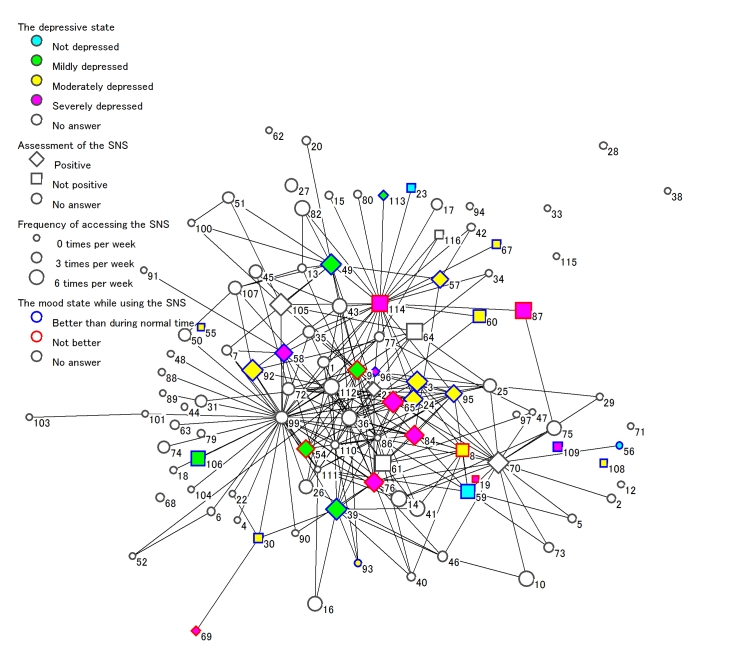
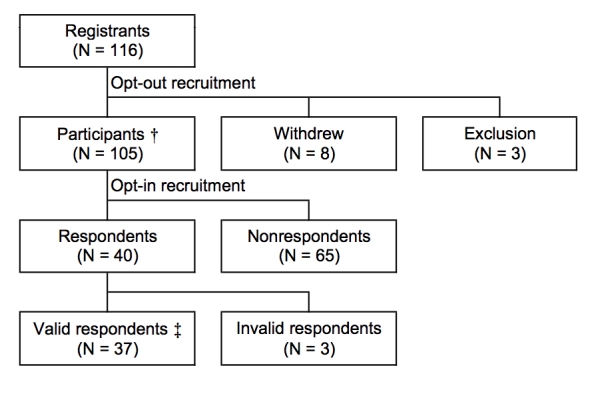
There were 105 participants. Median age was 36 years, and 51% (36/71) were male. There were 37 valid respondents; their number of friends and frequency of accessing the SNS were significantly higher than for invalid/nonrespondents (P = .008 and P = .003). Among respondents, 90% (28/31) were mildly, moderately, or severely depressed. Assessment of the SNS was performed by determining the access frequency of the SNS and the number of friends. Qualitative content analysis indicated that user-selectable peer support could be passive, active, and/or interactive based on anonymity or ease of use, and there was the potential harm of a downward depressive spiral triggered by aggravated psychological burden. Social network analysis revealed that users communicated one-on-one with each other or in small groups (five people or less). A downward depressive spiral was related to friends who were moderately or severely depressed and friends with negative assessment of the SNS.
An SNS for people with depressive tendencies provides various opportunities to obtain support that meets users' needs. To avoid a downward depressive spiral, we recommend that participants do not use SNSs when they feel that the SNS is not user-selectable, when they get egocentric comments, when friends have a negative assessment of the SNS, or when they have additional psychological burden.
抑郁症的网络同伴支持小组正变得越来越普遍,并且可能受到越来越多社交网络服务(SNS)的影响。然而,对于参与者特征、SNS中的社会关系以及使用原因却知之甚少。此外,SNS参与对抑郁症患者的影响也相当不明。
基于混合方法策略的并行三角测量设计,包括定性内容分析和社会网络分析,探讨一个针对抑郁症的SNS的潜在益处和危害。
2007年在日本一个针对有自我报告抑郁倾向者的SNS中,对参与者进行了一项横断面网络调查,其中包括收集SNS日志文件和一份问卷。对包括用户人口统计学、抑郁状态以及对SNS的评估(积极与非积极)在内的定量数据进行了统计分析。使用定性内容分析的归纳方法,分析了关于SNS参与的优点和缺点的开放式问题的回答的描述性内容。根据扎根理论方法将内容组织成代码、概念、类别和一个故事情节。利用社会网络分析对源自“朋友”数据的社会关系进行分析,其中基于社会网络理论计算网络指标和人际关联程度。通过混合方法策略的并行三角测量设计对结果进行每项分析和整合。
共有105名参与者。年龄中位数为36岁,51%(36/71)为男性。有37名有效受访者;他们的朋友数量和访问SNS的频率显著高于无效/未受访者(P = .008和P = .003)。在受访者中,90%(28/31)有轻度、中度或重度抑郁。通过确定SNS的访问频率和朋友数量来对SNS进行评估。定性内容分析表明,基于匿名性或易用性,用户可选的同伴支持可以是被动的、主动的和/或互动的,并且存在因心理负担加重引发抑郁螺旋式下降的潜在危害。社会网络分析显示,用户彼此一对一交流或在小群体(五人或更少)中交流。抑郁螺旋式下降与中度或重度抑郁的朋友以及对SNS有负面评价的朋友有关。
一个针对有抑郁倾向者的SNS提供了各种机会来获得满足用户需求的支持。为避免抑郁螺旋式下降,我们建议参与者在感觉SNS不可选、收到以自我为中心的评论、朋友对SNS有负面评价或有额外心理负担时不要使用SNS。