Tolmie Elizabeth P, Lindsay Grace M, Kelly Tim, Tolson Debbie, Baxter Susan, Belcher Philip R
Glasgow Royal Infirmary, Glasgow, UK.
J Clin Nurs. 2009 Jul;18(13):1878-88. doi: 10.1111/j.1365-2702.2009.02798.x.
The primary aim of this study was to examine the needs of older people in relation to cardiac rehabilitation and to determine if these were currently being met. A secondary aim was to compare illness representations, quality of life and anxiety and depression in groups with different levels of attendance at a cardiac rehabilitation programme.
Coronary heart disease accounted for over seven million cardiovascular deaths globally in 2001. Associated deaths increase with age and are highest in those older than 65. Effective cardiac rehabilitation can assist independent function and maintain health but programme uptake rates are low. We have, therefore, focussed specifically on the older patient to determine reasons for the low uptake.
Mixed methods.
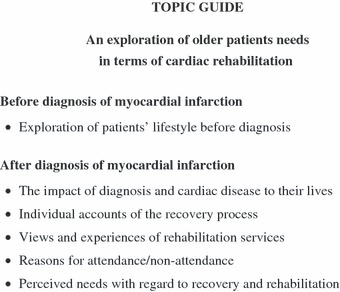
A purposive sample of 31 older men and women (> or =65 years) completed three questionnaires to determine illness representations, quality of life and anxiety and depression. They then underwent a brief clinical assessment and participated in a face-to-face audio-taped interview.
Quantitative: Older adults, who did not attend a cardiac rehabilitation programme, had significantly poorer personal control and depression scores (p < 0.01) and lower quality of life scores than those who had attended. Few achieved recommended risk factor reduction targets. Qualitative: The three main themes identified as reflecting the views and experiences of and attendance at the cardiac rehabilitation programme were: 'The sensible thing to do', 'Assessing the impact' and 'Nothing to gain'.
Irrespective of level of attendance, cardiac rehabilitation programmes are not meeting the needs of many older people either in terms of risk factor reduction or programme uptake. More appropriate programmes are needed.
Cardiac rehabilitation nurses are ideally placed to identify the rehabilitation needs of older people. Identifying these from the older person's perspective could help guide more appropriate intervention strategies.
本研究的主要目的是调查老年人对心脏康复的需求,并确定这些需求目前是否得到满足。次要目的是比较参加心脏康复计划不同程度的人群的疾病认知、生活质量以及焦虑和抑郁情况。
2001年,冠心病在全球导致超过700万人心血管死亡。相关死亡人数随年龄增长而增加,在65岁以上人群中最高。有效的心脏康复可以帮助维持独立功能和保持健康,但项目参与率较低。因此,我们特别关注老年患者,以确定参与率低的原因。
混合方法。
通过目的抽样选取31名65岁及以上的老年男性和女性,完成三份问卷以确定疾病认知、生活质量以及焦虑和抑郁情况。然后他们接受简短的临床评估,并参与面对面的录音访谈。
定量分析:未参加心脏康复计划的老年人在个人控制和抑郁评分方面显著较差(p < 0.01),生活质量得分也低于参加者。很少有人达到推荐的危险因素降低目标。定性分析:确定的反映心脏康复计划的观点、经历和参与情况的三个主要主题是:“明智之举”、“评估影响”和“无所得”。
无论参与程度如何,心脏康复计划在降低危险因素或项目参与方面都未满足许多老年人的需求。需要更合适的计划。
心脏康复护士最适合确定老年人的康复需求。从老年人的角度识别这些需求有助于指导更合适的干预策略。