Wu Tao, Yuan Tiezheng, Tsai Sau-Na, Wang Chunmei, Sun Sai-Ming, Lam Hon-Ming, Ngai Sai-Ming
Department of Biology and State (China) Key Laboratory of Agrobiotechnology, The Chinese University of Hong Kong, Hong Kong, PR China.
BMC Plant Biol. 2009 Jul 31;9:98. doi: 10.1186/1471-2229-9-98.
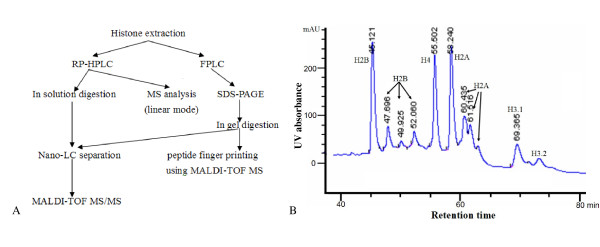
Histone modifications and histone variants are of importance in many biological processes. To understand the biological functions of the global dynamics of histone modifications and histone variants in higher plants, we elucidated the variants and post-translational modifications of histones in soybean, a legume plant with a much bigger genome than that of Arabidopsis thaliana.
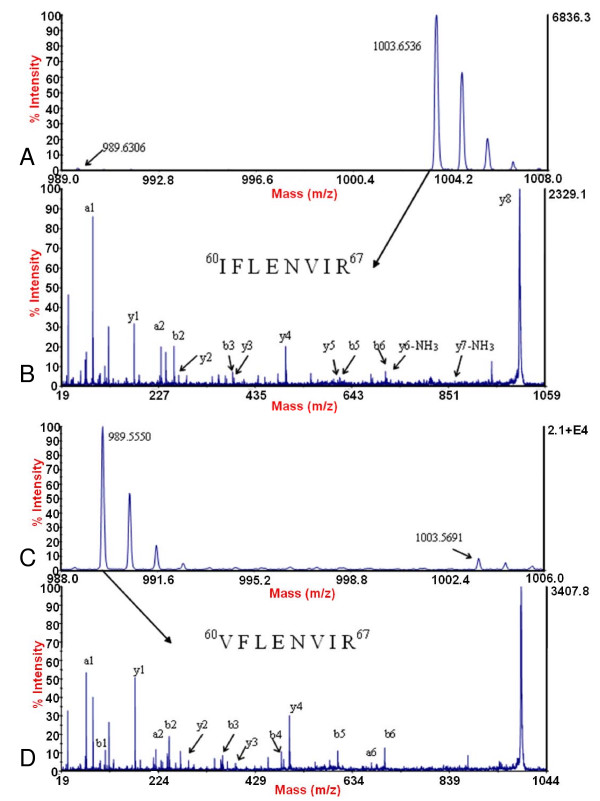
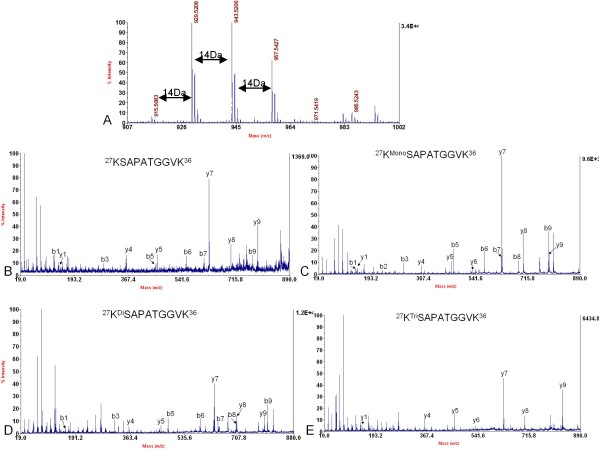
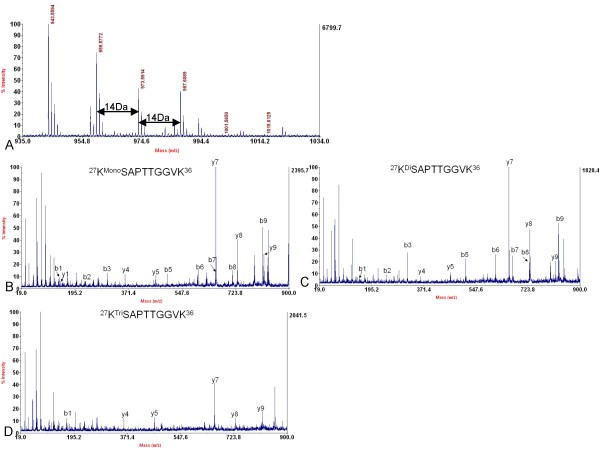
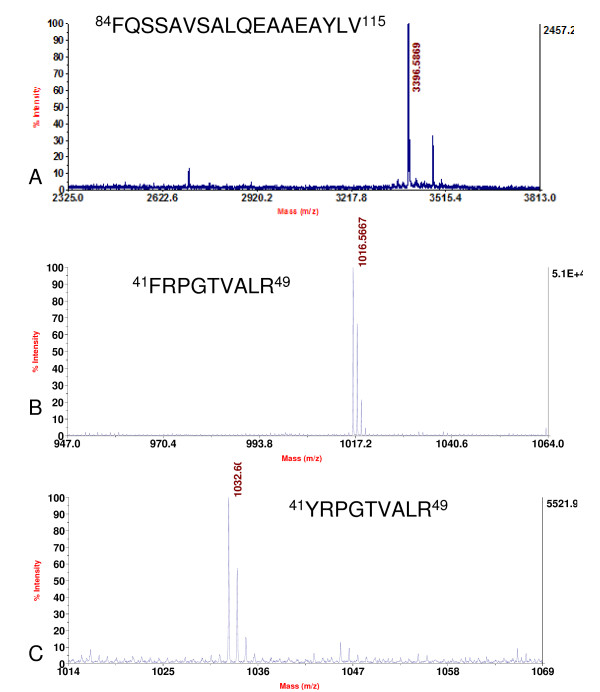
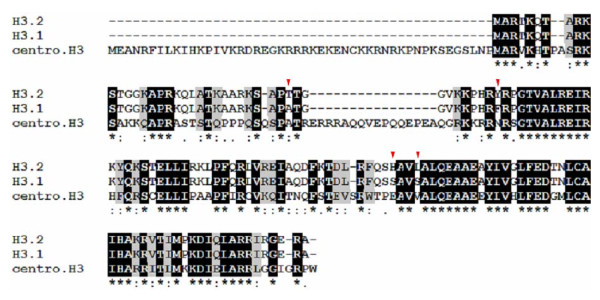
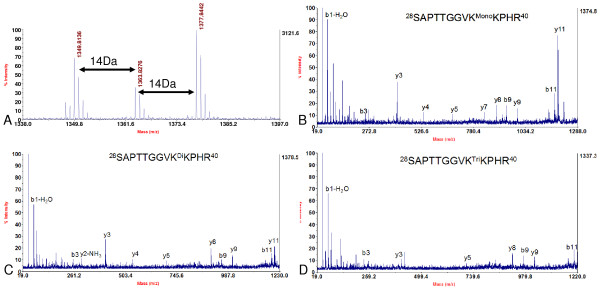
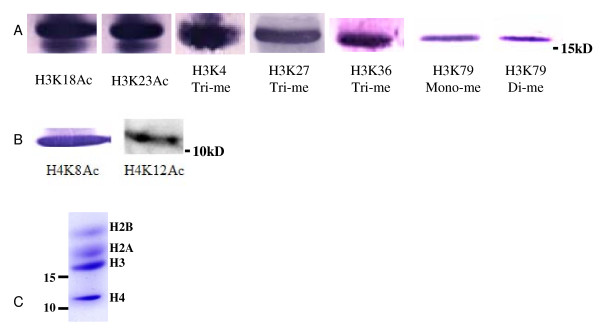
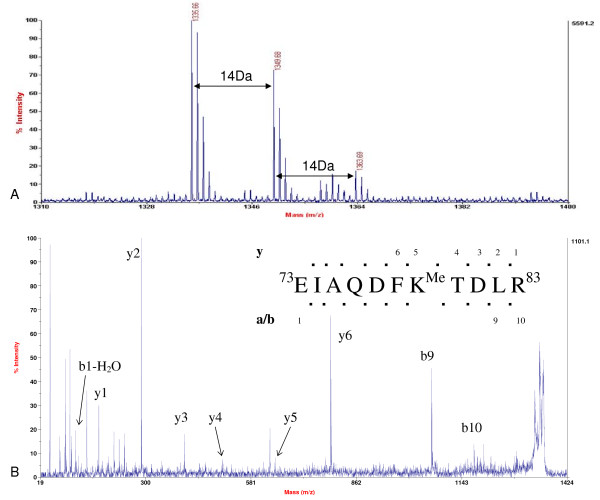
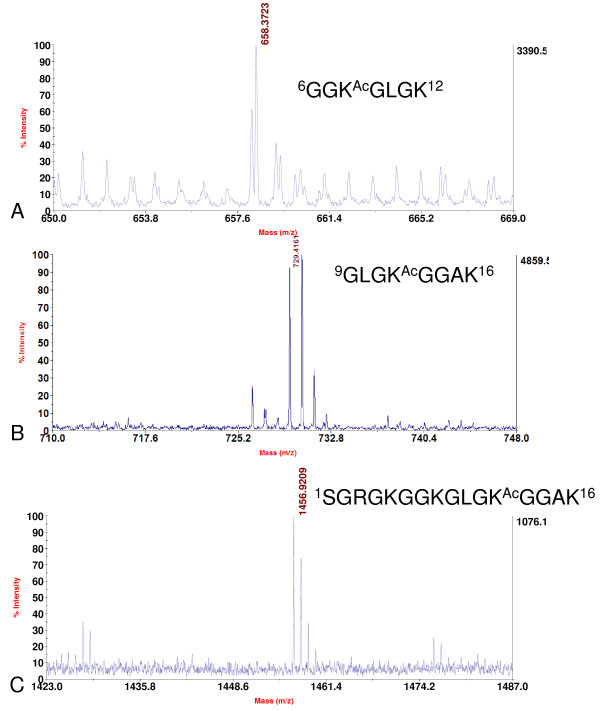
In soybean leaves, mono-, di- and tri-methylation at Lysine 4, Lysine 27 and Lysine 36, and acetylation at Lysine 14, 18 and 23 were detected in HISTONE H3. Lysine 27 was prone to being mono-methylated, while tri-methylation was predominant at Lysine 36. We also observed that Lysine 27 methylation and Lysine 36 methylation usually excluded each other in HISTONE H3. Although methylation at HISTONE H3 Lysine 79 was not reported in A. thaliana, mono- and di-methylated HISTONE H3 Lysine 79 were detected in soybean. Besides, acetylation at Lysine 8 and 12 of HISTONE H4 in soybean were identified. Using a combination of mass spectrometry and nano-liquid chromatography, two variants of HISTONE H3 were detected and their modifications were determined. They were different at positions of A31F41S87S90 (HISTONE variant H3.1) and T31Y41H87L90 (HISTONE variant H3.2), respectively. The methylation patterns in these two HISTONE H3 variants also exhibited differences. Lysine 4 and Lysine 36 methylation were only detected in HISTONE H3.2, suggesting that HISTONE variant H3.2 might be associated with actively transcribing genes. In addition, two variants of histone H4 (H4.1 and H4.2) were also detected, which were missing in other organisms. In the histone variant H4.1 and H4.2, the amino acid 60 was isoleucine and valine, respectively.
This work revealed several distinct variants of soybean histone and their modifications that were different from A. thaliana, thus providing important biological information toward further understanding of the histone modifications and their functional significance in higher plants.
组蛋白修饰和组蛋白变体在许多生物学过程中都很重要。为了了解高等植物中组蛋白修饰和组蛋白变体的整体动态的生物学功能,我们阐明了大豆中组蛋白的变体和翻译后修饰,大豆是一种豆科植物,其基因组比拟南芥大得多。
在大豆叶片中,在组蛋白H3中检测到赖氨酸4、赖氨酸27和赖氨酸36处的单甲基化、二甲基化和三甲基化,以及赖氨酸14、18和23处的乙酰化。赖氨酸27易于发生单甲基化,而赖氨酸36处则以三甲基化为主。我们还观察到,在组蛋白H3中,赖氨酸27甲基化和赖氨酸36甲基化通常相互排斥。虽然在拟南芥中未报道组蛋白H3赖氨酸79处的甲基化,但在大豆中检测到了单甲基化和二甲基化的组蛋白H3赖氨酸79。此外,还鉴定了大豆中组蛋白H4赖氨酸8和12处的乙酰化。使用质谱和纳升液相色谱相结合的方法,检测到了组蛋白H3的两种变体并确定了它们的修饰。它们在A31F41S87S90(组蛋白变体H3.1)和T31Y41H87L90(组蛋白变体H3.2)位置上有所不同。这两种组蛋白H3变体中的甲基化模式也存在差异。仅在组蛋白H3.2中检测到赖氨酸4和赖氨酸36甲基化,这表明组蛋白变体H3.2可能与活跃转录的基因相关。此外,还检测到了组蛋白H4的两种变体(H4.1和H4.2),这在其他生物体中是缺失的。在组蛋白变体H4.1和H4.2中,氨基酸60分别为异亮氨酸和缬氨酸。
这项工作揭示了大豆组蛋白的几种不同变体及其修饰,这些与拟南芥不同,从而为进一步了解高等植物中的组蛋白修饰及其功能意义提供了重要的生物学信息。