Birmingham Amanda, Selfors Laura M, Forster Thorsten, Wrobel David, Kennedy Caleb J, Shanks Emma, Santoyo-Lopez Javier, Dunican Dara J, Long Aideen, Kelleher Dermot, Smith Queta, Beijersbergen Roderick L, Ghazal Peter, Shamu Caroline E
The RNAi Global Initiative, Lafayette, Colorado, USA.
Nat Methods. 2009 Aug;6(8):569-75. doi: 10.1038/nmeth.1351.
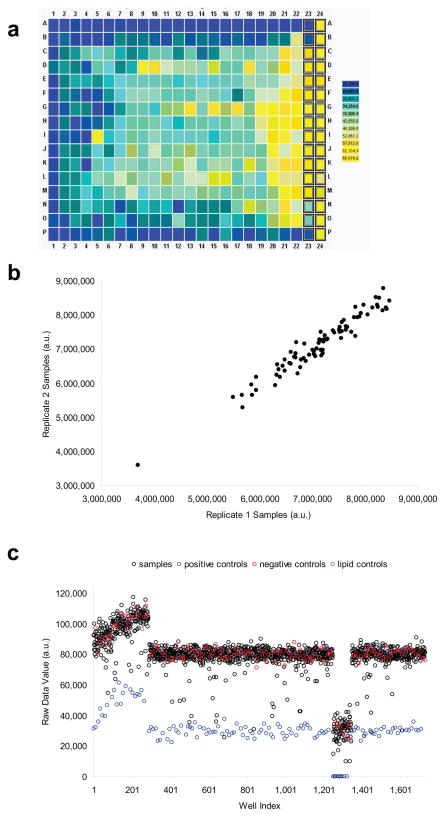
RNA interference (RNAi) has become a powerful technique for reverse genetics and drug discovery, and in both of these areas large-scale high-throughput RNAi screens are commonly performed. The statistical techniques used to analyze these screens are frequently borrowed directly from small-molecule screening; however, small-molecule and RNAi data characteristics differ in meaningful ways. We examine the similarities and differences between RNAi and small-molecule screens, highlighting particular characteristics of RNAi screen data that must be addressed during analysis. Additionally, we provide guidance on selection of analysis techniques in the context of a sample workflow.
RNA干扰(RNAi)已成为反向遗传学和药物发现的强大技术,在这两个领域中,大规模高通量RNAi筛选都很常见。用于分析这些筛选的统计技术通常直接借鉴小分子筛选;然而,小分子和RNAi数据特征在有意义的方面存在差异。我们研究了RNAi和小分子筛选之间的异同,突出了RNAi筛选数据在分析过程中必须解决的特定特征。此外,我们在示例工作流程的背景下提供了分析技术选择的指导。