Division of Diabetes Translation, Centers for Disease Control and Prevention, Atlanta, Georgia, USA.
Diabetes Care. 2009 Nov;32(11):2010-5. doi: 10.2337/dc09-0891. Epub 2009 Aug 12.
Seasonal environment at birth may influence diabetes incidence in later life. We sought evidence for this effect in a large sample of diabetic youth residing in the U.S.
We compared the distribution of birth months within the SEARCH for Diabetes in Youth Study (SEARCH study) with the monthly distributions in U.S. births tabulated by race for years 1982-2005. SEARCH study participants (9,737 youth with type 1 diabetes and 1,749 with type 2 diabetes) were identified by six collaborating U.S. centers.
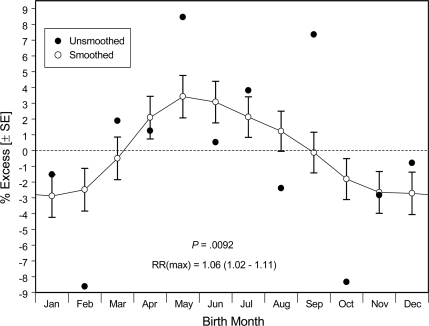
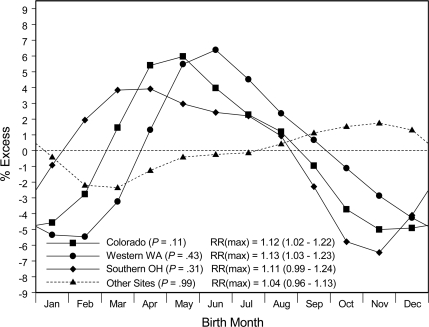
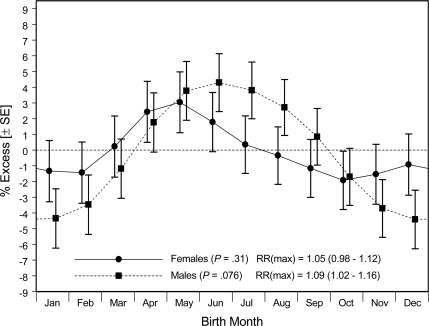
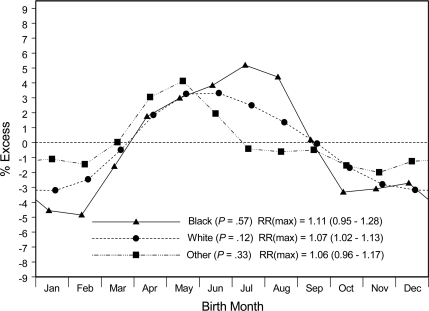
Among type 1 diabetic youth, the percentage of observed to expected births differed across the months (P = 0.0092; decreased in October-February and increased in March-July). Their smoothed birth-month estimates demonstrated a deficit in November-February births and an excess in April-July births (smoothed May versus January relative risk [RR] = 1.06 [95% CI 1.02-1.11]). Stratifications by sex or by three racial groups showed similar patterns relating type 1 diabetes to month of birth. Stratification by geographic regions showed a peak-to-nadir RR of 1.10 [1.04-1.16] in study regions from the northern latitudes (Colorado, western Washington State, and southern Ohio) but no birth-month effect (P > 0.9) in study regions from more southern locations. Among type 2 diabetic youth, associations with birth month were inconclusive.
Spring births were associated with increased likelihood of type 1 diabetes but possibly not in all U.S. regions. Causal mechanisms may involve factors dependent on geographic latitude such as solar irradiance, but it is unknown whether they influence prenatal or early postnatal development.
出生时的季节性环境可能会影响日后的糖尿病发病情况。我们在美国的大量青年糖尿病患者中寻找了这种影响的证据。
我们比较了 SEARCH for Diabetes in Youth 研究(SEARCH 研究)中出生月份的分布与美国 1982-2005 年按种族分类的出生月份分布。SEARCH 研究参与者(9737 名 1 型糖尿病患者和 1749 名 2 型糖尿病患者)由美国六个合作中心确定。
在 1 型糖尿病患者中,观察到的出生人数与预期人数在各月份之间存在差异(P = 0.0092;10 月至 2 月减少,3 月至 7 月增加)。他们的平滑出生月份估计表明 11 月至 2 月出生人数不足,4 月至 7 月出生人数过多(平滑 5 月与 1 月的相对风险 [RR] = 1.06 [95% CI 1.02-1.11])。按性别或三个种族群体进行分层,1 型糖尿病与出生月份之间存在相似的关系。按地理位置分层显示,来自北部纬度地区(科罗拉多州、华盛顿州西部和俄亥俄州南部)的研究地区的峰值至谷值 RR 为 1.10 [1.04-1.16],但来自更南部地区的研究地区没有出生月份的影响(P > 0.9)。2 型糖尿病患者中,与出生月份的关联不明确。
春季出生与 1 型糖尿病的发病几率增加有关,但可能并非在美国所有地区都如此。致病机制可能涉及依赖地理位置的纬度的因素,如太阳辐射,但尚不清楚它们是否影响产前或产后早期的发育。