Hutzinger Roland, Feederle Regina, Mrazek Jan, Schiefermeier Natalia, Balwierz Piotr J, Zavolan Mihaela, Polacek Norbert, Delecluse Henri-Jacques, Hüttenhofer Alexander
Innsbruck Biocenter, Division of Genomics and RNomics, Innsbruck Medical University, Innsbruck, Austria.
PLoS Pathog. 2009 Aug;5(8):e1000547. doi: 10.1371/journal.ppat.1000547. Epub 2009 Aug 14.
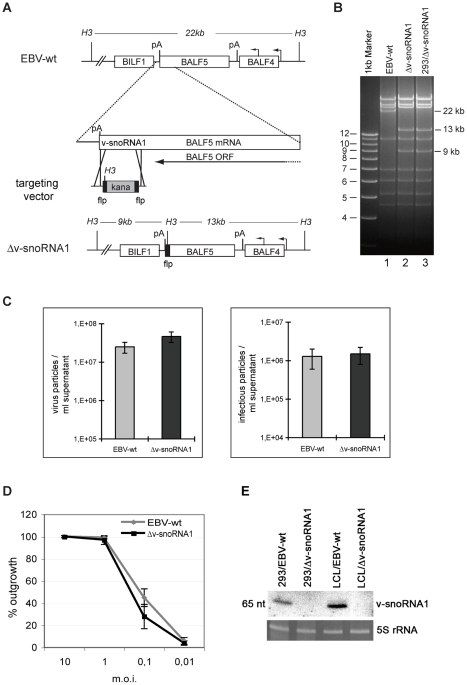
Small nucleolar RNAs (snoRNAs) are localized within the nucleolus, a sub-nuclear compartment, in which they guide ribosomal or spliceosomal RNA modifications, respectively. Up until now, snoRNAs have only been identified in eukaryal and archaeal genomes, but are notably absent in bacteria. By screening B lymphocytes for expression of non-coding RNAs (ncRNAs) induced by the Epstein-Barr virus (EBV), we here report, for the first time, the identification of a snoRNA gene within a viral genome, designated as v-snoRNA1. This genetic element displays all hallmark sequence motifs of a canonical C/D box snoRNA, namely C/C'- as well as D/D'-boxes. The nucleolar localization of v-snoRNA1 was verified by in situ hybridisation of EBV-infected cells. We also confirmed binding of the three canonical snoRNA proteins, fibrillarin, Nop56 and Nop58, to v-snoRNA1. The C-box motif of v-snoRNA1 was shown to be crucial for the stability of the viral snoRNA; its selective deletion in the viral genome led to a complete down-regulation of v-snoRNA1 expression levels within EBV-infected B cells. We further provide evidence that v-snoRNA1 might serve as a miRNA-like precursor, which is processed into 24 nt sized RNA species, designated as v-snoRNA1(24pp). A potential target site of v-snoRNA1(24pp) was identified within the 3'-UTR of BALF5 mRNA which encodes the viral DNA polymerase. V-snoRNA1 was found to be expressed in all investigated EBV-positive cell lines, including lymphoblastoid cell lines (LCL). Interestingly, induction of the lytic cycle markedly up-regulated expression levels of v-snoRNA1 up to 30-fold. By a computational approach, we identified a v-snoRNA1 homolog in the rhesus lymphocryptovirus genome. This evolutionary conservation suggests an important role of v-snoRNA1 during gamma-herpesvirus infection.
小核仁RNA(snoRNAs)定位于核仁,即一个亚核区室,在其中它们分别指导核糖体RNA或剪接体RNA的修饰。到目前为止,snoRNAs仅在真核生物和古细菌基因组中被鉴定出来,而在细菌中则明显不存在。通过筛选爱泼斯坦-巴尔病毒(EBV)诱导的非编码RNA(ncRNAs)在B淋巴细胞中的表达,我们在此首次报告在病毒基因组中鉴定出一个snoRNA基因,命名为v-snoRNA1。这个遗传元件展示了典型C/D盒snoRNA的所有标志性序列基序,即C/C'以及D/D'盒。通过对EBV感染细胞进行原位杂交验证了v-snoRNA1的核仁定位。我们还证实了三种典型的snoRNA蛋白,即纤维蛋白原、Nop56和Nop58与v-snoRNA1的结合。v-snoRNA1的C盒基序被证明对病毒snoRNA的稳定性至关重要;其在病毒基因组中的选择性缺失导致EBV感染的B细胞内v-snoRNA1表达水平完全下调。我们进一步提供证据表明v-snoRNA1可能作为一种类似miRNA的前体,被加工成24个核苷酸大小的RNA物种,命名为v-snoRNA1(24pp)。在编码病毒DNA聚合酶的BALF5 mRNA的3'-UTR内鉴定出v-snoRNA1(24pp)的一个潜在靶位点。发现v-snoRNA1在所有研究的EBV阳性细胞系中表达,包括淋巴母细胞系(LCL)。有趣的是,裂解周期的诱导显著上调了v-snoRNA1的表达水平,高达30倍。通过计算方法,我们在恒河猴淋巴细胞性隐病毒基因组中鉴定出一个v-snoRNA1同源物。这种进化保守性表明v-snoRNA1在γ-疱疹病毒感染过程中起重要作用。