Institute of General Practice and Family Medicine, Faculty of Medicine, University of Witten/Herdecke, Alfred-Herrhausen-Str, 50, 58448 Witten, Germany.
BMC Med Res Methodol. 2009 Aug 14;9:61. doi: 10.1186/1471-2288-9-61.
This article describes the challenges a research team experienced recruiting physicians within a randomised controlled trial about leg ulcer care that seeks to foster the cooperation between the medical and nursing professions. Community-based physicians in North Rhine-Westphalia, Germany, were recruited for an interdisciplinary intervention designed to enhance leg ulcer patients' self-care agency. The aim of this article is to investigate the success of different recruitment strategies employed and reasons for physicians' non-participation.
The first recruitment phase stressed the recruitment of GPs, the second the recruitment of specialists. Throughout the recruitment process data were collected through phone conversations with GP practices who indicated reasons for non-participation.
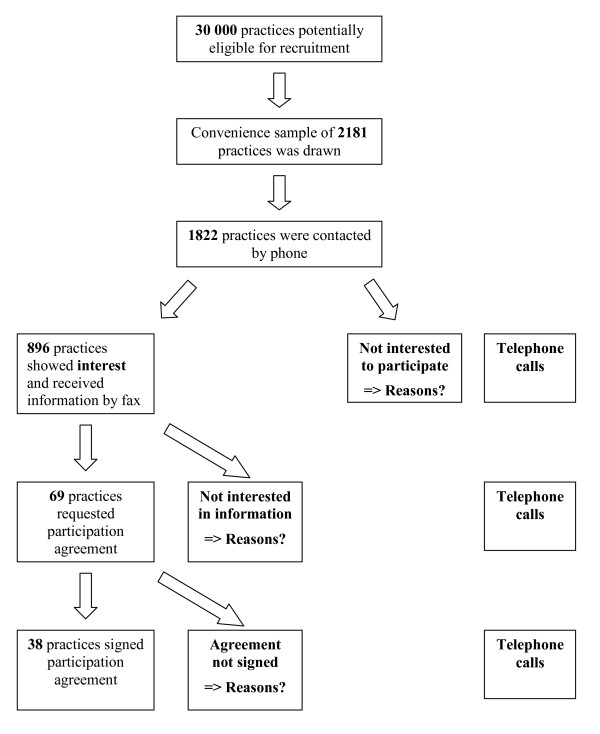
Despite great efforts to recruit physicians, the recruitment rate reached only 26 out of 1549 contacted practices (1.7%) and 12 out of 273 (4.4%) practices during the first and second recruitment phase respectively. The overall recruitment rate over the 16-month recruitment period was 2%. With a target recruitment rate of n = 300, only 45 patients were enrolled in the study, not meeting study projections. Various reasons for community physicians' non-participation are presented as stated spontaneously during phone conversations that might explain low recruitment rates. The recruitment strategy utilised is discussed against the background of factors associated with high participation rates from the international literature.
Time, money, and effort needed during the planning and recruitment phase of a study must not be underestimated to avoid higher than usual rates of refusal and lack of initial contact. Pilot studies prior to a study start-up may provide some evidence on whether the target recruitment rate is feasible.
Current Controlled Trials ISRCTN42122226.
本文描述了一个研究团队在一项关于腿部溃疡护理的随机对照试验中招募医生时所面临的挑战,该试验旨在促进医疗和护理专业之间的合作。德国北莱茵-威斯特法伦州的社区医生被招募参加一项跨学科干预措施,旨在增强腿部溃疡患者的自我护理能力。本文的目的是调查所采用的不同招募策略的成功之处以及医生不参与的原因。
第一招募阶段强调招募全科医生,第二阶段强调招募专家。在整个招募过程中,通过与表示不参与原因的全科医生诊所进行电话交谈来收集数据。
尽管努力招募医生,但在第一和第二招募阶段,仅分别有 26 家(1.7%)和 12 家(4.4%)接触到的诊所参与,招募率仅为 1549 家的 26%和 273 家的 12%。在 16 个月的招募期间,总体招募率为 2%。以目标招募率 n = 300 计算,只有 45 名患者入组研究,未达到研究预期。在电话交谈中,社区医生不参与的各种原因被提出,这些原因可能解释了低招募率的原因。所采用的招募策略是根据国际文献中与高参与率相关的因素进行讨论的。
在研究的规划和招募阶段所需要的时间、金钱和精力切不可低估,以避免高于通常的拒绝率和初始联系的缺乏。在研究启动之前进行试点研究可能会提供一些关于目标招募率是否可行的证据。
当前对照试验 ISRCTN42122226。