Woo Sun-Mi, Kim Janghwan, Han Hyo-Won, Chae Jung-Il, Son Mi-Young, Cho Sunwha, Chung Hyung-Min, Han Yong-Mahn, Kang Yong-Kook
Development and Differentiation Research Center, KRIBB, 111 Gwahangno, Yuseong-gu, Daejeon 305-806, South Korea.
BMC Neurosci. 2009 Aug 17;10:97. doi: 10.1186/1471-2202-10-97.
Studies have provided important findings about the roles of Notch signaling in neural development. Unfortunately, however, most of these studies have investigated the neural stem cells (NSCs) of mice or other laboratory animals rather than humans, mainly owing to the difficulties associated with obtaining human brain samples. It prompted us to focus on neuroectodermal spheres (NESs) which are derived from human embryonic stem cell (hESC) and densely inhabited by NSCs. We here investigated the role of Notch signaling with the hESC-derived NESs.
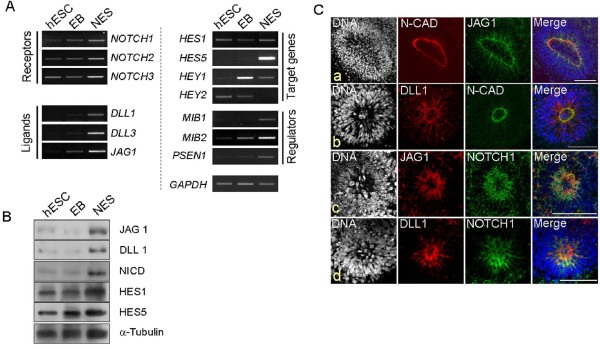
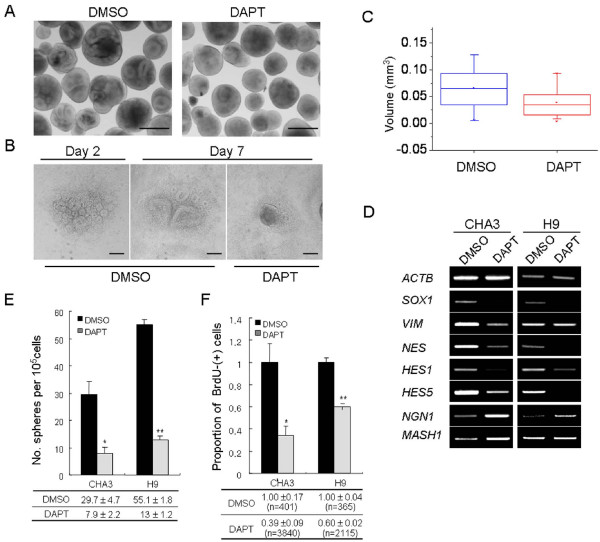
From hESCs, we derived NESs, the in-vitro version of brain-derived neurospheres. NES formation was confirmed by increased levels of various NSC marker genes and the emergence of rosette structures in which neuroprogenitors are known to reside. We found that Notch signaling, which maintains stem cell characteristics of in-vivo-derived neuroprogenitors, is active in these hESC-derived NESs, similar to their in-vivo counterpart. Expression levels of Notch signaling molecules such as NICD, DLLs, JAG1, HES1 and HES5 were increased in the NESs. Inhibition of the Notch signaling by a gamma-secretase inhibitor reduced rosette structures, expression levels of NSC marker genes and proliferation potential in the NESs, and, if combined with withdrawal of growth factors, triggered differentiation toward neurons.
Our results indicate that the hESC-derived NESs, which share biochemical features with brain-derived neurospheres, maintain stem cell characteristics mainly through Notch signaling, which suggests that the hESC-derived NESs could be an in-vitro model for in-vivo neurogenesis.
多项研究已就Notch信号通路在神经发育中的作用得出重要发现。然而,遗憾的是,这些研究大多针对小鼠或其他实验动物的神经干细胞(NSC),而非人类神经干细胞,主要原因是获取人类脑样本存在困难。这促使我们将重点放在源自人类胚胎干细胞(hESC)且富含神经干细胞的神经外胚层球(NES)上。我们在此研究了Notch信号通路在hESC衍生的NES中的作用。
我们从hESC中获得了NES,它是脑源性神经球的体外版本。通过多种神经干细胞标记基因水平的升高以及已知神经祖细胞所在的玫瑰花结结构的出现,证实了NES的形成。我们发现,维持体内衍生神经祖细胞干细胞特性的Notch信号通路在这些hESC衍生的NES中具有活性,类似于其体内对应物。NES中Notch信号分子如NICD、DLLs、JAG1、HES1和HES5的表达水平升高。γ-分泌酶抑制剂对Notch信号通路的抑制作用降低了NES中的玫瑰花结结构、神经干细胞标记基因的表达水平和增殖潜能,并且,如果与生长因子撤除相结合,会触发向神经元的分化。
我们的结果表明,与脑源性神经球具有共同生化特征的hESC衍生的NES主要通过Notch信号通路维持干细胞特性,这表明hESC衍生的NES可能是体内神经发生的体外模型。