Institute for Infectious Diseases, Beijing Center for Disease Prevention and Control, Capital Medical University School of Public Health and Family Medicine, Beijing 100013, China.
J Biomed Inform. 2010 Feb;43(1):97-103. doi: 10.1016/j.jbi.2009.08.003. Epub 2009 Aug 13.
Many researchers have evaluated the performance of outbreak detection algorithms with recommended parameter values. However, the influence of parameter values on algorithm performance is often ignored.
Based on reported case counts of bacillary dysentery from 2005 to 2007 in Beijing, semi-synthetic datasets containing outbreak signals were simulated to evaluate the performance of five outbreak detection algorithms. Parameters' values were optimized prior to the evaluation.
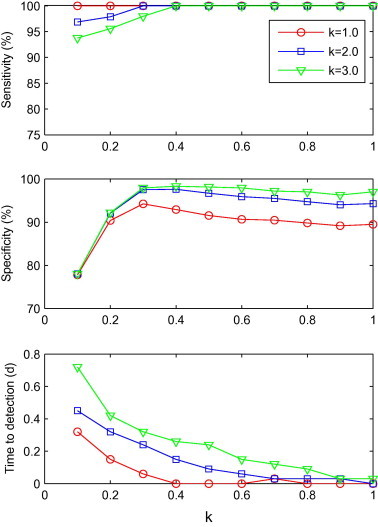
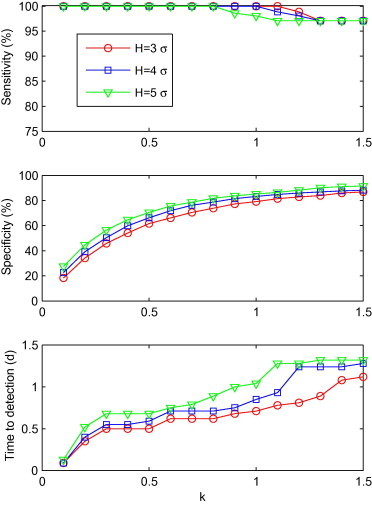
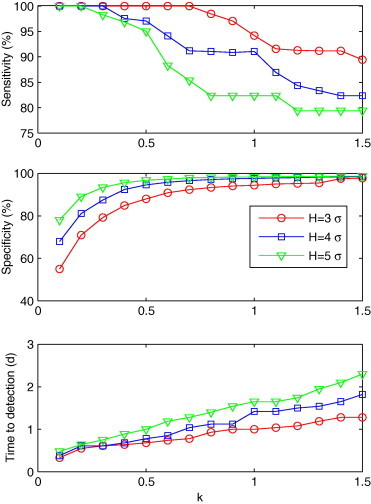
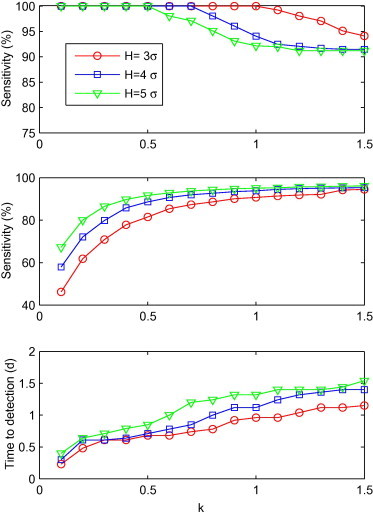
Differences in performances were observed as parameter values changed. Of the five algorithms, space-time permutation scan statistics had a specificity of 99.9% and a detection time of less than half a day. The exponential weighted moving average exhibited the shortest detection time of 0.1 day, while the modified C1, C2 and C3 exhibited a detection time of close to one day.
The performance of these algorithms has a correlation to their parameter values, which may affect the performance evaluation.
许多研究人员已经使用推荐的参数值评估了爆发检测算法的性能。然而,参数值对算法性能的影响往往被忽视。
基于 2005 年至 2007 年北京细菌性痢疾报告病例数,模拟了包含爆发信号的半合成数据集,以评估五种爆发检测算法的性能。在评估之前,对参数值进行了优化。
随着参数值的变化,观察到性能存在差异。在这五种算法中,时空置换扫描统计具有 99.9%的特异性和不到半天的检测时间。指数加权移动平均表现出最短的检测时间为 0.1 天,而修正的 C1、C2 和 C3 则接近一天的检测时间。
这些算法的性能与其参数值相关,这可能会影响性能评估。