Stice Eric, Marti C Nathan, Shaw Heather, Jaconis Maryanne
Department of Psychology, University of Texas at Austin, Texas, USA.
J Abnorm Psychol. 2009 Aug;118(3):587-97. doi: 10.1037/a0016481.
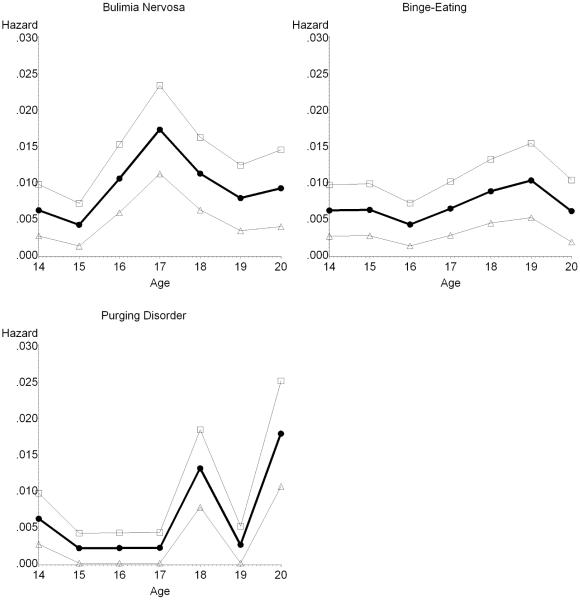
The authors examined the natural history of threshold, subthreshold, and partial eating disorders in a community sample of 496 adolescent girls who completed annual diagnostic interviews over an 8-year period. Lifetime prevalence by age 20 years was 0.6% and 0.6% for threshold and subthreshold anorexia nervosa (AN), 1.6% and 6.1% for threshold and subthreshold bulimia nervosa (BN), 1.0% and 4.6% for threshold and subthreshold binge-eating disorder (BED), and 4.4% for purging disorder (PD). Overall, 12% of adolescents experienced some form of eating disorder. Subthreshold BN and BED and threshold PD were associated with elevated treatment, impairment, and distress. Peak age of onset was 17-18 years for BN and BED and 18-20 years for PD. Average episode duration in months was 3.9 for BN and BED and 5.1 for PD. One-year recovery rates ranged from 91% to 96%. Relapse rates were 41% for BN, 33% for BED, and 5% for PD. For BN and BED, subthreshold cases often progressed to threshold cases and diagnostic crossover was most likely for these disorders. Results suggest that subthreshold eating disorders are more prevalent than threshold eating disorders and are associated with marked impairment.
作者对496名青春期女孩的社区样本进行了研究,这些女孩在8年时间里每年都接受诊断访谈,以考察阈下、部分饮食失调症的自然病史。20岁时,阈下和阈上神经性厌食症(AN)的终生患病率分别为0.6%和0.6%,阈下和阈上神经性贪食症(BN)分别为1.6%和6.1%,阈下和阈上暴饮暴食症(BED)分别为1.0%和4.6%,清除障碍(PD)为4.4%。总体而言,12%的青少年经历过某种形式的饮食失调。阈下BN和BED以及阈上PD与治疗需求增加、功能损害和痛苦相关。BN和BED的发病高峰年龄为17 - 18岁,PD为18 - 20岁。BN和BED的平均发作时长(以月计)为3.9,PD为5.1。一年康复率在91%至96%之间。BN的复发率为41%,BED为33%,PD为5%。对于BN和BED,阈下病例常进展为阈上病例,且这些疾病最易出现诊断交叉。结果表明,阈下饮食失调症比阈上饮食失调症更为普遍,且与明显的功能损害相关。