Pohuang Tawatchai, Chansiripornchai Niwat, Tawatsin Achara, Sasipreeyajan Jiroj
Department of Veterinary Medicine, Faculty of Veterinary Science, Chulalongkorn University, Bangkok 10330, Thailand.
J Vet Sci. 2009 Sep;10(3):219-23. doi: 10.4142/jvs.2009.10.3.219.
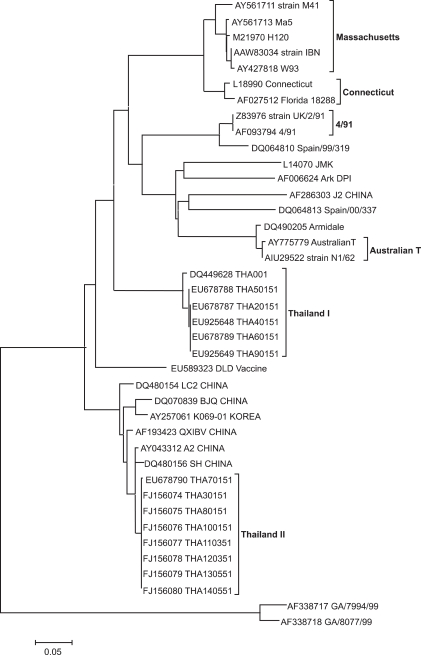
Thirteen field isolates of infectious bronchitis virus (IBV) were isolated from broiler flocks in Thailand between January and June 2008. The 878-bp of the S1 gene covering a hypervariable region was amplified and sequenced. Phylogenetic analysis based on that region revealed that these viruses were separated into two groups (I and II). IBV isolates in group I were not related to other IBV strains published in the GenBank database. Group 1 nucleotide sequence identities were less than 85% and amino acid sequence identities less than 84% in common with IBVs published in the GenBank database. This group likely represents the strains indigenous to Thailand. The isolates in group II showed a close relationship with Chinese IBVs. They had nucleotide sequence identities of 97-98% and amino acid sequence identities 96-98% in common with Chinese IBVs (strain A2, SH and QXIBV). This finding indicated that the recent Thai IBVs evolved separately and at least two groups of viruses are circulating in Thailand.
2008年1月至6月期间,从泰国的肉鸡群中分离出13株传染性支气管炎病毒(IBV)野毒株。扩增并测序了S1基因中覆盖高变区的878bp片段。基于该区域的系统发育分析表明,这些病毒被分为两组(I组和II组)。I组的IBV分离株与GenBank数据库中公布的其他IBV毒株无关。I组与GenBank数据库中公布的IBV的核苷酸序列同一性低于85%,氨基酸序列同一性低于84%。这一组可能代表泰国本土毒株。II组的分离株与中国的IBV毒株关系密切。它们与中国IBV毒株(A2株、SH株和QXIBV株)的核苷酸序列同一性为97 - 98%,氨基酸序列同一性为96 - 98%。这一发现表明,近期泰国的IBV毒株是独立进化的,并且至少有两组病毒在泰国传播。