Department of Anaesthesiology and Intensive Care, University of Modena and Reggio Emilia and University Hospital of Modena, Lgo del Pozzo, Modena 41100, Italy.
Crit Care. 2009;13(5):R143. doi: 10.1186/cc8029. Epub 2009 Sep 3.
The application in clinical practice of evidence-based guidelines for the management of patients with severe sepsis/septic shock is still poor in the emergency department, while little data are available for patients admitted to the intensive care unit (ICU). The aim of this study was to evaluate the effect of an in-hospital sepsis program on the adherence to evidence-based guidelines and outcome of patients with severe sepsis/septic shock admitted to the ICU.
This prospective observational cohort study included 67 patients with severe sepsis/septic shock admitted to a multidisciplinary ICU at a University Hospital from January 2005 to June 2007. Compliance to 5 resuscitation and 4 management sepsis interventions and in-hospital mortality were measured following an educational program on sepsis for physician and nurses of all hospital departments and hospital implementation of a specific protocol for recognition and management of patients with severe sepsis/septic shock, including an early consultation by a skilled 'sepsis team'.
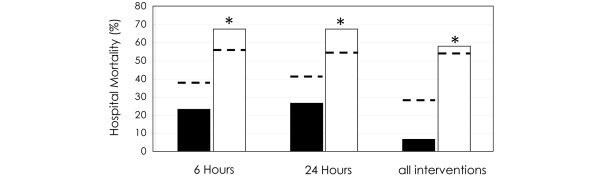
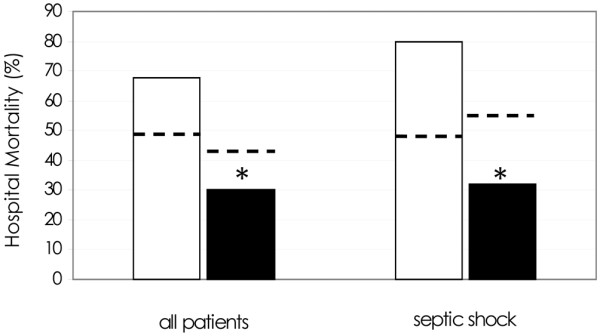
During the study period, the compliance to all 9 interventions increased from 8% to 35% of the patients (P < 0.01). The implementation of resuscitation and management interventions was associated with a lower risk of in-hospital mortality (23% vs 68% and 27% vs 68%, P < 0.01). In the latter 2 semesters, after activation of the 'sepsis team', in-hospital mortality of ICU septic shock patients decreased by about 40% compared with the previous period (32% vs 79%, P < 0.01).
In our experience, an in-hospital sepsis program, including education of health-care personnel and process-changes, improved the adherence to guidelines and the survival rate of patients with severe sepsis/septic shock admitted to the ICU.
在急诊科,将基于证据的严重脓毒症/脓毒性休克管理指南应用于临床实践的情况仍不理想,而关于收入重症监护病房(ICU)的患者的数据则较少。本研究旨在评估院内脓毒症计划对 ICU 收治的严重脓毒症/脓毒性休克患者遵循基于证据的指南和预后的影响。
本前瞻性观察性队列研究纳入了 2005 年 1 月至 2007 年 6 月期间收入一家大学医院多学科 ICU 的 67 例严重脓毒症/脓毒性休克患者。在对所有医院科室的医生和护士进行脓毒症教育计划以及在医院实施针对严重脓毒症/脓毒性休克患者的识别和管理的特定方案(包括由熟练的“脓毒症小组”进行早期咨询)之后,测量了对 5 项复苏和 4 项脓毒症管理干预措施的依从性以及院内死亡率。
在研究期间,所有 9 项干预措施的依从性从 8%增加到 35%的患者(P < 0.01)。实施复苏和管理干预措施与较低的院内死亡率相关(23%对 68%和 27%对 68%,P < 0.01)。在后续的 2 个学期中,在激活“脓毒症小组”后,与前一时期相比,ICU 脓毒性休克患者的院内死亡率降低了约 40%(32%对 79%,P < 0.01)。
根据我们的经验,包括医护人员教育和流程变更的院内脓毒症计划可提高 ICU 收治的严重脓毒症/脓毒性休克患者对指南的依从性和生存率。