Veljkovic Veljko, Niman Henry L, Glisic Sanja, Veljkovic Nevena, Perovic Vladimir, Muller Claude P
Center for Multidisciplinary Research, Institute of Nuclear Sciences VINCA, PO Box 522, 11001 Belgrade, Serbia.
BMC Struct Biol. 2009 Sep 28;9:62. doi: 10.1186/1472-6807-9-62.
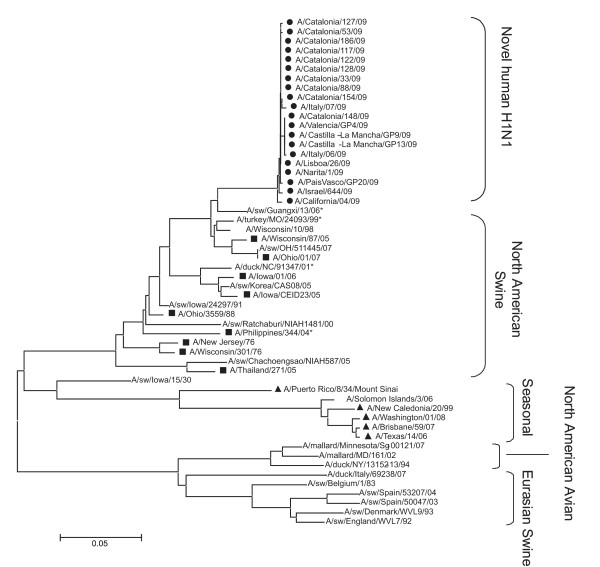
The novel A/H1N1 influenza virus, which recently emerged in North America is most closely related to North American H1N1/N2 swine viruses. Until the beginning of 2009, North American swine H1N1/N2 viruses have only sporadically infected humans as dead-end hosts. In 2009 the A/H1N1 virus acquired the capacity to spread efficiently by human to human transmission. The novel A/H1N1 influenza virus has struck thousands of people in more than 70 countries and killed more than 140, representing a public health emergency of international concern. Here we have studied properties of hemagglutinin of A/H1N1 which may modulate virus/receptor interaction.
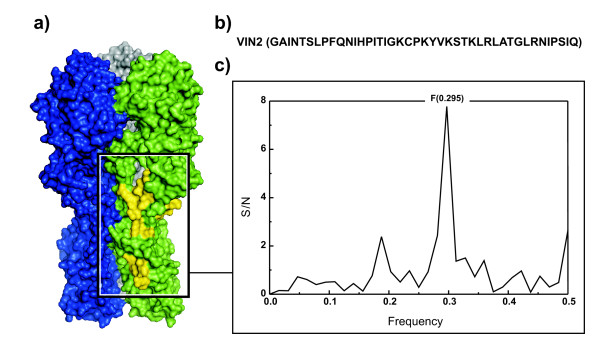
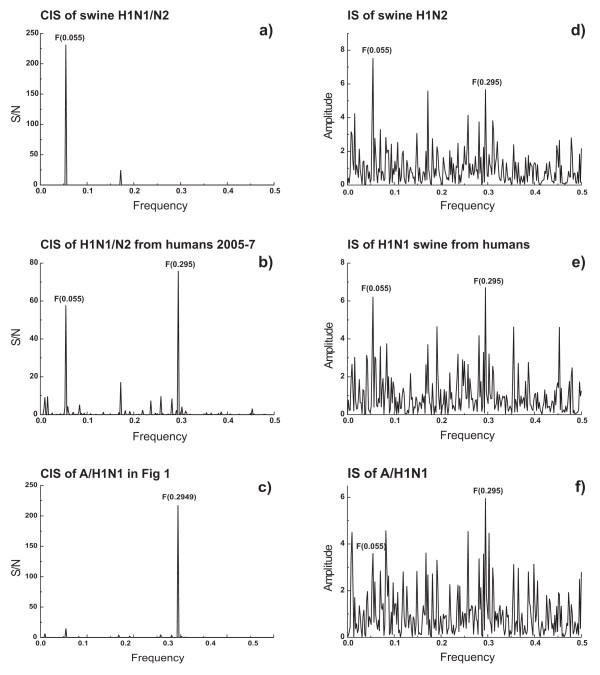
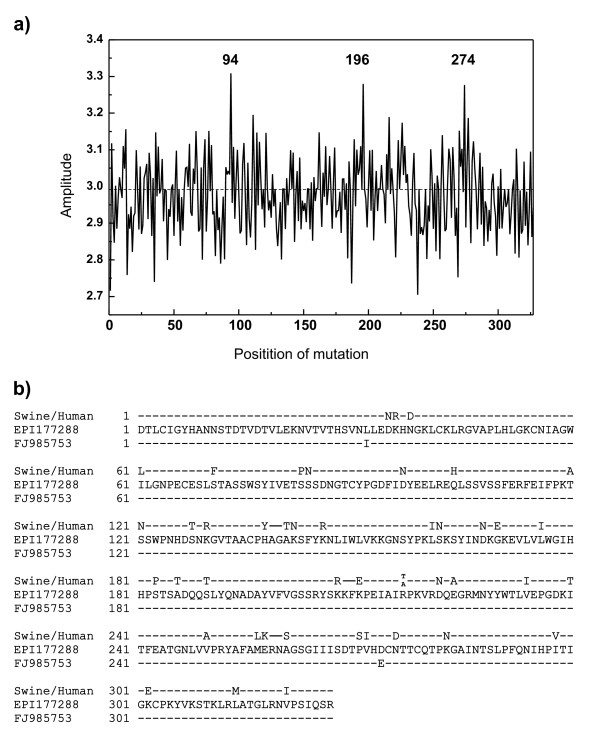
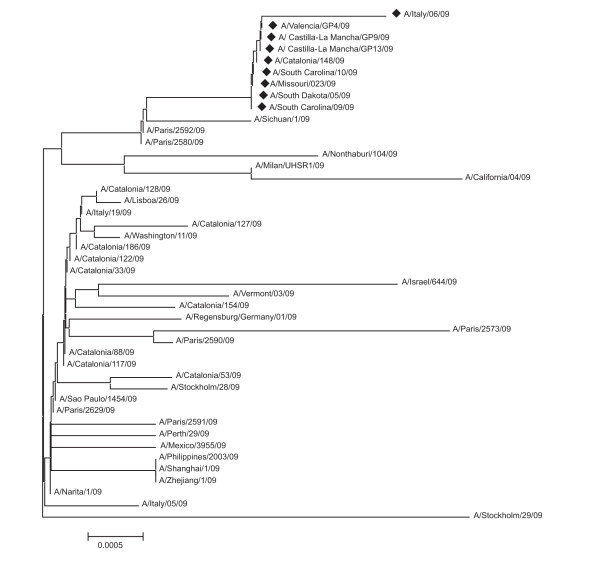
Analyses by ISM bioinformatics platform of the HA1 protein of North American swine H1N1/N2 viruses and the new A/H1N1 showed that both groups of viruses differed in conserved characteristics that reflect a distinct propensity of these viruses to undergo a specific interaction with swine or human host proteins or receptors. Swine H1N1/N2 viruses that sporadically infected humans featured both the swine and the human interaction pattern. Substitutions F71S, T128S, E302K, M314L in HA1 of swine H1N1 viruses from North America are identified as critical for the human interaction pattern of A/H1N1 and residues D94, D196 and D274 are predicted to be "hot-spots" for polymorphisms which could increase infectivity of A/H1N1 virus. At least one of these residues has already emerged in the A/H1N1 isolates from Spain, Italy and USA. The domain 286-326 was identified to be involved in virus/receptor interaction.
Our results (i) contribute to better understanding of the origin of the novel A/H1N1 influenza virus, (ii) provide a tool for monitoring its molecular evolution (iii) predicts hotspots associated with enhanced infectivity in humans and (iv) identify therapeutic and diagnostic targets for prevention and treatment of A/H1N1 infection.
最近在北美出现的新型甲型H1N1流感病毒与北美H1N1/N2猪病毒关系最为密切。直到2009年初,北美猪H1N1/N2病毒仅偶尔感染人类,且人类只是终末宿主。2009年,甲型H1N1病毒获得了通过人际传播有效传播的能力。新型甲型H1N1流感病毒已在70多个国家感染了数千人,并导致140多人死亡,这是一个国际关注的突发公共卫生事件。在此,我们研究了甲型H1N1流感病毒血凝素可能调节病毒/受体相互作用的特性。
通过ISM生物信息学平台对北美猪H1N1/N2病毒和新型甲型H1N1流感病毒的HA1蛋白进行分析,结果表明,这两组病毒在保守特征上存在差异,这反映了这些病毒与猪或人类宿主蛋白或受体进行特定相互作用的不同倾向。偶尔感染人类的猪H1N1/N2病毒同时具有与猪和人类的相互作用模式。北美猪H1N1病毒HA1中的F71S、T128S、E302K、M314L替换被确定为甲型H1N1流感病毒人类相互作用模式的关键因素,而D94、D196和D274残基预计是多态性的“热点”,这些多态性可能增加甲型H1N1流感病毒的传染性。这些残基中至少有一个已经出现在来自西班牙、意大利和美国的甲型H1N1流感病毒分离株中。286 - 326结构域被确定参与病毒/受体相互作用。
我们的研究结果(i)有助于更好地理解新型甲型H1N1流感病毒的起源,(ii)提供了监测其分子进化的工具,(iii)预测与人类感染性增强相关的热点,以及(iv)确定预防和治疗甲型H1N1流感感染的治疗和诊断靶点。