Shen Wei, Ganetzky Barry
Laboratory of Genetics, University of Wisconsin-Madison, Madison, WI 53706, USA.
J Cell Biol. 2009 Oct 5;187(1):71-9. doi: 10.1083/jcb.200907109. Epub 2009 Sep 28.
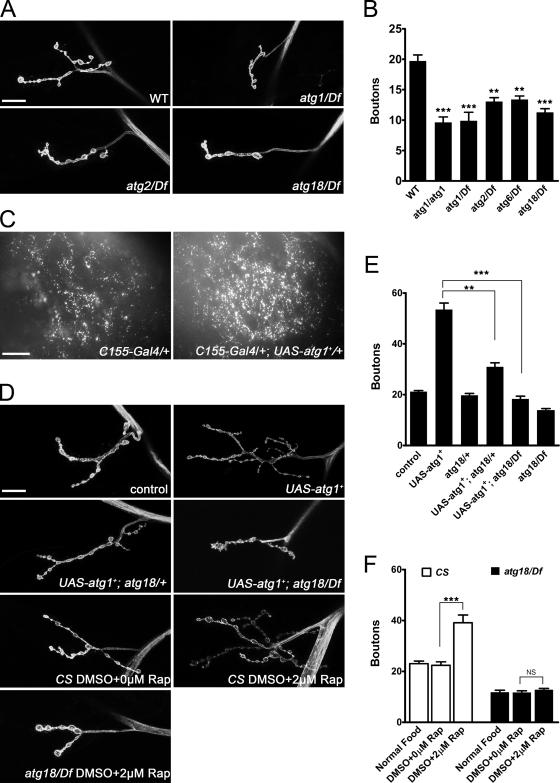
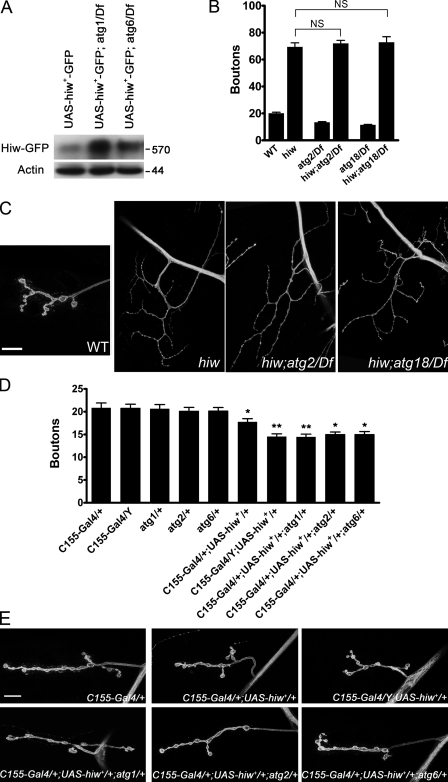
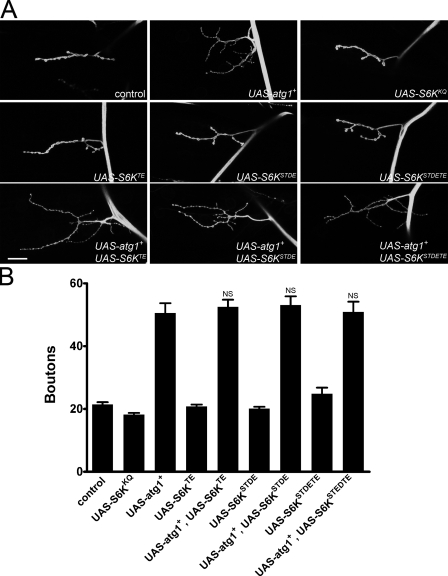
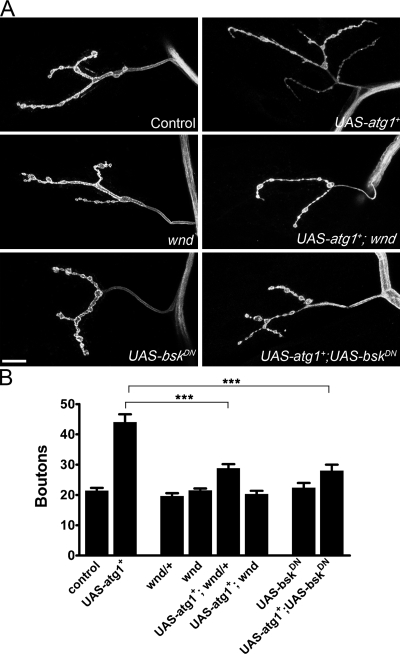
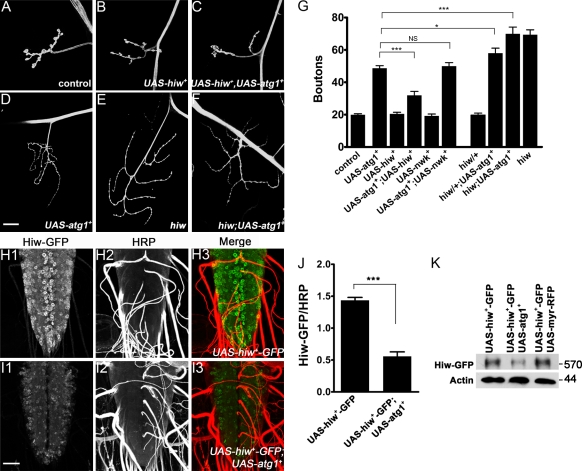
Autophagy, a lysosome-dependent degradation mechanism, mediates many biological processes, including cellular stress responses and neuroprotection. In this study, we demonstrate that autophagy positively regulates development of the Drosophila melanogaster larval neuromuscular junction (NMJ). Autophagy induces an NMJ overgrowth phenotype closely resembling that of highwire (hiw), an E3 ubiquitin ligase mutant. Moreover, like hiw, autophagy-induced NMJ overgrowth is suppressed by wallenda (wnd) and by a dominant-negative c-Jun NH(2)-terminal kinase (bsk(DN)). We show that autophagy promotes NMJ growth by reducing Hiw levels. Thus, autophagy and the ubiquitin-proteasome system converge in regulating synaptic development. Because autophagy is triggered in response to many environmental cues, our findings suggest that it is perfectly positioned to link environmental conditions with synaptic growth and plasticity.
自噬是一种依赖溶酶体的降解机制,介导许多生物学过程,包括细胞应激反应和神经保护。在本研究中,我们证明自噬正向调节黑腹果蝇幼虫神经肌肉接头(NMJ)的发育。自噬诱导出一种NMJ过度生长表型,与E3泛素连接酶突变体highwire(hiw)的表型极为相似。此外,与hiw一样,自噬诱导的NMJ过度生长受到wallenda(wnd)和显性负性c-Jun氨基末端激酶(bsk(DN))的抑制。我们表明自噬通过降低Hiw水平促进NMJ生长。因此,自噬和泛素-蛋白酶体系统在调节突触发育方面存在共同作用。由于自噬是响应许多环境线索而触发的,我们的研究结果表明,它完全有能力将环境条件与突触生长和可塑性联系起来。