Biological and Experimental Psychology Group, School of Biological and Chemical Sciences, Queen Mary, University of London, London, United Kingdom.
PLoS One. 2009 Sep 30;4(9):e7252. doi: 10.1371/journal.pone.0007252.
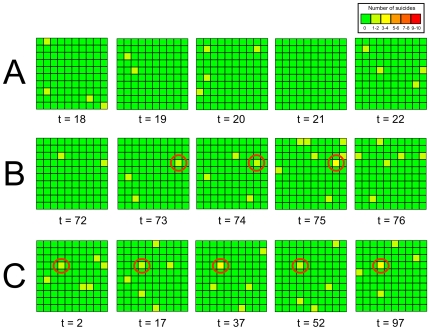
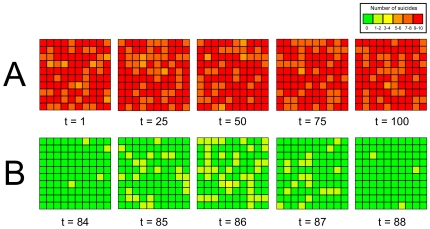
The observation that suicides sometimes cluster in space and/or time has led to suggestions that these clusters are caused by the social learning of suicide-related behaviours, or "copycat suicides". Point clusters are clusters of suicides localised in both time and space, and have been attributed to direct social learning from nearby individuals. Mass clusters are clusters of suicides localised in time but not space, and have been attributed to the dissemination of information concerning celebrity suicides via the mass media. Here, agent-based simulations, in combination with scan statistic methods for detecting clusters of rare events, were used to clarify the social learning processes underlying point and mass clusters. It was found that social learning between neighbouring agents did generate point clusters as predicted, although this effect was partially mimicked by homophily (individuals preferentially assorting with similar others). The one-to-many transmission dynamics characterised by the mass media were shown to generate mass clusters, but only where social learning was weak, perhaps due to prestige bias (only copying prestigious celebrities) and similarity bias (only copying similar models) acting to reduce the subset of available models. These findings can help to clarify and formalise existing hypotheses and to guide future empirical work relating to real-life copycat suicides.
自杀事件有时会在空间和/或时间上聚集,这一观察结果促使人们提出这些聚集是由于自杀相关行为的社会学习,或者说是“模仿自杀”导致的。点状聚集是指在时间和空间上都集中发生的自杀事件,归因于个体附近的直接社会学习。大量聚集是指在时间上集中发生的自杀事件,但在空间上没有集中,归因于大众媒体传播有关名人自杀的信息。在这里,基于代理的模拟与用于检测稀有事件聚集的扫描统计方法相结合,用于阐明点状和大量聚集背后的社会学习过程。研究发现,尽管同质性(个体更倾向于与相似的个体交往)部分模拟了这种社交学习,但是邻居之间的社交学习确实会产生点状聚集,如预测的那样。大众媒体所具有的一对多的传播动力学,被证明可以产生大量聚集,但前提是社交学习是微弱的,这可能是由于威望偏见(只模仿有威望的名人)和相似性偏见(只模仿相似的榜样)减少了可用模型的子集。这些发现有助于澄清和形式化现有的假设,并指导与现实生活中的模仿自杀相关的未来实证工作。