Aathavan K, Politzer Adam T, Kaplan Ariel, Moffitt Jeffrey R, Chemla Yann R, Grimes Shelley, Jardine Paul J, Anderson Dwight L, Bustamante Carlos
Biophysics Graduate Group, University of California, Berkeley, California 94720, USA.
Nature. 2009 Oct 1;461(7264):669-73. doi: 10.1038/nature08443.
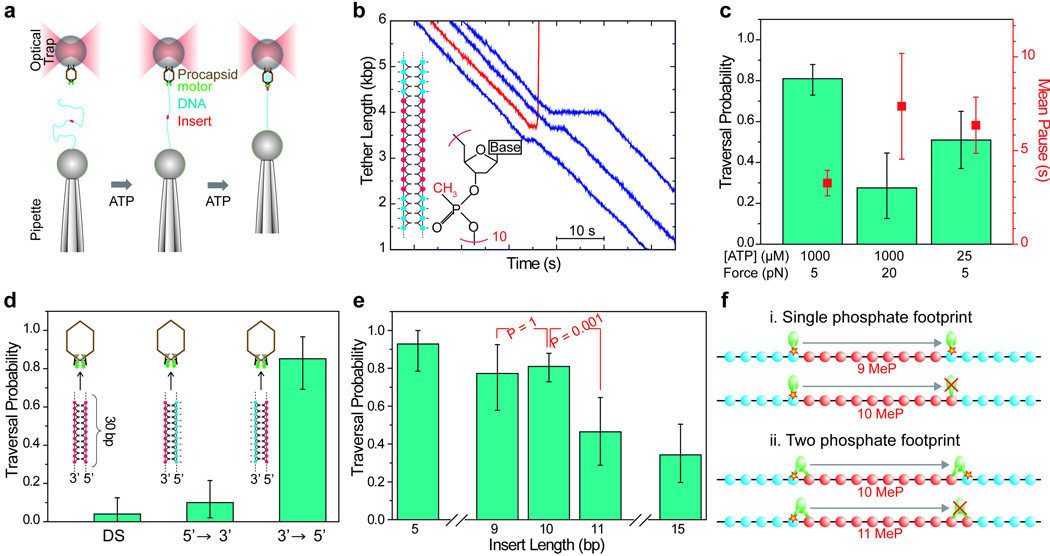
The ASCE (additional strand, conserved E) superfamily of proteins consists of structurally similar ATPases associated with diverse cellular activities involving metabolism and transport of proteins and nucleic acids in all forms of life. A subset of these enzymes consists of multimeric ringed pumps responsible for DNA transport in processes including genome packaging in adenoviruses, herpesviruses, poxviruses and tailed bacteriophages. Although their mechanism of mechanochemical conversion is beginning to be understood, little is known about how these motors engage their nucleic acid substrates. Questions remain as to whether the motors contact a single DNA element, such as a phosphate or a base, or whether contacts are distributed over several parts of the DNA. Furthermore, the role of these contacts in the mechanochemical cycle is unknown. Here we use the genome packaging motor of the Bacillus subtilis bacteriophage varphi29 (ref. 4) to address these questions. The full mechanochemical cycle of the motor, in which the ATPase is a pentameric-ring of gene product 16 (gp16), involves two phases-an ATP-loading dwell followed by a translocation burst of four 2.5-base-pair (bp) steps triggered by hydrolysis product release. By challenging the motor with a variety of modified DNA substrates, we show that during the dwell phase important contacts are made with adjacent phosphates every 10-bp on the 5'-3' strand in the direction of packaging. As well as providing stable, long-lived contacts, these phosphate interactions also regulate the chemical cycle. In contrast, during the burst phase, we find that DNA translocation is driven against large forces by extensive contacts, some of which are not specific to the chemical moieties of DNA. Such promiscuous, nonspecific contacts may reflect common translocase-substrate interactions for both the nucleic acid and protein translocases of the ASCE superfamily.
ASCE(附加链,保守E)蛋白超家族由结构相似的ATP酶组成,这些ATP酶与各种细胞活动相关,涉及所有生命形式中蛋白质和核酸的代谢及转运。这些酶的一个子集由多聚体环状泵组成,负责在包括腺病毒、疱疹病毒、痘病毒和有尾噬菌体的基因组包装等过程中的DNA转运。尽管它们的机械化学转化机制已开始被理解,但对于这些马达如何与核酸底物结合却知之甚少。关于马达是与单个DNA元件(如磷酸或碱基)接触,还是接触分布在DNA的几个部分,仍存在疑问。此外,这些接触在机械化学循环中的作用尚不清楚。在这里,我们使用枯草芽孢杆菌噬菌体φ29的基因组包装马达(参考文献4)来解决这些问题。该马达的完整机械化学循环中,ATP酶是基因产物16(gp16)的五聚体环,包括两个阶段——一个ATP加载停顿阶段,随后是由水解产物释放触发的四个2.5碱基对(bp)步骤的转运爆发阶段。通过用各种修饰的DNA底物挑战该马达,我们表明在停顿阶段,在包装方向上5'-3'链上每10bp与相邻磷酸形成重要接触。这些磷酸相互作用不仅提供稳定、持久的接触,还调节化学循环。相比之下,在爆发阶段,我们发现DNA转运是由广泛的接触克服大力驱动的,其中一些接触并非特异性针对DNA的化学基团。这种杂乱、非特异性的接触可能反映了ASCE超家族的核酸和蛋白质转运酶常见的转位酶-底物相互作用。