Zhao Zhengyi, De-Donatis Gian Marco, Schwartz Chad, Fang Huaming, Li Jingyuan, Guo Peixuan
Division of Pharmaceutics and Pharmaceutical Chemistry, College of Pharmacy, and Department of Physiology and Cell Biology, College of Medicine, The Ohio State University, Columbus, Ohio, USA College of Pharmacy, University of Kentucky, Lexington, Kentucky, USA.
College of Pharmacy, University of Kentucky, Lexington, Kentucky, USA.
Mol Cell Biol. 2016 Sep 12;36(19):2514-23. doi: 10.1128/MCB.00142-16. Print 2016 Oct 1.
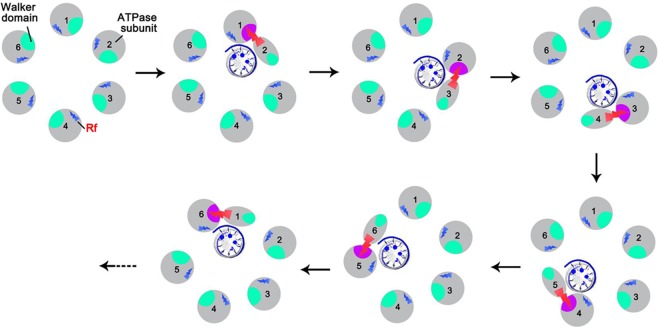
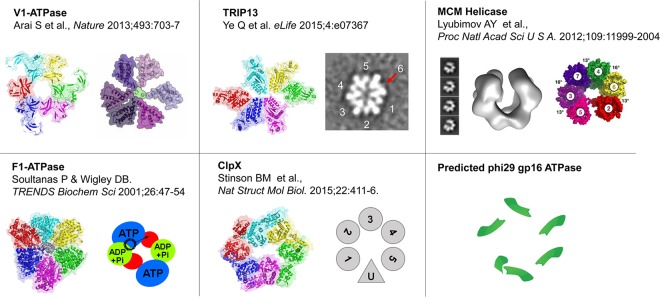
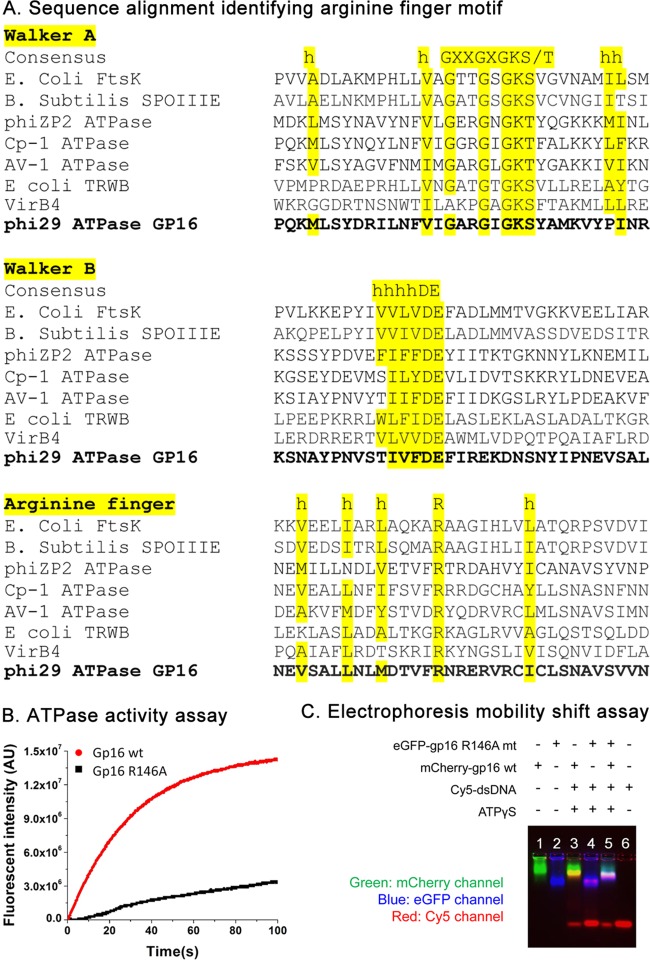
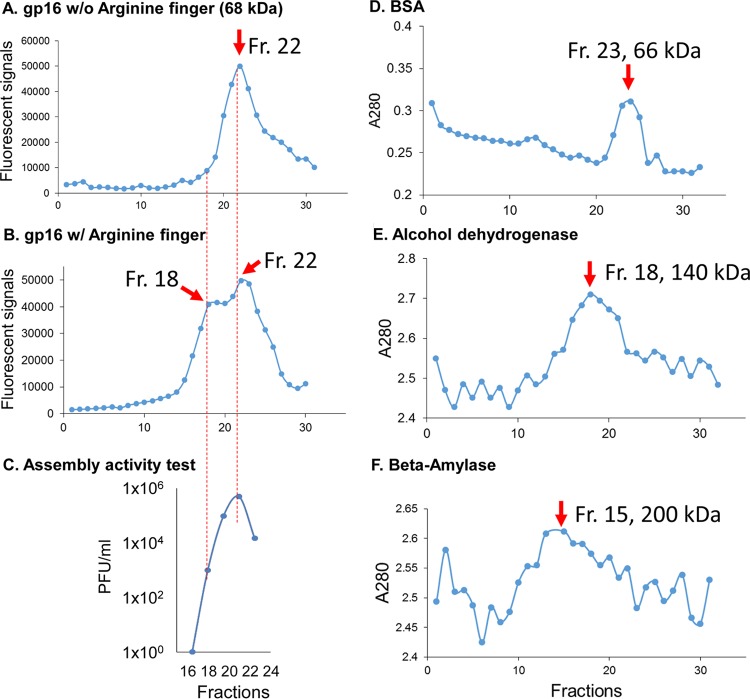
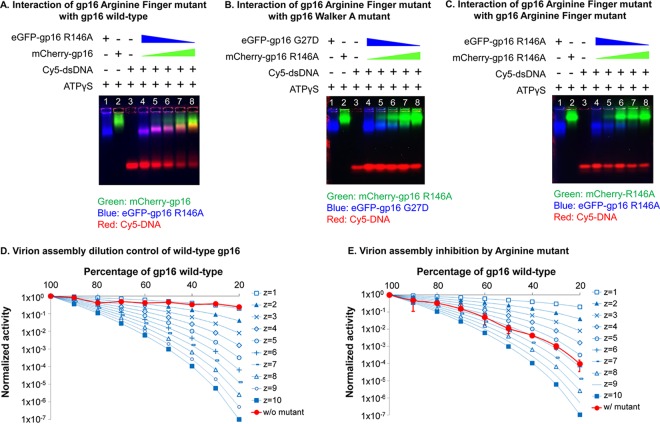
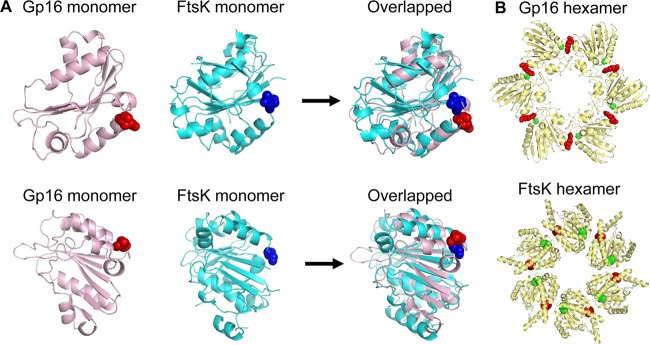
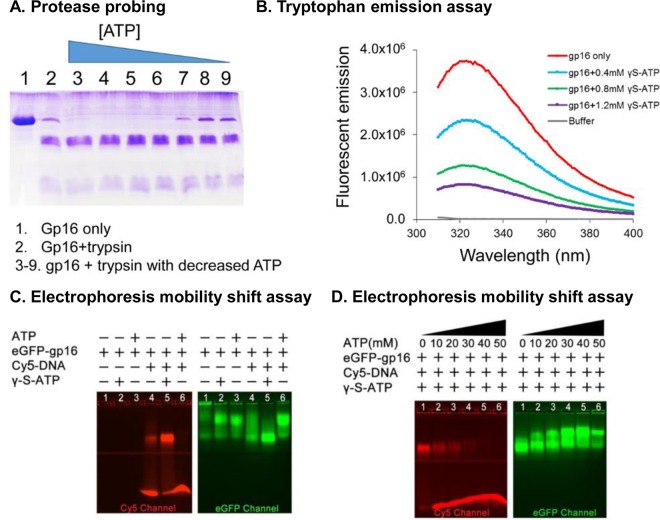
Biological motors are ubiquitous in living systems. Currently, how the motor components coordinate the unidirectional motion is elusive in most cases. Here, we report that the sequential action of the ATPase ring in the DNA packaging motor of bacteriophage ϕ29 is regulated by an arginine finger that extends from one ATPase subunit to the adjacent unit to promote noncovalent dimer formation. Mutation of the arginine finger resulted in the interruption of ATPase oligomerization, ATP binding/hydrolysis, and DNA translocation. Dimer formation reappeared when arginine mutants were mixed with other ATPase subunits that can offer the arginine to promote their interaction. Ultracentrifugation and virion assembly assays indicated that the ATPase was presenting as monomers and dimer mixtures. The isolated dimer alone was inactive in DNA translocation, but the addition of monomer could restore the activity, suggesting that the hexameric ATPase ring contained both dimer and monomers. Moreover, ATP binding or hydrolysis resulted in conformation and entropy changes of the ATPase with high or low DNA affinity. Taking these observations together, we concluded that the arginine finger regulates sequential action of the motor ATPase subunit by promoting the formation of the dimer inside the hexamer. The finding of asymmetrical hexameric organization is supported by structural evidence of many other ATPase systems showing the presence of one noncovalent dimer and four monomer subunits. All of these provide clues for why the asymmetrical hexameric ATPase gp16 of ϕ29 was previously reported as a pentameric configuration by cryo-electron microscopy (cryo-EM) since the contact by the arginine finger renders two adjacent ATPase subunits closer than other subunits. Thus, the asymmetrical hexamer would appear as a pentamer by cryo-EM, a technology that acquires the average of many images.
生物马达在生命系统中无处不在。目前,在大多数情况下,马达组件如何协调单向运动仍不清楚。在这里,我们报告噬菌体ϕ29的DNA包装马达中ATP酶环的顺序作用受精氨酸指调控,该精氨酸指从一个ATP酶亚基延伸到相邻亚基以促进非共价二聚体形成。精氨酸指的突变导致ATP酶寡聚化、ATP结合/水解以及DNA转位的中断。当精氨酸突变体与其他能够提供精氨酸以促进其相互作用的ATP酶亚基混合时,二聚体形成重新出现。超速离心和病毒体组装试验表明,ATP酶以单体和二聚体混合物的形式存在。单独分离的二聚体在DNA转位中无活性,但添加单体可恢复活性,这表明六聚体ATP酶环同时包含二聚体和单体。此外,ATP结合或水解导致具有高或低DNA亲和力的ATP酶构象和熵发生变化。综合这些观察结果,我们得出结论,精氨酸指通过促进六聚体内二聚体的形成来调节马达ATP酶亚基的顺序作用。许多其他ATP酶系统的结构证据支持了不对称六聚体组织的发现,这些证据表明存在一个非共价二聚体和四个单体亚基。所有这些都为为什么之前通过冷冻电子显微镜(cryo-EM)将ϕ29的不对称六聚体ATP酶gp16报道为五聚体构型提供了线索,因为精氨酸指的接触使两个相邻的ATP酶亚基比其他亚基更靠近。因此,通过cryo-EM(一种获取许多图像平均值的技术),不对称六聚体将呈现为五聚体。