Gonzalez Maria Rosaida, Marcelo Claudia Dolores, Stringer Matthew
Department of Medical Education, Florida Hospital East Orlando Medical Plaza, 7975 Lake Underhill Road, Suite 200, Orlando, FL 32822, USA.
Cases J. 2009 Jun 25;2:8357. doi: 10.4076/1757-1626-2-8357.
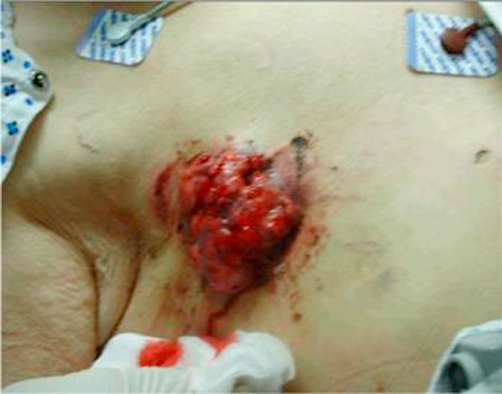
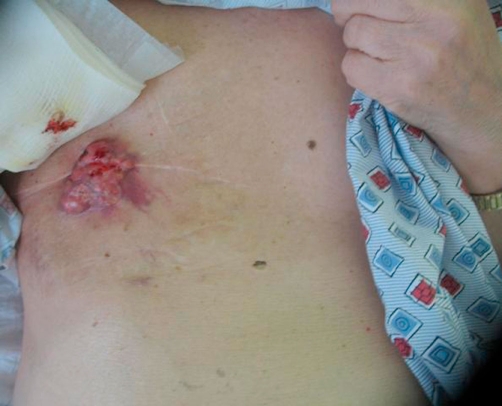
Terminal illness poses a tremendous challenge to patients, their families and their health care providers. It is often difficult to determine when hospice is appropriate. Timely referrals are beneficial to both patient and caregivers as a way to offer improved care and support at end of life; when multiple, complicated, co-morbid states affect care. This is especially true when a patient's psychosocial background would otherwise make it difficult to ensure proper comfort and quality of life. In this report, we present an 86 year old man with a history of right-sided breast cancer, bipolar disorder and dementia. Patient is 20 years status-post a total mastectomy. He declined adjuvant radiation, chemotherapy, and hormone therapy, and did not pursue any further medical follow-up. Patient now presented with a rapidly enlarging, ulcerating right anterior chest wall tumor. Surgical biopsy revealed recurrent infiltrating ductal carcinoma of the breast. Patient was started on tamoxifen and palliative radiation. An oncology evaluation determined that he is not a candidate for curative treatment. Patient's primary caregiver (wife) concurrently suffers from dementia, one son is Bipolar, and the second son is out of state. A full geriatric assessment concluded that based on the patient's medical and socioeconomic history, he is an ideal candidate for hospice. With the family's consent, he was enrolled in one of our local hospice organizations. Currently, he is in a skilled nursing facility with hospice.
晚期疾病给患者、其家人及医疗服务提供者带来了巨大挑战。通常很难确定何时适合进入临终关怀阶段。及时转诊对患者和护理人员都有益,可在生命末期提供更好的护理和支持,尤其是当多种复杂的共病状态影响护理时。当患者的社会心理背景可能导致难以确保适当的舒适度和生活质量时,情况更是如此。在本报告中,我们介绍了一位86岁男性,有右侧乳腺癌、双相情感障碍和痴呆病史。患者在全乳切除术后已有20年。他拒绝辅助放疗、化疗和激素治疗,也未进行任何进一步的医学随访。患者现出现右侧前胸壁肿瘤迅速增大并溃疡。手术活检显示为复发性浸润性乳腺癌。患者开始服用他莫昔芬并接受姑息性放疗。肿瘤学评估确定他不适合进行根治性治疗。患者的主要照顾者(妻子)同时患有痴呆,一个儿子患有双相情感障碍,另一个儿子不在本州。全面的老年评估得出结论,基于患者的医疗和社会经济病史,他是临终关怀的理想人选。在家人同意后,他加入了我们当地的一家临终关怀机构。目前,他在一家配备临终关怀服务的专业护理机构中。