Sreekumar E, Issac Aneesh, Nair Sajith, Hariharan Ramkumar, Janki M B, Arathy D S, Regu R, Mathew Thomas, Anoop M, Niyas K P, Pillai M R
Molecular Virology Laboratory, Rajiv Gandhi Centre for Biotechnology (RGCB), Thycaud P.O., Thiruvananthapuram 695014, Kerala, India.
Virus Genes. 2010 Feb;40(1):14-27. doi: 10.1007/s11262-009-0411-9. Epub 2009 Oct 23.
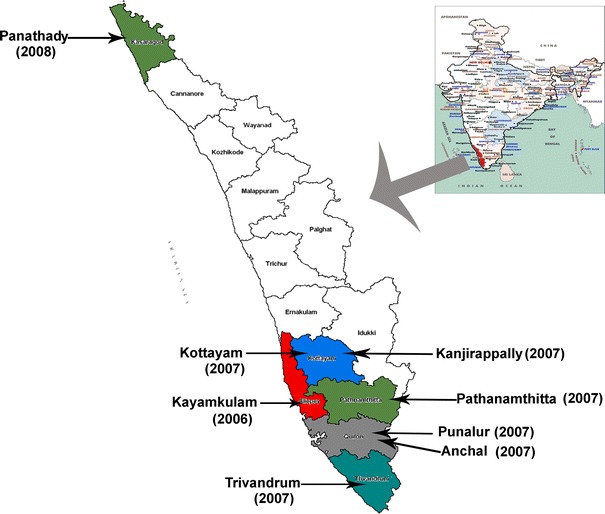
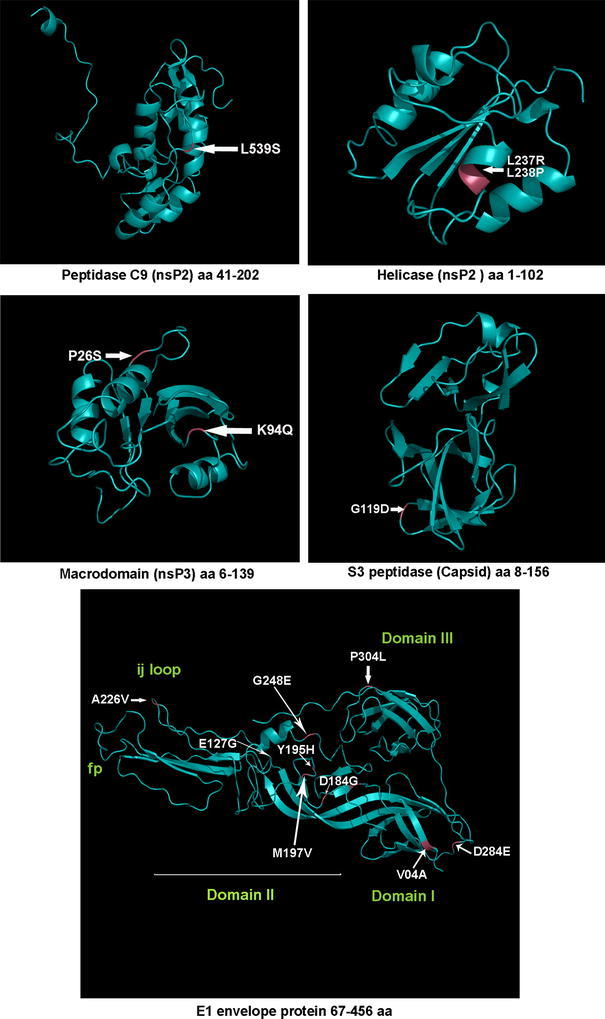
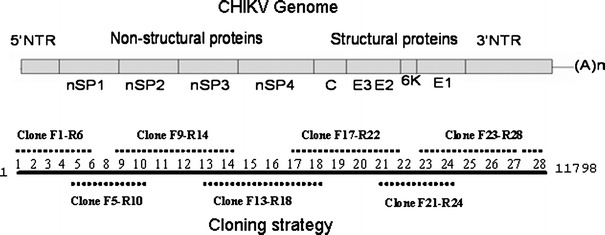
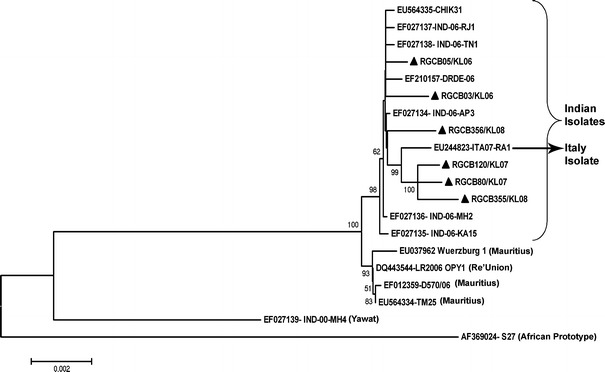
Chikungunya virus (CHIKV), a positive-stranded alphavirus, causes epidemic febrile infections characterized by severe and prolonged arthralgia. In the present study, six CHIKV isolates (2006 RGCB03, RGCB05; 2007 RGCB80, RGCB120; 2008 RGCB355, RGCB356) from three consecutive Chikungunya outbreaks in Kerala, South India, were analyzed for genetic variations by sequencing the 11798 bp whole genome of the virus. A total of 37 novel mutations were identified and they were predominant in the 2007 and 2008 isolates among the six isolates studied. The previously identified E1 A226V critical mutation, which enhances mosquito adaptability, was present in the 2007 and 2008 samples. An important observation was the presence of two coding region substitutions, leading to nsP2 L539S and E2 K252Q change. These were identified in three isolates (2007 RGCB80 and RGCB120; 2008 RGCB355) by full-genome analysis, and also in 13 of the 31 additional samples (42%), obtained from various parts of the state, by sequencing the corresponding genomic regions. These mutations showed 100% co-occurrence in all these samples. In phylogenetic analysis, formation of a new genetic clade by these isolates within the East, Central and South African (ECSA) genotypes was observed. Homology modeling followed by mapping revealed that at least 20 of the identified mutations fall into functionally significant domains of the viral proteins and are predicted to affect protein structure. Eighteen of the identified mutations in structural proteins, including the E2 K252Q change, are predicted to disrupt T-cell epitope immunogenicity. Our study reveals that CHIK virus with novel genetic changes were present in the severe Chikungunya outbreaks in 2007 and 2008 in South India.
基孔肯雅病毒(CHIKV)是一种正链α病毒,可引起以严重且持久的关节痛为特征的流行性发热感染。在本研究中,对来自印度南部喀拉拉邦连续三次基孔肯雅热疫情的六个CHIKV分离株(2006年的RGCB03、RGCB05;2007年的RGCB80、RGCB120;2008年的RGCB355、RGCB356)进行了分析,通过对该病毒11798 bp的全基因组进行测序来检测基因变异。共鉴定出37个新突变,在研究的六个分离株中,这些突变在2007年和2008年的分离株中占主导地位。先前鉴定出的增强蚊子适应性的关键突变E1 A226V存在于2007年和2008年的样本中。一个重要的发现是存在两个编码区替换,导致nsP2 L539S和E2 K252Q变化。通过全基因组分析在三个分离株(2007年的RGCB80和RGCB120;2008年的RGCB355)中鉴定到了这些变化,并且通过对来自该邦不同地区的31个额外样本中的13个(42%)的相应基因组区域进行测序也鉴定到了这些变化。这些突变在所有这些样本中均100%同时出现。在系统发育分析中,观察到这些分离株在东、中、南非(ECSA)基因型内形成了一个新的遗传分支。随后通过映射进行的同源建模显示,所鉴定的突变中至少有20个位于病毒蛋白的功能重要结构域内,并预计会影响蛋白质结构。在结构蛋白中鉴定出的18个突变,包括E2 K252Q变化,预计会破坏T细胞表位免疫原性。我们的研究表明,具有新基因变化的基孔肯雅病毒存在于2007年和2008年印度南部严重的基孔肯雅热疫情中。