Center of Marine Biotechnology, University of Maryland Biotechnology Institute, Baltimore, 701 East Pratt Street, Baltimore, Maryland 21202-3101, USA.
Virol J. 2009 Oct 25;6:171. doi: 10.1186/1743-422X-6-171.
Viral hemorrhagic septicemia virus (VHSV) is a highly contagious viral disease of fresh and saltwater fish worldwide. VHSV caused several large scale fish kills in the Great Lakes area and has been found in 28 different host species. The emergence of VHS in the Great Lakes began with the isolation of VHSV from a diseased muskellunge (Esox masquinongy) caught from Lake St. Clair in 2003. VHSV is a member of the genus Novirhabdovirus, within the family Rhabdoviridae. It has a linear single-stranded, negative-sense RNA genome of approximately 11 kbp, with six genes. VHSV replicates in the cytoplasm and produces six monocistronic mRNAs. The gene order of VHSV is 3'-N-P-M-G-NV-L-5'. This study describes molecular characterization of the Great Lakes VHSV strain (MI03GL), and its phylogenetic relationships with selected European and North American isolates.
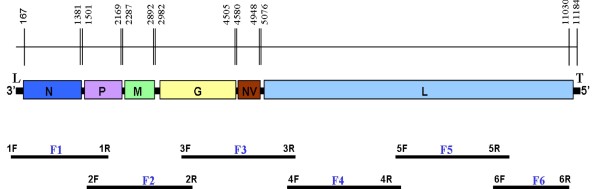
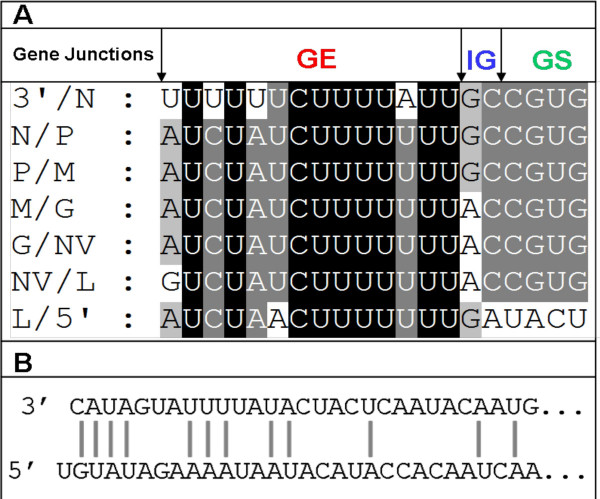
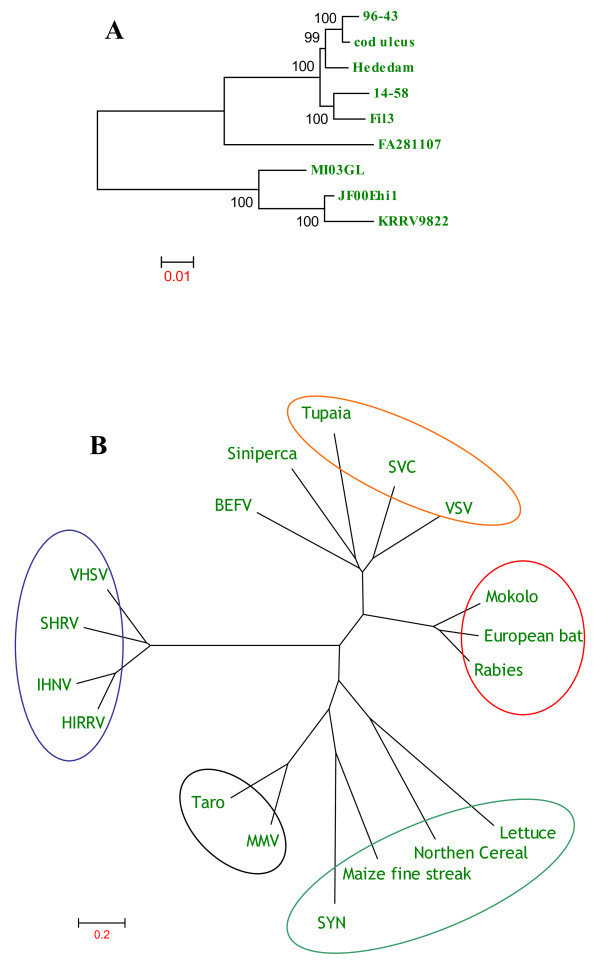
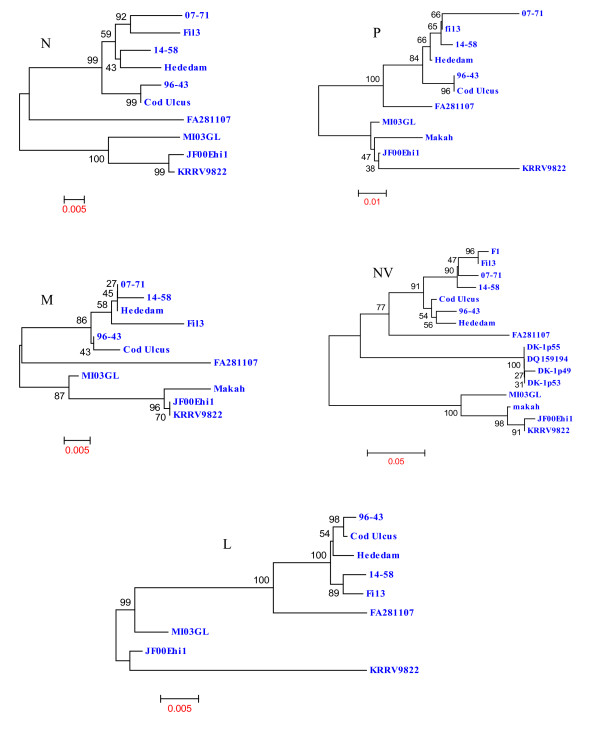
The complete genomic sequences of VHSV-MI03GL strain was determined from cloned cDNA of six overlapping fragments, obtained by RT-PCR amplification of genomic RNA. The complete genome sequence of MI03GL comprises 11,184 nucleotides (GenBank GQ385941) with the gene order of 3'-N-P-M-G-NV-L-5'. These genes are separated by conserved gene junctions, with di-nucleotide gene spacers. The first 4 nucleotides at the termini of the VHSV genome are complementary and identical to other novirhadoviruses genomic termini. Sequence homology and phylogenetic analysis show that the Great Lakes virus is closely related to the Japanese strains JF00Ehi1 (96%) and KRRV9822 (95%). Among other novirhabdoviruses, VHSV shares highest sequence homology (62%) with snakehead rhabdovirus.
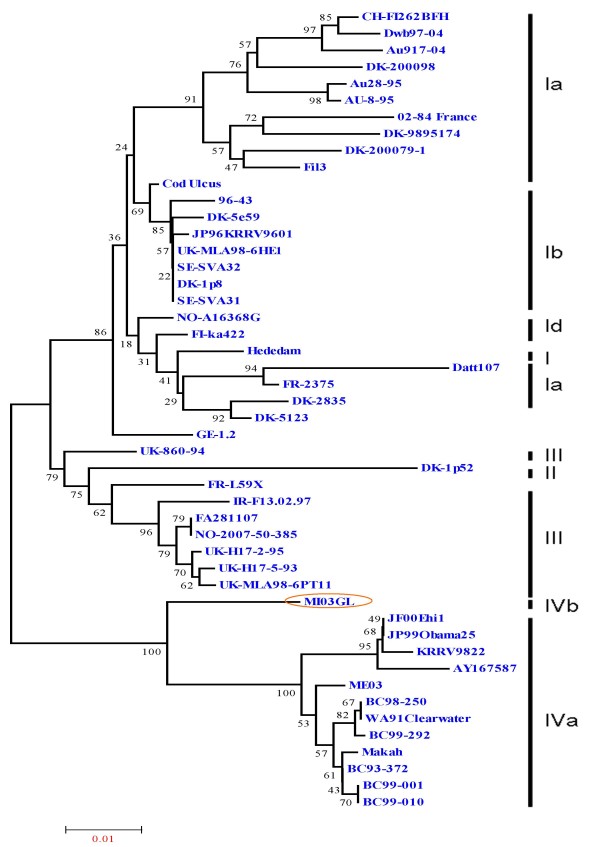
Phylogenetic tree obtained by comparing 48 glycoprotein gene sequences of different VHSV strains demonstrate that the Great Lakes VHSV is closely related to the North American and Japanese genotype IVa, but forms a distinct genotype IVb, which is clearly different from the three European genotypes. Molecular characterization of the Great Lakes isolate will be helpful in studying the pathogenesis of VHSV using a reverse genetics approach and developing efficient control strategies.
病毒性出血性败血症病毒(VHSV)是一种具有高度传染性的淡水和海水鱼类病毒疾病,在全球范围内发生。VHSV 已导致大湖区的几次大规模鱼类死亡,并在 28 种不同的宿主物种中发现。VHS 在大湖区的出现始于 2003 年从圣克莱尔湖捕获的患病 Muskellunge(Esox masquinongy)中分离出 VHSV。VHSV 是 Rhabdoviridae 科 Novirhabdovirus 属的一员。它具有约 11kbp 的线性单链、负义 RNA 基因组,包含六个基因。VHSV 在细胞质中复制,并产生六个单顺反子 mRNAs。VHSV 的基因顺序为 3'-N-P-M-G-NV-L-5'。本研究描述了大湖 VHSV 株(MI03GL)的分子特征及其与选定的欧洲和北美分离株的系统发育关系。
通过 RT-PCR 扩增基因组 RNA 获得的六个重叠片段的 cDNA 克隆,确定了 VHSV-MI03GL 株的完整基因组序列。MI03GL 的完整基因组序列由 11,184 个核苷酸(GenBank GQ385941)组成,基因顺序为 3'-N-P-M-G-NV-L-5'。这些基因被保守的基因接头隔开,具有二核苷酸基因间隔区。VHSV 基因组末端的前 4 个核苷酸是互补的,与其他新病毒基因组末端相同。序列同源性和系统发育分析表明,大湖病毒与日本株 JF00Ehi1(96%)和 KRRV9822(95%)密切相关。在其他新病毒中,VHSV 与蛇头病毒的序列同源性最高(62%)。
比较不同 VHSV 株的 48 种糖蛋白基因序列得到的系统发育树表明,大湖 VHSV 与北美的日本基因型 IVa 密切相关,但形成了一个独特的基因型 IVb,与三种欧洲基因型明显不同。大湖分离株的分子特征将有助于使用反向遗传学方法研究 VHSV 的发病机制,并开发有效的控制策略。