School of Optometry and Helen Wills Neuroscience Institute, University of California, Berkeley, Berkeley, CA 94720-2020, USA.
Curr Biol. 2009 Dec 15;19(23):1988-93. doi: 10.1016/j.cub.2009.09.056. Epub 2009 Oct 22.
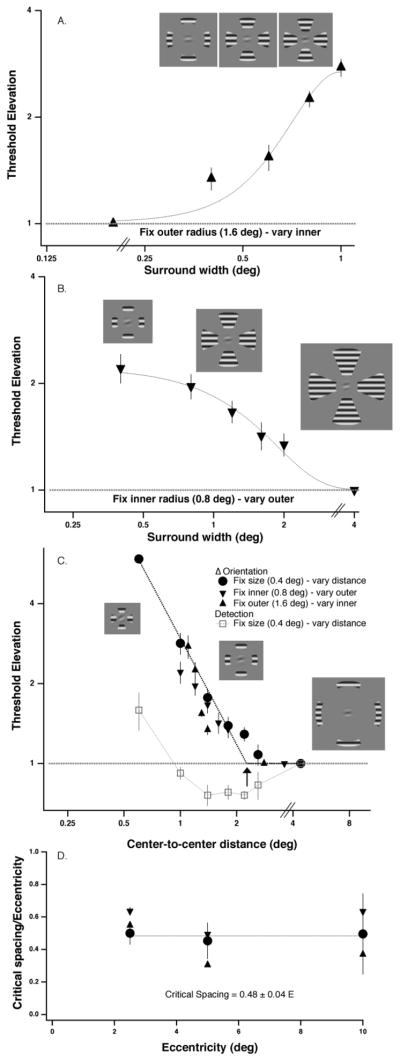
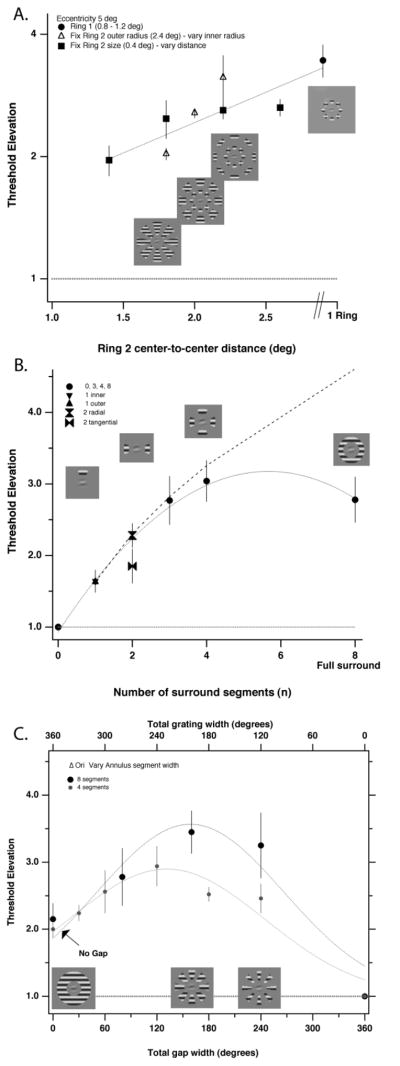
We enjoy the illusion that visual resolution is high across the entire field of vision. However, this illusion can be easily dispelled by trying to identify objects in a cluttered environment out of the corner of your eye. This reflects, in part, the well-known decline in visual resolution in peripheral vision; however, the main bottleneck for reading or object recognition in peripheral vision is crowding. Objects that can be easily identified in isolation seem indistinct and jumbled in clutter. Crowding is thought to reflect inappropriate integration of the target and flankers in peripheral vision [1, 2]. Here, we uncover and explain a paradox in peripheral crowding: under certain conditions, increasing the size or number of flanking rings results in a paradoxical decrease in the magnitude of crowding-i.e., the bigger or more numerous the flanks, the smaller the crowding. These surprising results are predicted by a model in which crowding is determined by the centroids of approximately 4-8 independent features within approximately 0.5x the target eccentricity. These features are then integrated into a texture beyond the stage of feature analysis. We speculate that this process may contribute to the illusion of high resolution across the field of vision.
我们有一种错觉,认为整个视野的分辨率都很高。然而,这种错觉很容易被打破,只需尝试从眼角辨认出杂乱环境中的物体即可。这在一定程度上反映了周边视觉中众所周知的视觉分辨率下降;然而,阅读或在周边视觉中识别物体的主要瓶颈是拥挤。在孤立的情况下可以轻松识别的物体,在杂乱中看起来模糊不清。拥挤被认为反映了在周边视觉中目标和侧翼之间不合适的整合[1,2]。在这里,我们揭示并解释了周边拥挤中的一个悖论:在某些条件下,增加侧翼环的大小或数量会导致拥挤程度的悖论性减小,即侧翼越大或越多,拥挤越小。这些令人惊讶的结果是由一个模型预测的,该模型认为拥挤是由目标偏心距的大约 0.5x 内大约 4-8 个独立特征的质心决定的。然后,这些特征被整合到特征分析之外的纹理中。我们推测,这个过程可能有助于产生整个视野分辨率高的错觉。