Centre for Legumes in Mediterranean Agriculture, The University of Western Australia, 35 Stirling Highway, Crawley, WA 6009, Australia.
J Exp Bot. 2010;61(2):335-45. doi: 10.1093/jxb/erp307. Epub 2009 Oct 23.
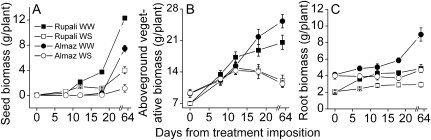
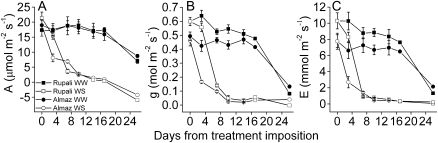
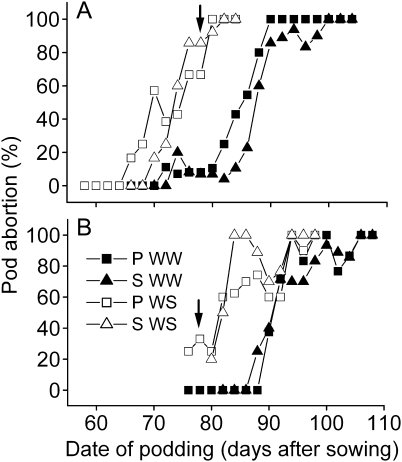
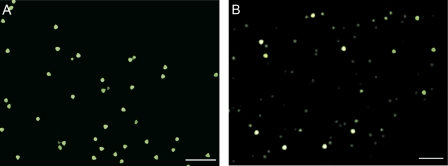
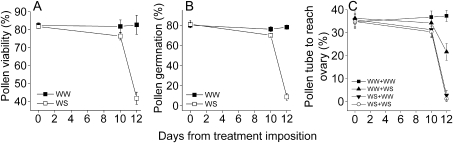
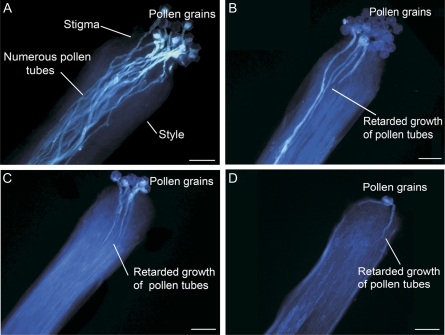
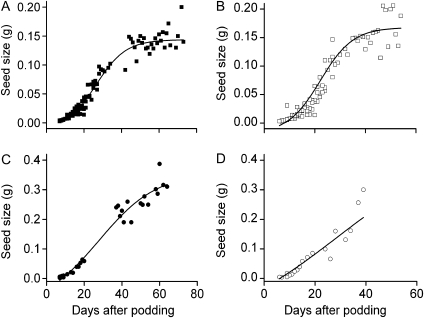
Terminal drought during the reproductive stage is a major constraint to yield of chickpea in many regions of the world. Termination of watering (WS) during podding in a small-seeded desi chickpea (Cicer arietinum L.) cultivar, Rupali, and a large-seeded kabuli chickpea cultivar, Almaz, induced a decrease in predawn leaf water potential (LWP), in the rate of photosynthesis, and in stomatal conductance. Compared to well-watered (WW) controls, the WS treatment reduced flower production by about two-thirds. In the WW treatment, about 15% of the flowers aborted and 42% (Rupali) and 67% (Almaz) of the pods aborted, whereas in the WS treatment 37% and 56% of the flowers aborted and 54% and 73% of the pods aborted, resulting in seed yields of 33% and 15% of the yields in WW plants in Rupali and Almaz, respectively. In vitro pollen viability and germination in Rupali decreased by 50% and 89% in the WS treatment, and pollen germination decreased by 80% in vivo when pollen from a WS plant was placed on a stigma of a WW plant. While about 37% of the germinated pollen tubes from WW plants and 22% from the WS plants reached the ovary in the WW plants, less than 3% of pollen grains reached the ovary when pollen from either WS or WW plants was placed on a stigma of a WS plant. It is concluded that, in addition to pod abortion, flower abortion is an important factor limiting yield in chickpea exposed to terminal drought and that water deficit impaired the function of the pistil/style more than the pollen.
生殖期的终末干旱是世界许多地区小粒型鹰嘴豆(Cicer arietinum L.)栽培品种 Rupali 和大粒型鹰嘴豆栽培品种 Almaz 产量的主要限制因素。在这两个品种的鹰嘴豆中,在结荚期停止浇水(WS)会导致破晓前叶片水势(LWP)、光合作用和气孔导度降低。与充分浇水(WW)的对照相比,WS 处理使花朵产量减少了约三分之二。在 WW 处理中,约有 15%的花朵败育,42%(Rupali)和 67%(Almaz)的荚果败育,而在 WS 处理中,37%和 56%的花朵败育,54%和 73%的荚果败育,导致 Rupali 和 Almaz 的 WW 植株种子产量分别为 33%和 15%。在 Rupali 中,WS 处理使体外花粉活力和萌发分别降低了 50%和 89%,而体内花粉萌发降低了 80%,当 WS 植株的花粉放在 WW 植株的柱头时。当 WW 植株的花粉有 37%和 WS 植株的花粉有 22%到达 WW 植株的子房时,只有不到 3%的花粉粒到达 WS 植株的子房,当 WW 或 WS 植株的花粉放在 WS 植株的柱头时。因此,除荚果败育外,花朵败育也是鹰嘴豆在终末干旱下限制产量的重要因素,水分亏缺对雌蕊/花柱的功能损害大于花粉。