Islami F, Ren J-S, Taylor P R, Kamangar F
Digestive Disease Research Center, Shariati Hospital, Tehran University of Medical Sciences, Tehran 14117, Iran.
Br J Cancer. 2009 Nov 3;101(9):1641-7. doi: 10.1038/sj.bjc.6605372.
Ecological and experimental studies have suggested a relationship between Asian pickled vegetable consumption and oesophageal squamous cell carcinoma (OSCC), but the results of epidemiological studies investigating the association have been inconsistent. We conducted a meta-analysis of observational studies of this association to evaluate the existing evidence.
We searched the PubMed, ISI-Web of Science, J-EAST, IndMed, Vip Chinese Periodical, and China National Knowledge Infrastructure databases for all studies published in English or Chinese languages. Pooled results for all studies combined and for several study subgroups were computed.
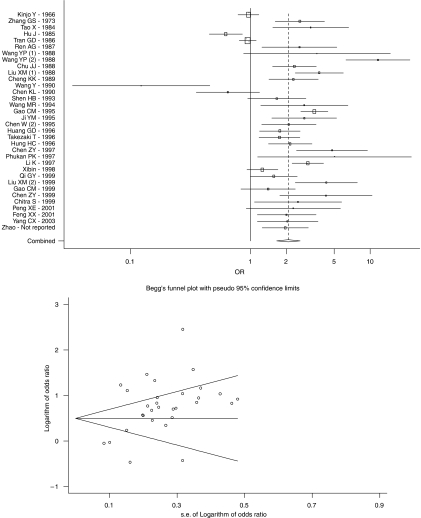
A total of 34 studies were included in this analysis. The overall random effects odds ratio (OR) and 95% confidence interval (CI) for pickled vegetable consumption was 2.08 (1.66-2.60), but the results were heterogeneous across studies. After excluding the three most influential studies, the respective numbers were 2.32 (1.92-2.81). Similar to the overall association, the majority of subgroup analyses showed a statistically significant association between consuming pickled vegetables and OSCC risk. There were only three prospective studies.
Our results suggest a potential two-fold increased risk of oesophageal cancer associated with the intake of pickled vegetables. However, because the majority of data was from retrospective studies and there was a high heterogeneity in the results, further well-designed prospective studies are warranted.
生态学和实验研究表明,食用亚洲泡菜与食管鳞状细胞癌(OSCC)之间存在关联,但调查该关联的流行病学研究结果并不一致。我们对有关此关联的观察性研究进行了荟萃分析,以评估现有证据。
我们在PubMed、ISI-Web of Science、J-EAST、IndMed、维普中文期刊和中国知网数据库中检索了所有以英文或中文发表的研究。计算了所有研究合并以及几个研究亚组的汇总结果。
本分析共纳入34项研究。食用泡菜的总体随机效应比值比(OR)和95%置信区间(CI)为2.08(1.66 - 2.60),但各研究结果存在异质性。排除三项最具影响力的研究后,相应数字为2.32(1.92 - 2.81)。与总体关联相似,大多数亚组分析显示食用泡菜与OSCC风险之间存在统计学显著关联。仅有三项前瞻性研究。
我们的结果表明,食用泡菜可能使患食管癌的风险增加两倍。然而,由于大多数数据来自回顾性研究且结果存在高度异质性,因此有必要开展进一步精心设计的前瞻性研究。