Department of Biostatistics, University of Copenhagen, Copenhagen, Denmark.
BMC Med Res Methodol. 2009 Nov 12;9:75. doi: 10.1186/1471-2288-9-75.
In Sub-Sahara Africa, malaria due to Plasmodium falciparum is the main cause of ill health. Evaluation of malaria interventions, such as drugs and vaccines depends on clinical definition of the disease, which is still a challenge due to lack of distinct malaria specific clinical features. Parasite threshold is used in definition of clinical malaria in evaluation of interventions. This however, is likely to be influenced by other factors such as transmission intensity as well as individual level of immunity against malaria.
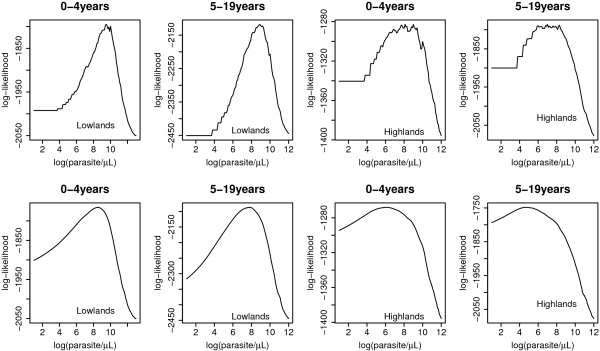
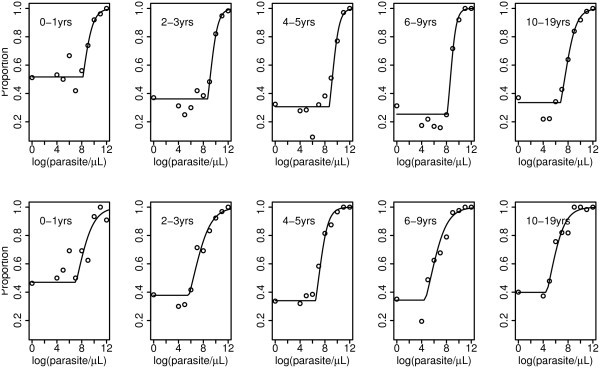
This paper describes step function and dose response model with threshold parameter as a tool for estimation of parasite threshold for onset of malaria fever in highlands (low transmission) and lowlands (high transmission intensity) strata. These models were fitted using logistic regression stratified by strata and age groups (0-1, 2-3, 4-5, 6-9, and 10-19 years). Dose response model was further extended to fit all age groups combined in each stratum. Sub-sampling bootstrap was used to compute confidence intervals. Cross-sectional and passive case detection data from Korogwe district, north eastern Tanzania were used.
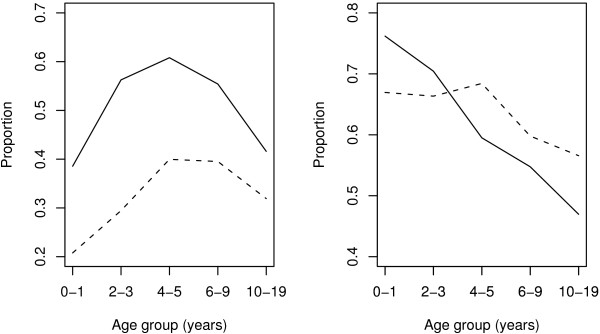
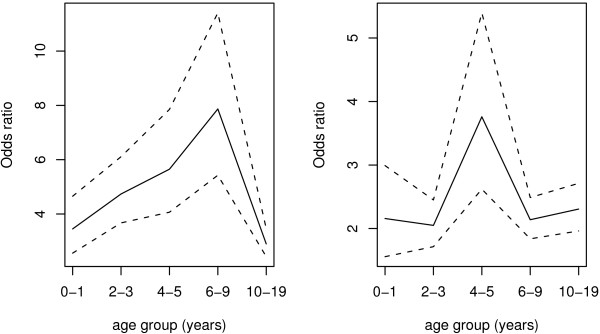
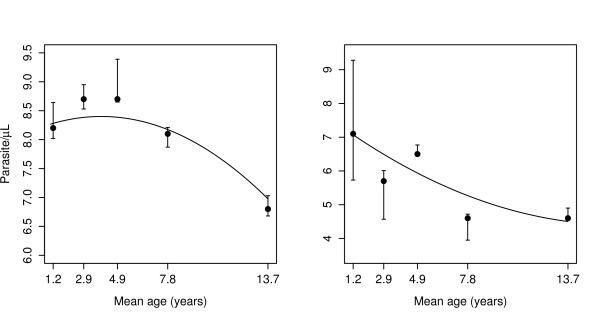
Dose response model was better in the estimation of parasite thresholds. Parasite thresholds (scale = log parasite/microL) were high in lowlands than in highlands. In the lowlands, children in age group 4-5 years had the highest parasite threshold (8.73) while individuals aged 10-19 years had the lowest (6.81). In the highlands, children aged 0-1 years had the highest threshold (7.12) and those aged 10-19 years had the lowest (4.62). Regression analysis with all ages combined showed similar pattern of thresholds in both strata, whereby, in the lowlands the threshold was highest in age group 2-5 years and lowest in older individuals, while in the highlands was highest in age group 0-1 and decreased with increased age. The sensitivity of parasite threshold by age group ranged from 64%-74% in the lowlands and 67%-97% in the highlands; while specificity ranged between 67%-90% in the lowlands and 37%-73% in the highlands.
Dose response model with threshold parameter can be used to estimate parasite threshold associated with malaria fever onset. Parasite threshold were lower in older individuals and in low malaria transmission area.
在撒哈拉以南非洲,疟原虫引起的疟疾是导致健康不良的主要原因。药物和疫苗等疟疾干预措施的评估取决于疾病的临床定义,但由于缺乏独特的疟疾特异性临床特征,这仍然是一个挑战。寄生虫阈值用于评估干预措施中临床疟疾的定义。然而,这可能受到其他因素的影响,如传播强度以及个体对疟疾的免疫水平。
本文描述了具有阈值参数的阶跃函数和剂量反应模型,作为估计高海拔地区(低传播)和低海拔地区(高传播强度)疟疾发热起始时寄生虫阈值的工具。这些模型使用逻辑回归按层和年龄组(0-1、2-3、4-5、6-9 和 10-19 岁)分层进行拟合。剂量反应模型进一步扩展到适用于每个层的所有年龄组。使用子抽样引导法计算置信区间。使用来自坦桑尼亚东北部科罗韦区的横断面和被动病例检测数据。
剂量反应模型在寄生虫阈值的估计中表现更好。低地的寄生虫阈值(比例=对数寄生虫/微升)高于高地。在低地,4-5 岁年龄组的儿童具有最高的寄生虫阈值(8.73),而 10-19 岁的个体具有最低的寄生虫阈值(6.81)。在高地,0-1 岁年龄组的儿童具有最高的阈值(7.12),而 10-19 岁的儿童具有最低的阈值(4.62)。对所有年龄组进行回归分析,显示出两种情况下的阈值相似模式,即低地的阈值在 2-5 岁年龄组最高,而在年龄较大的个体中最低,而在高地的阈值在 0-1 岁年龄组最高,随着年龄的增加而降低。按年龄组划分的寄生虫阈值的敏感性在低地为 64%-74%,在高地为 67%-97%;而特异性在低地为 67%-90%,在高地为 37%-73%。
具有阈值参数的剂量反应模型可用于估计与疟疾发热发作相关的寄生虫阈值。寄生虫阈值在年龄较大的个体和低疟疾传播地区较低。