Tanga Research Centre, National Institute for Medical Research, Tanga, Tanzania.
Tanzania Meteorological Agency, Dar es Salaam, Tanzania.
Malar J. 2018 Jul 6;17(1):252. doi: 10.1186/s12936-018-2395-1.
Although the recent decline of malaria burden in some African countries has been attributed to a scale-up of interventions, such as bed nets (insecticide-treated bed nets, ITNs/long-lasting insecticidal nets, LLINs), the contribution of other factors to these changes has not been rigorously assessed. This study assessed the trends of Plasmodium falciparum prevalence in Magoda (1992-2017) and Mpapayu (1998-2017) villages of Muheza district, North-eastern Tanzania, in relation to changes in the levels of different interventions and rainfall patterns.
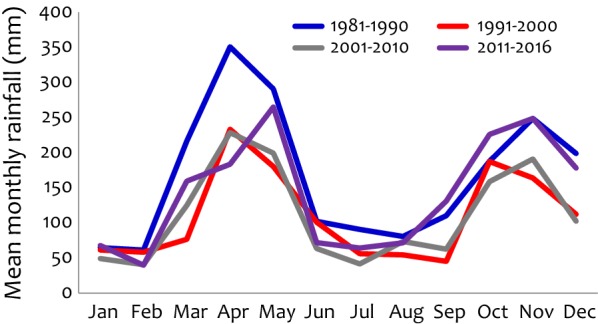
Individuals aged 0-19 years were recruited in cross-sectional surveys to determine the prevalence of P. falciparum infections in relation to different malaria interventions deployed, particularly bed nets and anti-malarial drugs. Trends and patterns of rainfall in Muheza for 35 years (from 1981 to 2016) were assessed to determine changes in the amount and pattern of rainfall and their possible impacts on P. falciparum prevalence besides of those ascribed to interventions.
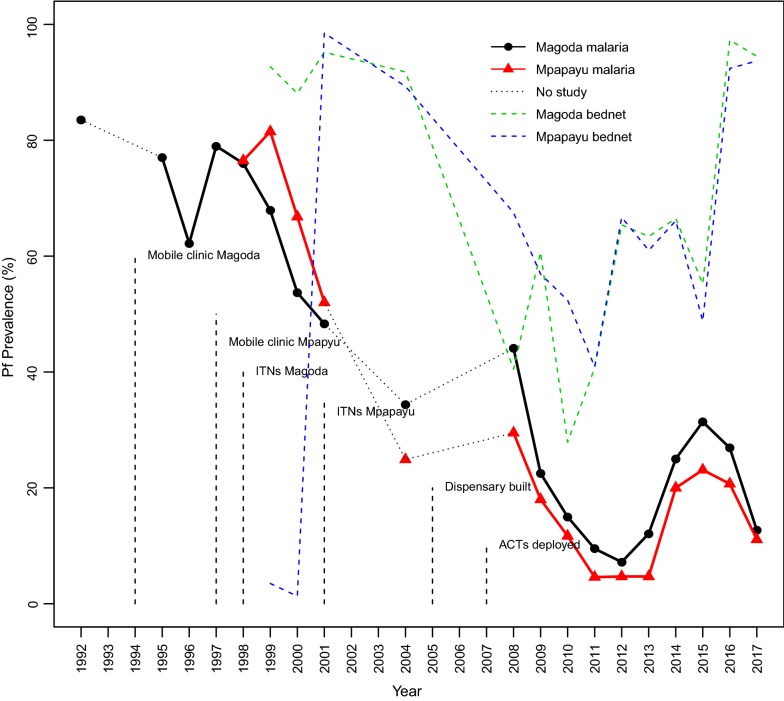
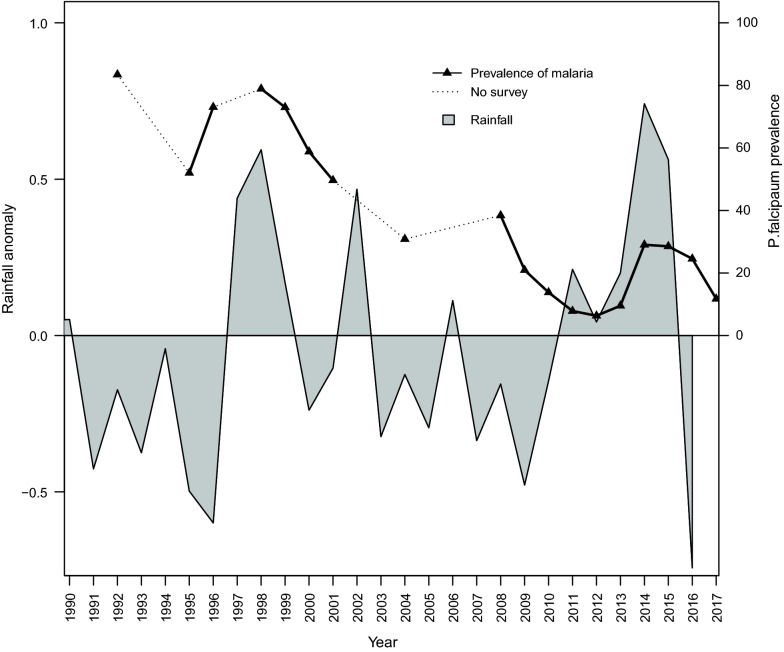
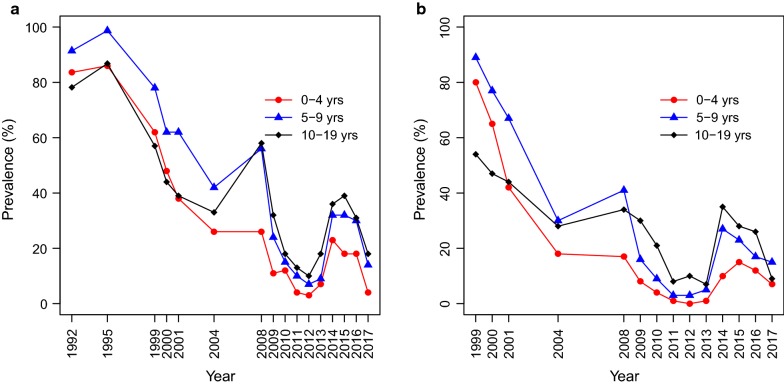
High prevalence (84-54%) was reported between 1992 and 2000 in Magoda, and 1998 and 2000 in Mpapayu, but it declined sharply from 2001 to 2004 (from 52.0 to 25.0%), followed by a progressive decline between 2008 and 2012 (to ≤ 7% in both villages). However, the prevalence increased significantly from 2013 to 2016 reaching ≥ 20.0% in 2016 (both villages), but declined in the two villages to ≤ 13% in 2017. Overall and age specific P. falciparum prevalence decreased in both villages over the years but with a peak prevalence shifting from children aged 5-9 years to those aged 10-19 years from 2008 onwards. Bed net coverage increased from < 4% in 1998 to > 98% in 2001 and was ≥ 85.0% in 2004 in both villages; followed by fluctuations with coverage ranging from 35.0 to ≤ 98% between 2008 and 2017. The 12-month weighted anomaly standardized precipitation index showed a marked rainfall deficit in 1990-1996 and 1999-2010 coinciding with declining prevalence and despite relatively high bed net coverage from 2000. From 1992, the risk of infection decreased steadily up to 2013 when the lowest risk was observed (RR = 0.07; 95% CI 0.06-0.08, P < 0.001), but it was significantly higher during periods with positive rainfall anomalies (RR = 2.79; 95% CI 2.23-3.50, P < 0.001). The risk was lower among individuals not owning bed nets compared to those with nets (RR = 1.35; 95% CI 1.22-1.49, P < 0.001).
A decline in prevalence up to 2012 and resurgence thereafter was likely associated with changes in monthly rainfall, offset against changing malaria interventions. A sustained surveillance covering multiple factors needs to be undertaken and climate must be taken into consideration when relating control interventions to malaria prevalence.
尽管最近一些非洲国家疟疾负担的下降归因于干预措施的扩大,如蚊帐(经杀虫剂处理的蚊帐、长效杀虫剂蚊帐、长寿命杀虫剂蚊帐),但其他因素对这些变化的贡献尚未得到严格评估。本研究评估了坦桑尼亚东北部穆哈扎区 Magoda(1992-2017 年)和 Mpapayu(1998-2017 年)村庄间恶性疟原虫流行率的变化趋势,这些变化与不同干预措施和降雨模式的变化有关。
在横断面研究中招募了 0-19 岁的个体,以确定在部署不同疟疾干预措施(特别是蚊帐和抗疟药物)时恶性疟原虫感染的流行率。评估了穆哈扎 35 年来(1981 年至 2016 年)的降雨趋势和模式,以确定降雨量的数量和模式的变化,以及这些变化对恶性疟原虫流行率的可能影响,除了归因于干预措施的影响外。
Magoda 村 1992 年至 2000 年报告的高流行率(84-54%),1998 年至 2000 年在 Mpapayu 村报告的高流行率,但从 2001 年至 2004 年急剧下降(从 52.0%降至 25.0%),随后从 2008 年至 2012 年呈逐步下降趋势(两个村庄均降至≤7%)。然而,2013 年至 2016 年的流行率显著上升,2016 年(两个村庄)均达到≥20.0%,但在 2017 年,两个村庄的流行率均降至≤13%。总的来说,恶性疟原虫的流行率在这两个村庄中逐年下降,但从 2008 年开始,年龄特异性流行率从 5-9 岁儿童高峰转移到 10-19 岁儿童。从 1998 年的<4%到 2001 年的>98%,再到 2004 年的≥85.0%,两个村庄的蚊帐覆盖率都有所增加;随后,从 2008 年至 2017 年,覆盖率波动在 35.0%至≤98%之间。12 个月加权异常标准化降水指数显示,1990-1996 年和 1999-2010 年出现明显的降雨不足,与流行率下降相对应,尽管从 2000 年开始,蚊帐覆盖率相对较高。从 1992 年开始,感染风险稳步下降,直到 2013 年达到最低风险(RR=0.07;95%CI 0.06-0.08,P<0.001),但在出现正降雨异常的时期风险显著增加(RR=2.79;95%CI 2.23-3.50,P<0.001)。与拥有蚊帐的个体相比,没有蚊帐的个体感染的风险较低(RR=1.35;95%CI 1.22-1.49,P<0.001)。
直到 2012 年流行率下降,此后又出现反弹,这可能与每月降雨量的变化有关,抵消了疟疾干预措施的变化。需要进行包括多种因素的持续监测,并在将控制干预措施与疟疾流行率相关联时考虑气候因素。