University of Warwick, Warwick Medical School, Clinical Sciences Research Institute, Coventry, UK.
Diabetes Care. 2010 Feb;33(2):414-20. doi: 10.2337/dc09-1124. Epub 2009 Nov 12.
To assess the relationship between habitual sleep disturbances and the incidence of type 2 diabetes and to obtain an estimate of the risk.
We conducted a systematic search of publications using MEDLINE (1955-April 2009), EMBASE, and the Cochrane Library and manual searches without language restrictions. We included studies if they were prospective with follow-up >3 years and had an assessment of sleep disturbances at baseline and incidence of type 2 diabetes. We recorded several characteristics for each study. We extracted quantity and quality of sleep, how they were assessed, and incident cases defined with different validated methods. We extracted relative risks (RRs) and 95% CI and pooled them using random-effects models. We performed sensitivity analysis and assessed heterogeneity and publication bias.
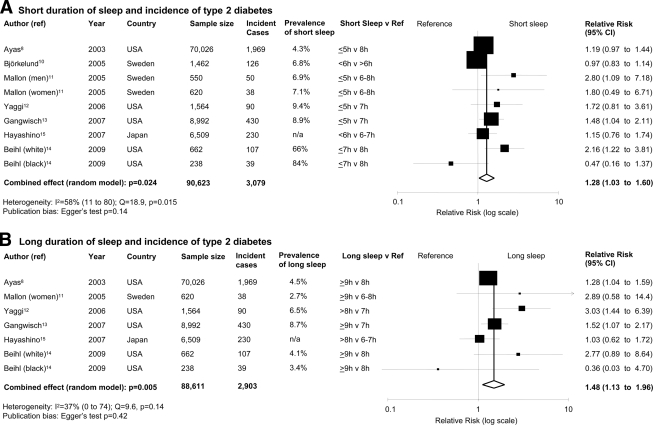
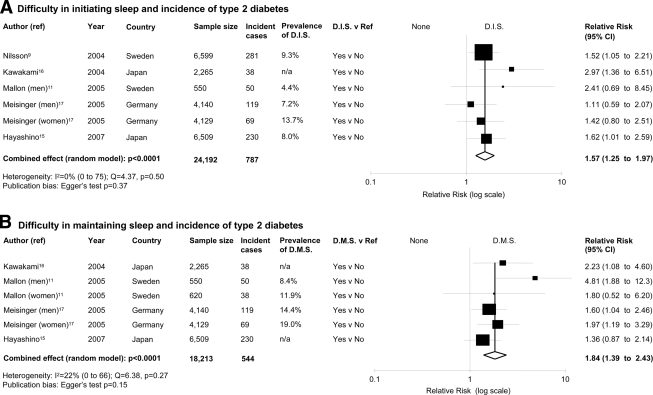
We included 10 studies (13 independent cohort samples; 107,756 male and female participants, follow-up range 4.2-32 years, and 3,586 incident cases of type 2 diabetes). In pooled analyses, quantity and quality of sleep predicted the risk of development of type 2 diabetes. For short duration of sleep (< or =5-6 h/night), the RR was 1.28 (95% CI 1.03-1.60, P = 0.024, heterogeneity P = 0.015); for long duration of sleep (>8-9 h/night), the RR was 1.48 (1.13-1.96, P = 0.005); for difficulty in initiating sleep, the RR was 1.57 (1.25-1.97, P < 0.0001); and for difficulty in maintaining sleep, the RR was 1.84 (1.39-2.43, P < 0.0001).
Quantity and quality of sleep consistently and significantly predict the risk of the development of type 2 diabetes. The mechanisms underlying this relation may differ between short and long sleepers.
评估习惯性睡眠障碍与 2 型糖尿病发病之间的关系,并估算发病风险。
我们系统检索了 MEDLINE(1955 年-2009 年 4 月)、EMBASE 和 Cochrane 图书馆的文献,并进行了无语言限制的手工检索。我们纳入了前瞻性随访时间超过 3 年、基线时评估睡眠障碍、并采用不同的已验证方法定义 2 型糖尿病发病的研究。我们记录了每项研究的多个特征。我们提取了睡眠的数量和质量、评估方法以及采用不同的已验证方法定义的发病病例。我们提取了相对危险度(RR)和 95%置信区间(CI),并用随机效应模型进行了合并。我们进行了敏感性分析,并评估了异质性和发表偏倚。
我们纳入了 10 项研究(13 个独立的队列样本;107756 名男性和女性参与者,随访时间 4.2-32 年,3586 例 2 型糖尿病发病)。在汇总分析中,睡眠的数量和质量均预测了 2 型糖尿病的发病风险。对于较短的睡眠时间(<或=5-6 小时/夜),RR 为 1.28(95%CI 1.03-1.60,P=0.024,异质性 P=0.015);对于较长的睡眠时间(>8-9 小时/夜),RR 为 1.48(1.13-1.96,P=0.005);对于入睡困难,RR 为 1.57(1.25-1.97,P<0.0001);对于睡眠维持困难,RR 为 1.84(1.39-2.43,P<0.0001)。
睡眠的数量和质量一致且显著地预测了 2 型糖尿病的发病风险。在短睡眠者和长睡眠者中,这种关系的潜在机制可能不同。