Department of Molecular Biology, Lewis Thomas Laboratory, Princeton University, Princeton, NJ 08540, USA.
Mol Syst Biol. 2009;5:325. doi: 10.1038/msb.2009.79. Epub 2009 Nov 17.
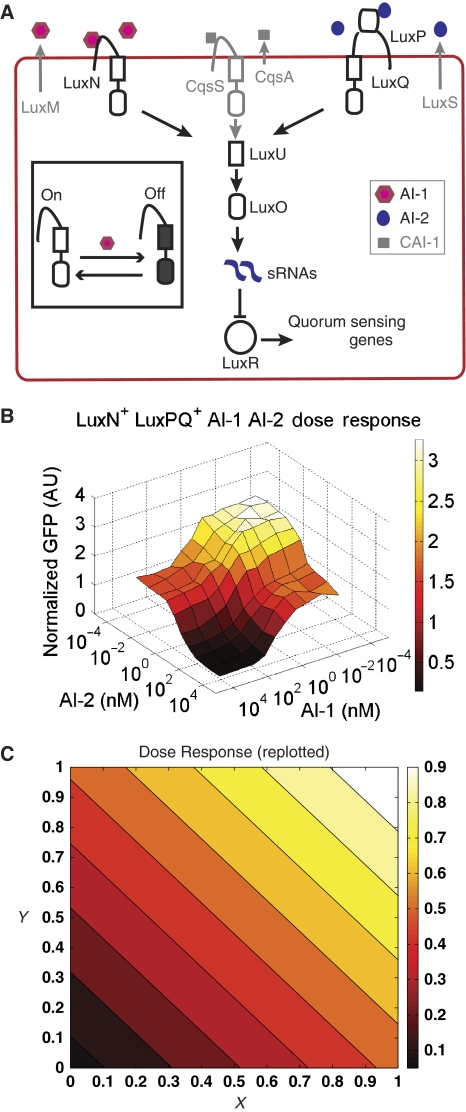
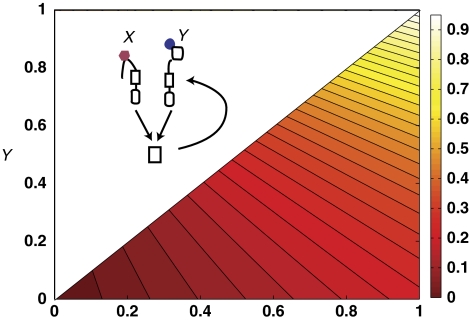
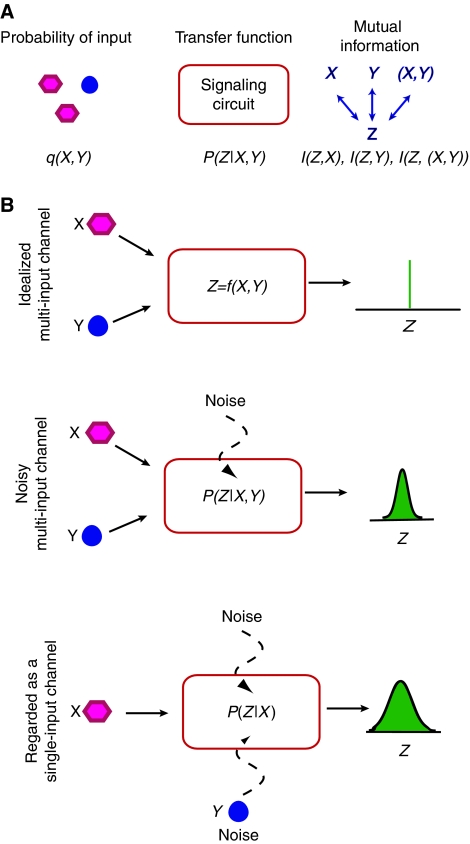
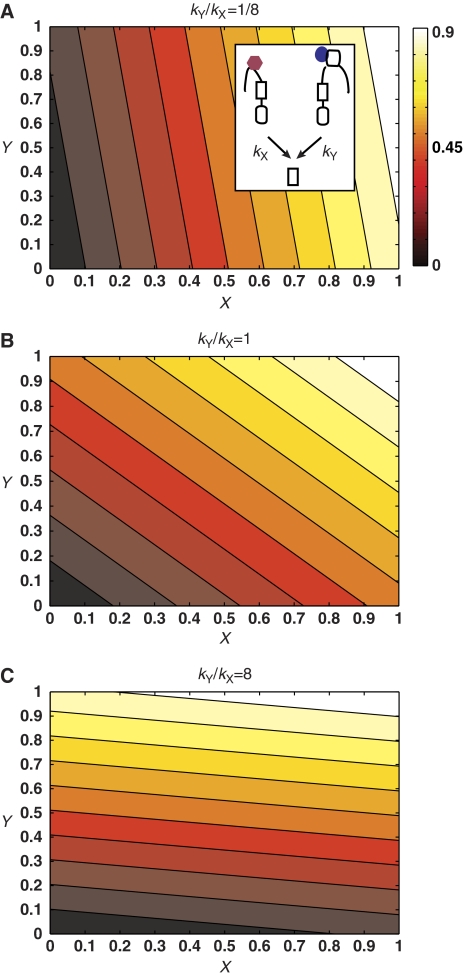
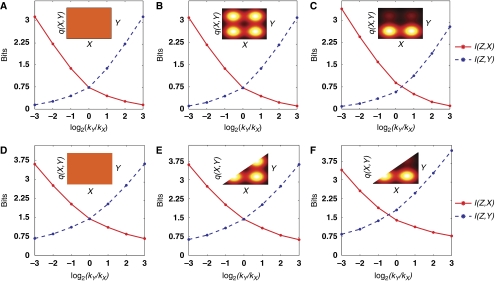
Bacteria communicate using secreted chemical signaling molecules called autoinducers in a process known as quorum sensing. The quorum-sensing network of the marine bacterium Vibrio harveyi uses three autoinducers, each known to encode distinct ecological information. Yet how cells integrate and interpret the information contained within these three autoinducer signals remains a mystery. Here, we develop a new framework for analyzing signal integration on the basis of information theory and use it to analyze quorum sensing in V. harveyi. We quantify how much the cells can learn about individual autoinducers and explain the experimentally observed input-output relation of the V. harveyi quorum-sensing circuit. Our results suggest that the need to limit interference between input signals places strong constraints on the architecture of bacterial signal-integration networks, and that bacteria probably have evolved active strategies for minimizing this interference. Here, we analyze two such strategies: manipulation of autoinducer production and feedback on receptor number ratios.
细菌通过分泌被称为自动诱导物的化学信号分子在称为群体感应的过程中进行通信。海洋细菌哈维氏弧菌的群体感应网络使用三种自动诱导物,每种自动诱导物都被认为编码着不同的生态信息。然而,细胞如何整合和解释这三种自动诱导物信号中包含的信息仍然是一个谜。在这里,我们基于信息论开发了一种新的分析信号整合的框架,并将其应用于哈维氏弧菌的群体感应分析。我们量化了细胞可以从单个自动诱导物中学到多少信息,并解释了哈维氏弧菌群体感应回路的实验观察到的输入-输出关系。我们的结果表明,限制输入信号之间干扰的需要对细菌信号整合网络的结构施加了很强的限制,并且细菌可能已经进化出了主动的策略来最小化这种干扰。在这里,我们分析了两种这样的策略:自动诱导物产生的操纵和受体数量比的反馈。