Manuelidis L
Yale University School of Medicine, New Haven, CT 06510.
Proc Natl Acad Sci U S A. 1991 Feb 1;88(3):1049-53. doi: 10.1073/pnas.88.3.1049.
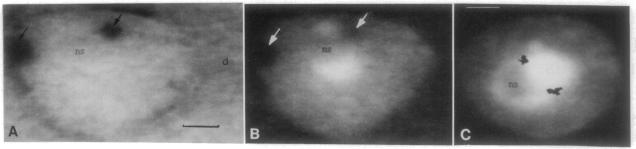
Transgenic mice provide a remarkable experimental setting for the study of nuclear architecture. The three-dimensional localization and fine structure of a foreign DNA within the mouse genome can be conveniently followed by using high-resolution in situ hybridization. Foreign DNAs designed with specific characteristics, such as base bias, sequence motif(s), and size can stably integrate into finite positions on host chromosomes. Thus the relative importance of each of these characteristics in determining the three-dimensional nuclear position and the detailed morphology of the transgene can be evaluated in different cell types. The aim of this study was to evaluate a transgene with sequence characteristics that might contribute to the de novo formation of heterochromatin in interphase nuclei. The structure of a phenotypically silent 11-megabase transgene, containing tandem repeats of beta-globin-pBR sequences integrated into the peritelomeric region of both mouse chromosome 3 homologs, was determined in adult brain cells. Neurons that are largely euchromatic were especially informative in three-dimensional studies of transgene position. The two transgenic loci behaved much like centromeric or paracentromeric A + T-rich satellite DNAs of comparable length from a single chromosome; one or both transgene domains localized together with centromeric satellite DNA on the nucleolus. This is an unusual nuclear position for a telomeric or chromosome arm region that does not contain a substantial amount of constitutively heterochromatic satellite DNA. G + C richness did not prevent these regions from assembling as dense heterochromatic bodies of approximately 1 micron3 in volume. Ultrastructurally, transgenic domains were often intimately connected with constitutive heterochromatin and were highly condensed. Labeled supercoils, formed by a discrete approximately 250-nm-wide fiber, were observed in oblique thin sections through the center of the domain. The structural data were consistent with negligible transcriptional activity detected for this locus, as well as the predicted conformation of constitutive heterochromatin. Interestingly, in transgenic but not control mice, a substantial number of large neurons, including approximately 30% of cerebellar Purkinje cells, showed excessive invaginations of the nuclear membrane.
转基因小鼠为核结构研究提供了一个卓越的实验环境。通过使用高分辨率原位杂交技术,可以方便地追踪外源DNA在小鼠基因组中的三维定位和精细结构。设计具有特定特征(如碱基偏好、序列基序和大小)的外源DNA能够稳定整合到宿主染色体的有限位置。因此,可以在不同细胞类型中评估这些特征中的每一个在确定三维核位置和转基因详细形态方面的相对重要性。本研究的目的是评估一种具有可能有助于在间期核中从头形成异染色质的序列特征的转基因。在成年脑细胞中确定了一个表型沉默的11兆碱基转基因的结构,该转基因包含整合到小鼠3号染色体两个同源染色体的近着丝粒区域的β-珠蛋白-pBR序列的串联重复。在转基因位置的三维研究中,主要为常染色质的神经元特别具有参考价值。这两个转基因位点的行为很像来自单个染色体的长度相当的着丝粒或近着丝粒富含A+T的卫星DNA;一个或两个转基因结构域与着丝粒卫星DNA一起定位在核仁上。对于一个不包含大量组成型异染色质卫星DNA的端粒或染色体臂区域来说,这是一个不寻常的核位置。富含G+C并没有阻止这些区域组装成体积约为1立方微米的致密异染色质体。在超微结构上,转基因结构域常常与组成型异染色质紧密相连且高度浓缩。在通过结构域中心的倾斜薄切片中观察到由离散的约250纳米宽的纤维形成的标记超螺旋。这些结构数据与该位点检测到的可忽略不计的转录活性以及组成型异染色质的预测构象一致。有趣的是,在转基因小鼠而非对照小鼠中,大量大神经元,包括约30%的小脑浦肯野细胞,显示出核膜过度内陷。