Institute for Human Genetics, University of California, San Francisco, 513 Parnassus Ave, San Francisco, CA 94143, USA.
Genome Biol. 2009;10(11):R132. doi: 10.1186/gb-2009-10-11-r132. Epub 2009 Nov 20.
While spouse correlations have been documented for numerous traits, no prior studies have assessed assortative mating for genetic ancestry in admixed populations.
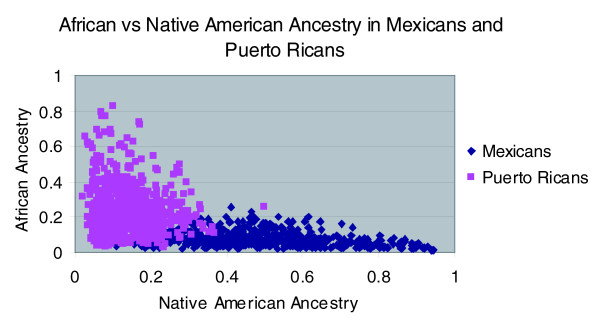
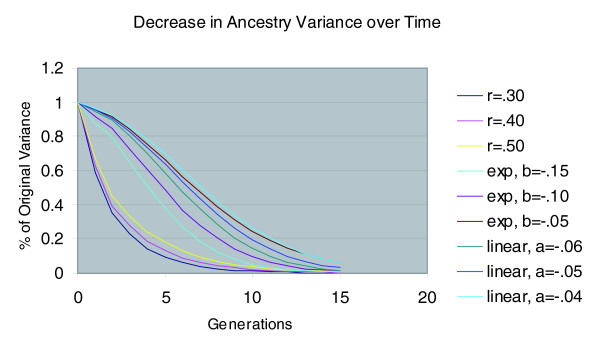
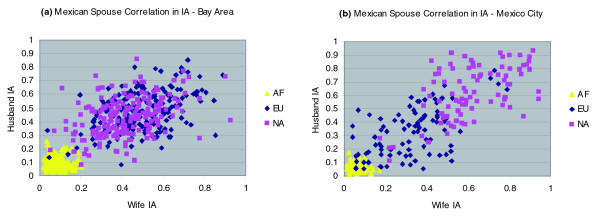
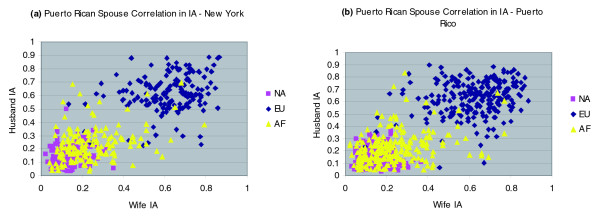
Using 104 ancestry informative markers, we examined spouse correlations in genetic ancestry for Mexican spouse pairs recruited from Mexico City and the San Francisco Bay Area, and Puerto Rican spouse pairs recruited from Puerto Rico and New York City. In the Mexican pairs, we found strong spouse correlations for European and Native American ancestry, but no correlation in African ancestry. In the Puerto Rican pairs, we found significant spouse correlations for African ancestry and European ancestry but not Native American ancestry. Correlations were not attributable to variation in socioeconomic status or geographic heterogeneity. Past evidence of spouse correlation was also seen in the strong evidence of linkage disequilibrium between unlinked markers, which was accounted for in regression analysis by ancestral allele frequency difference at the pair of markers (European versus Native American for Mexicans, European versus African for Puerto Ricans). We also observed an excess of homozygosity at individual markers within the spouses, but this provided weaker evidence, as expected, of spouse correlation. Ancestry variance is predicted to decline in each generation, but less so under assortative mating. We used the current observed variances of ancestry to infer even stronger patterns of spouse ancestry correlation in previous generations.
Assortative mating related to genetic ancestry persists in Latino populations to the current day, and has impacted on the genomic structure in these populations.
虽然配偶相关性已在许多特征中得到证实,但以前的研究尚未评估混合人群中遗传祖先的选择性交配。
我们使用 104 个祖先信息标记,研究了来自墨西哥城和旧金山湾区的墨西哥配偶对以及来自波多黎各和纽约市的波多黎各配偶对的遗传祖先中的配偶相关性。在墨西哥配偶对中,我们发现欧洲和美洲原住民祖先的配偶相关性很强,但非洲祖先没有相关性。在波多黎各配偶对中,我们发现非洲祖先和欧洲祖先的配偶相关性显著,但美洲原住民祖先没有相关性。相关性不是由社会经济地位或地理异质性的变化引起的。过去在连锁不平衡的证据中也可以看到配偶相关性的证据,这在回归分析中通过标记对的祖先等位基因频率差异得到解释(对于墨西哥人,欧洲与美洲原住民;对于波多黎各人,欧洲与非洲人)。我们还观察到配偶之间个体标记的同质性过剩,但这提供了预期的配偶相关性较弱的证据。每个世代的遗传祖先方差预计会下降,但选择性交配的下降幅度较小。我们利用当前观察到的祖先方差来推断过去几代中更强的配偶祖先相关性模式。
与遗传祖先相关的选择性交配在拉丁裔人群中一直持续到今天,并对这些人群的基因组结构产生了影响。