Max Planck Institute for Chemical Ecology, Department of Molecular Ecology, Hans Knöll Str, 8, 07745 Jena, Germany.
Plant Methods. 2009 Nov 25;5:17. doi: 10.1186/1746-4811-5-17.
Aliphatic molecules containing free carboxyl groups are important intermediates in many metabolic and signalling reactions, however, they accumulate to low levels in tissues and are not efficiently ionized by electrospray ionization (ESI) compared to more polar substances. Quantification of aliphatic molecules becomes therefore difficult when small amounts of tissue are available for analysis. Traditional methods for analysis of these molecules require purification or enrichment steps, which are onerous when multiple samples need to be analyzed. In contrast to aliphatic molecules, more polar substances containing free carboxyl groups such as some phytohormones are efficiently ionized by ESI and suitable for analysis by LC-MS/MS. Thus, the development of a method with which aliphatic and polar molecules -which their unmodified forms differ dramatically in their efficiencies of ionization by ESI- can be simultaneously detected with similar sensitivities would substantially simplify the analysis of complex biological matrices.
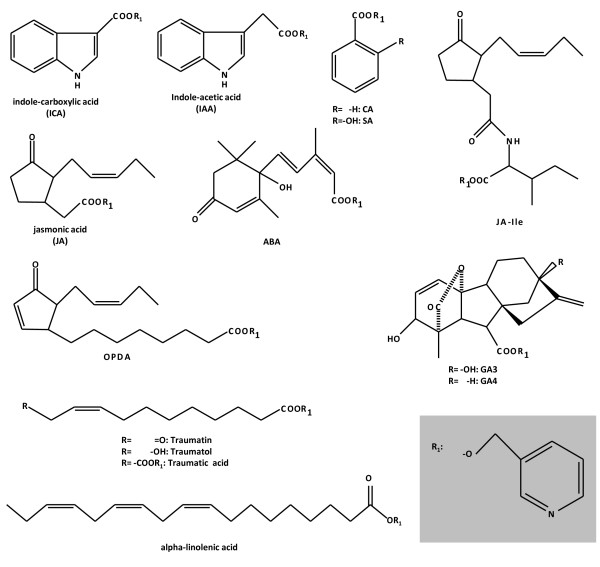
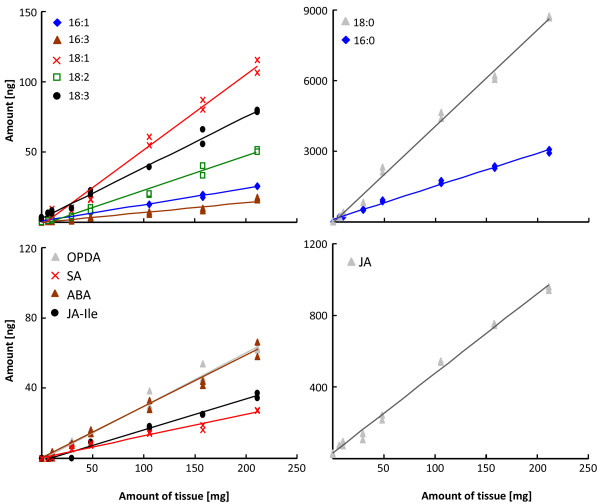
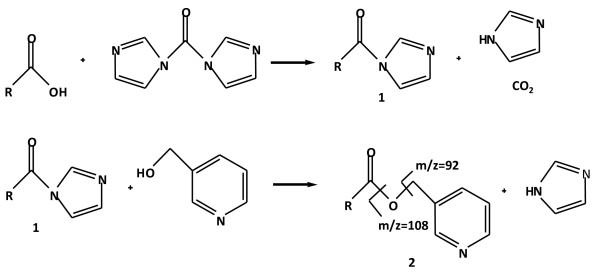
A simple, rapid, specific and sensitive method for the simultaneous detection and quantification of free aliphatic molecules (e.g., free fatty acids (FFA)) and small polar molecules (e.g., jasmonic acid (JA), salicylic acid (SA)) containing free carboxyl groups by direct derivatization of leaf extracts with Picolinyl reagent followed by LC-MS/MS analysis is presented. The presence of the N atom in the esterified pyridine moiety allowed the efficient ionization of 25 compounds tested irrespective of their chemical structure. The method was validated by comparing the results obtained after analysis of Nicotiana attenuata leaf material with previously described analytical methods.
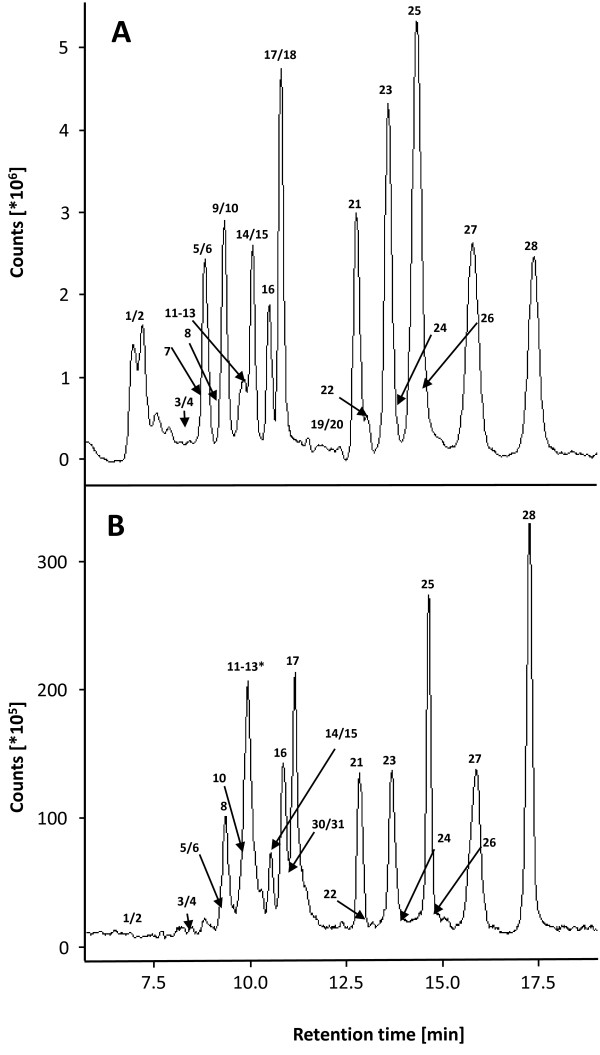
The method presented was used to detect 16 compounds in leaf extracts of N. attenuata plants. Importantly, the method can be adapted based on the specific analytes of interest with the only consideration that the molecules must contain at least one free carboxyl group.
含有游离羧基的脂肪族分子是许多代谢和信号反应中的重要中间体,然而,与更极性的物质相比,它们在组织中积累到低水平,并且通过电喷雾电离(ESI)不易有效离子化。因此,当可用于分析的组织量较少时,脂肪族分子的定量变得困难。分析这些分子的传统方法需要纯化或富集步骤,当需要分析多个样本时,这些步骤非常繁琐。与脂肪族分子相比,含有游离羧基的更极性物质,如一些植物激素,通过 ESI 有效地离子化,适合通过 LC-MS/MS 进行分析。因此,开发一种方法,使非电离形式在 ESI 中电离效率差异巨大的脂肪族和极性分子——同时以类似的灵敏度进行检测,将大大简化复杂生物基质的分析。
提出了一种简单、快速、特异、灵敏的方法,通过 Picolinyl 试剂直接衍生叶片提取物,然后进行 LC-MS/MS 分析,可同时检测和定量含有游离羧基的游离脂肪族分子(如游离脂肪酸(FFA))和小极性分子(如茉莉酸(JA)、水杨酸(SA))。酯化吡啶部分中的 N 原子允许测试的 25 种化合物的有效电离,而与它们的化学结构无关。通过比较分析 Nicotiana attenuata 叶片材料后的结果与以前描述的分析方法,对该方法进行了验证。
该方法用于检测 N. attenuata 植物叶片提取物中的 16 种化合物。重要的是,该方法可以根据特定的分析物进行调整,唯一的考虑因素是分子必须至少含有一个游离羧基。