School of Biological Sciences, Bangor University, Environment Centre Wales, Bangor, UK.
BMC Genomics. 2009 Nov 30;10:564. doi: 10.1186/1471-2164-10-564.
Venom variation occurs at all taxonomical levels and can impact significantly upon the clinical manifestations and efficacy of antivenom therapy following snakebite. Variation in snake venom composition is thought to be subject to strong natural selection as a result of adaptation towards specific diets. Members of the medically important genus Echis exhibit considerable variation in venom composition, which has been demonstrated to co-evolve with evolutionary shifts in diet. We adopt a venom gland transcriptome approach in order to investigate the diversity of toxins in the genus and elucidate the mechanisms which result in prey-specific adaptations of venom composition.
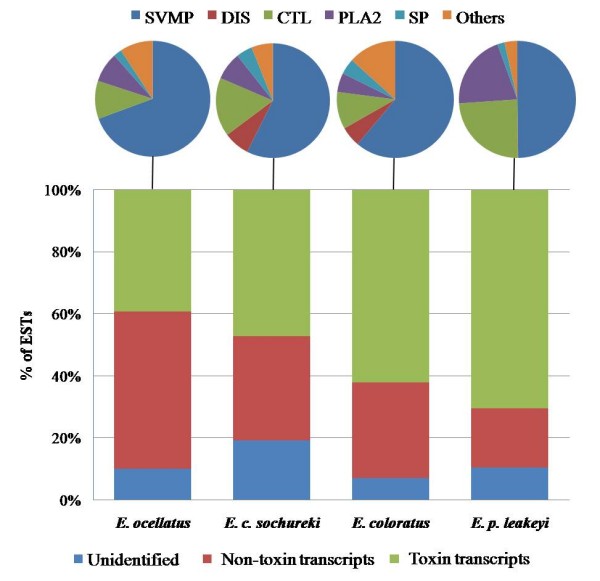
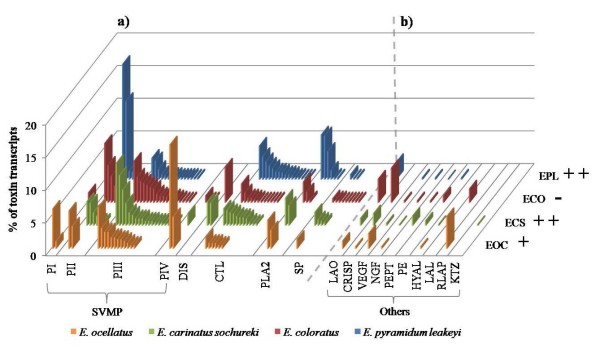
Venom gland transcriptomes were created for E. pyramidum leakeyi, E. coloratus and E. carinatus sochureki by sequencing approximately 1000 expressed sequence tags from venom gland cDNA libraries. A standardised methodology allowed a comprehensive intra-genus comparison of the venom gland profiles to be undertaken, including the previously described E. ocellatus transcriptome. Blast annotation revealed the presence of snake venom metalloproteinases, C-type lectins, group II phopholipases A2, serine proteases, L-amino oxidases and growth factors in all transcriptomes throughout the genus. Transcripts encoding disintegrins, cysteine-rich secretory proteins and hyaluronidases were obtained from at least one, but not all, species. A representative group of novel venom transcripts exhibiting similarity to lysosomal acid lipase were identified from the E. coloratus transcriptome, whilst novel metallopeptidases exhibiting similarity to neprilysin and dipeptidyl peptidase III were identified from E. p. leakeyi and E. coloratus respectively.
The comparison of Echis venom gland transcriptomes revealed substantial intrageneric venom variation in representations and cluster numbers of the most abundant venom toxin families. The expression profiles of established toxin groups exhibit little obvious association with venom-related adaptations to diet described from this genus. We suggest therefore that alterations in isoform diversity or transcript expression levels within the major venom protein families are likely to be responsible for prey specificity, rather than differences in the representation of entire toxin families or the recruitment of novel toxin families, although the recruitment of lysosomal acid lipase as a response to vertebrate feeding cannot be excluded. Evidence of marked intrageneric venom variation within the medically important genus Echis strongly advocates further investigations into the medical significance of venom variation in this genus and its impact upon antivenom therapy.
毒液在所有分类学水平上都存在变异,这可能会显著影响蛇咬伤后抗蛇毒血清治疗的临床表现和疗效。毒液成分的变异被认为是由于对特定饮食的适应而受到强烈的自然选择。在医学上重要的 Echis 属中,成员的毒液成分存在相当大的变异,这已经被证明与饮食进化的变化共同进化。我们采用毒液腺转录组学方法来研究该属毒素的多样性,并阐明导致毒液成分针对特定猎物的适应性的机制。
通过从毒液腺 cDNA 文库中测序约 1000 个表达序列标签,为 E. pyramidum leakeyi、E. coloratus 和 E. carinatus sochureki 创建了毒液腺转录组。一种标准化的方法允许对毒液腺图谱进行全面的属内比较,包括先前描述的 E. ocellatus 转录组。Blast 注释显示,所有属的转录组中都存在蛇毒金属蛋白酶、C 型凝集素、II 组磷脂酶 A2、丝氨酸蛋白酶、L-氨基酸氧化酶和生长因子。从至少一种,但不是所有物种中获得了编码分裂素、富含半胱氨酸的分泌蛋白和透明质酸酶的转录本。从 E. coloratus 转录组中鉴定出一组具有相似性的代表性新型毒液转录本,这些转录本与溶酶体酸性脂肪酶具有相似性,而从 E. p. leakeyi 和 E. coloratus 中分别鉴定出具有相似性的新型金属肽酶,与 Neprilysin 和二肽基肽酶 III 具有相似性。
Echis 毒液腺转录组的比较显示,在最丰富的毒液毒素家族的代表和聚类数量方面存在着显著的属内毒液变异。已建立的毒素组的表达谱与从该属描述的与饮食相关的毒液适应几乎没有明显的关联。因此,我们认为,主要毒液蛋白家族的同工型多样性或转录表达水平的改变可能是导致猎物特异性的原因,而不是整个毒素家族的代表或新毒素家族的招募,尽管不能排除溶酶体酸性脂肪酶作为对脊椎动物进食的反应而被招募。在医学上重要的 Echis 属内存在明显的属内毒液变异的证据强烈支持进一步研究该属毒液变异的医学意义及其对抗蛇毒血清治疗的影响。