Eick Stefan, Wallys Jens, Hofmann Boris, van Ooyen André, Schnakenberg Uwe, Ingebrandt Sven, Offenhäusser Andreas
Institute of Bio- and Nanosystems, Institute 2: Bioelectronics, Forschungszentrum Jülich GmbH Jülich, Germany.
Front Neuroeng. 2009 Nov 16;2:16. doi: 10.3389/neuro.16.016.2009. eCollection 2009.
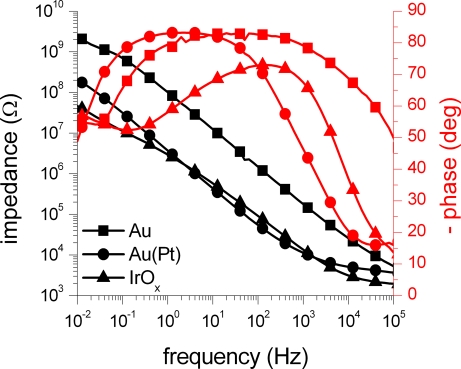
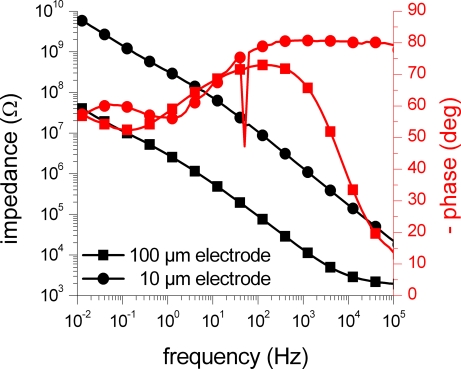
We present the first in vitro extracellular stimulation of individual neurons from dissociated cultures with iridium oxide (IrO(x)) electrodes. Microelectrode arrays with sputtered IrO(x) films (SIROF) were developed for electrophysiological investigations with electrogenic cells. The microelectrodes were characterized with scanning electron and atomic force microscopy, revealing rough and porous electrodes with enlarged surface areas. As shown by cyclic voltammetry and electrochemical impedance spectroscopy, the large surface area in combination with the good electrochemical properties of SIROF resulted in high charge storage capacity and low electrode impedance. Thus, we could transfer the good properties of IrO(x) as material for in vivo stimulation electrodes to multi-electrode arrays with electrode diameters as small as 10 mum for in vitro applications. Single rat cortical neurons from dissociated cultures were successfully stimulated to fire action potentials using single or trains of biphasic rectangular voltage-controlled stimulation pulses. The stimulated cell's membrane potential was simultaneously monitored using whole-cell current-clamp recordings. This experimental configuration allowed direct evaluation of the influence of pulse phase sequence, amplitude, and number on the stimulation success ratio and action potential latency. Negative phase first pulses were more effective for extracellular stimulation and caused reduced latency in comparison to positive phase first pulses. Increasing the pulse amplitude also improved stimulation reliability. However, in order to prevent cell or electrode damage, the pulse amplitude is limited to voltages below the threshold for irreversible electrochemical reactions at the electrode. As an alternative to increasing the amplitude, a higher number of stimulation pulses was also shown to increase stimulation success.
我们展示了首次使用氧化铱(IrO(x))电极对解离培养的单个神经元进行体外细胞外刺激。开发了带有溅射氧化铱薄膜(SIROF)的微电极阵列,用于对电活性细胞进行电生理研究。通过扫描电子显微镜和原子力显微镜对微电极进行了表征,结果显示电极表面粗糙且多孔,表面积增大。循环伏安法和电化学阻抗谱表明,SIROF的大表面积与良好的电化学性能相结合,导致了高电荷存储容量和低电极阻抗。因此,我们能够将IrO(x)作为体内刺激电极材料的良好性能转移到电极直径小至10μm的多电极阵列上,用于体外应用。使用单相或双相矩形电压控制刺激脉冲串成功刺激了解离培养的单个大鼠皮层神经元产生动作电位。使用全细胞电流钳记录同时监测受刺激细胞的膜电位。这种实验配置允许直接评估脉冲相位序列、幅度和数量对刺激成功率和动作电位潜伏期的影响。与正相先于负相的脉冲相比,负相先于正相的脉冲对细胞外刺激更有效,且潜伏期缩短。增加脉冲幅度也提高了刺激可靠性。然而,为了防止细胞或电极受损,脉冲幅度限制在低于电极不可逆电化学反应阈值的电压范围内。作为增加幅度的替代方法,较高数量的刺激脉冲也显示出能提高刺激成功率。