Zoologisches Forschungsmuseum Alexander Koenig, Adenauerallee 160, 53113 Bonn, Germany.
Front Zool. 2009 Dec 1;6:28. doi: 10.1186/1742-9994-6-28.
Among metazoans, retention of functional diet-derived chloroplasts (kleptoplasty) is known only from the sea slug taxon Sacoglossa (Gastropoda: Opisthobranchia). Intracellular maintenance of plastids in the slug's digestive epithelium has long attracted interest given its implications for understanding the evolution of endosymbiosis. However, photosynthetic ability varies widely among sacoglossans; some species have no plastid retention while others survive for months solely on photosynthesis. We present a molecular phylogenetic hypothesis for the Sacoglossa and a survey of kleptoplasty from representatives of all major clades. We sought to quantify variation in photosynthetic ability among lineages, identify phylogenetic origins of plastid retention, and assess whether kleptoplasty was a key character in the radiation of the Sacoglossa.
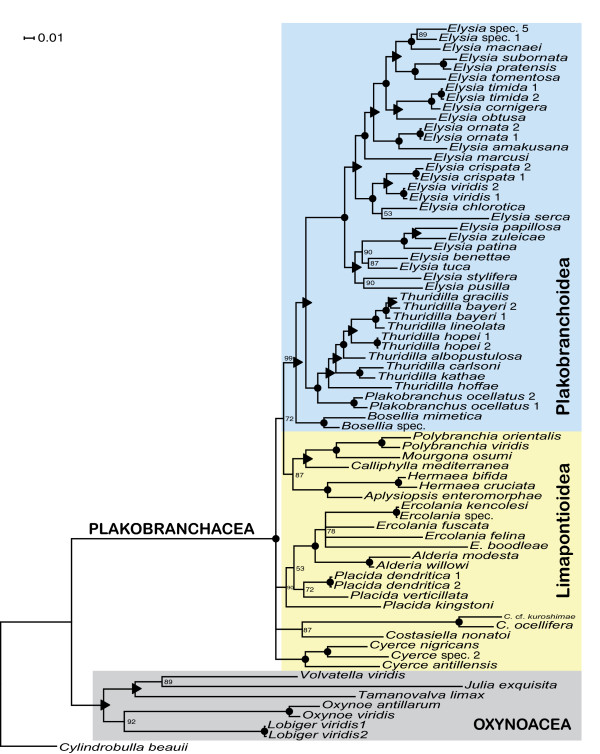
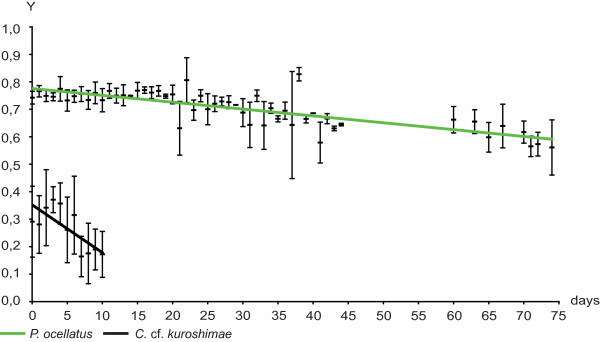
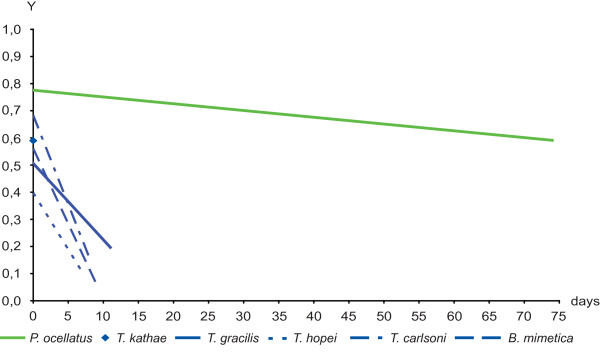
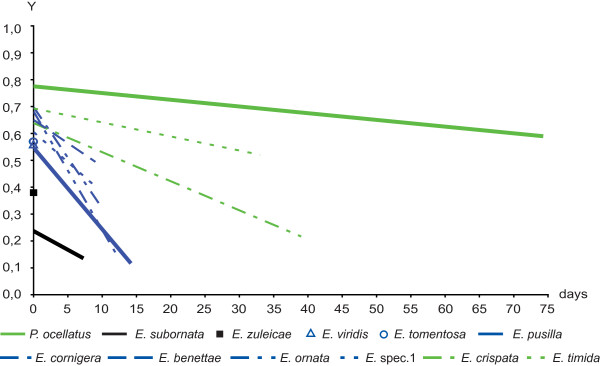
Three levels of photosynthetic activity were detected: (1) no functional retention; (2) short-term retention lasting about one week; and (3) long-term retention for over a month. Phylogenetic analysis of one nuclear and two mitochondrial loci revealed reciprocal monophyly of the shelled Oxynoacea and shell-less Plakobranchacea, the latter comprising a monophyletic Plakobranchoidea and paraphyletic Limapontioidea. Only species in the Plakobranchoidea expressed short- or long-term kleptoplasty, most belonging to a speciose clade of slugs bearing parapodia (lateral flaps covering the dorsum). Bayesian ancestral character state reconstructions indicated that functional short-term retention arose once in the last common ancestor of Plakobranchoidea, and independently evolved into long-term retention in four derived species.
We propose a sequential progression from short- to long-term kleptoplasty, with different adaptations involved in each step. Short-term kleptoplasty likely arose as a deficiency in plastid digestion, yielding additional energy via the release of fixed carbon. Functional short-term retention was an apomorphy of the Plakobranchoidea, but the subsequent evolution of parapodia enabled slugs to protect kleptoplasts against high irradiance and further prolong plastid survival. We conclude that functional short-term retention was necessary but not sufficient for an adaptive radiation in the Plakobranchoidea, especially in the genus Elysia which comprises a third of all sacoglossan species. The adaptations necessary for long-term chloroplast survival arose independently in species feeding on different algal hosts, providing a valuable study system for examining the parallel evolution of this unique trophic strategy.
在后生动物中,已知只有食源性叶绿体(偷取光合作用)保留在海蛞蝓分类群 Sacoglossa(腹足纲:后鳃类)中。由于其对共生进化的理解具有重要意义,因此,在蛞蝓消化上皮细胞中维持质体一直引起人们的兴趣。然而, Sacoglossans 中的光合作用能力差异很大;有些物种没有质体保留,而有些物种仅靠光合作用就能存活数月。我们提出了 Sacoglossa 的分子系统发育假说,并对所有主要进化枝的代表进行了偷取光合作用的调查。我们试图量化谱系之间光合作用能力的变化,确定质体保留的系统发生起源,并评估偷取光合作用是否是 Sacoglossa 辐射的关键特征。
检测到三种光合作用活性水平:(1)无功能保留;(2)持续约一周的短期保留;(3)超过一个月的长期保留。一个核和两个线粒体基因座的系统发育分析显示,有壳的 Oxynoacea 和无壳的 Plakobranchacea 是相互单系的,后者包括单系的 Plakobranchoidea 和并系的 Limapontioidea。只有 Plakobranchoidea 中的物种表达短期或长期的偷取光合作用,其中大多数属于具有侧足(覆盖背部的侧瓣)的多态性蛞蝓的一个多样化属。贝叶斯祖先特征状态重建表明,功能上的短期保留在 Plakobranchoidea 的最后共同祖先中仅发生过一次,并在四个衍生物种中独立进化为长期保留。
我们提出了从短期到长期偷取光合作用的连续进展,每个步骤都涉及不同的适应。短期偷取光合作用可能是由于质体消化不足而产生的,通过释放固定碳来提供额外的能量。功能上的短期保留是 Plakobranchoidea 的一个新特征,但随后侧足的进化使蛞蝓能够保护偷取的质体免受高光强的影响,并进一步延长质体的存活时间。我们得出的结论是,功能上的短期保留对于 Plakobranchoidea 的适应性辐射是必要的,但不是充分的,特别是在包含三分之一 Sacoglossan 物种的 Elysia 属中。长期叶绿体存活所需的适应是在以不同藻类为食的物种中独立进化的,为研究这种独特的营养策略的平行进化提供了一个有价值的研究系统。