Division of Medicine, Department of Paediatrics, Imperial College London, London, United Kingdom.
PLoS One. 2009 Nov 30;4(11):e8068. doi: 10.1371/journal.pone.0008068.
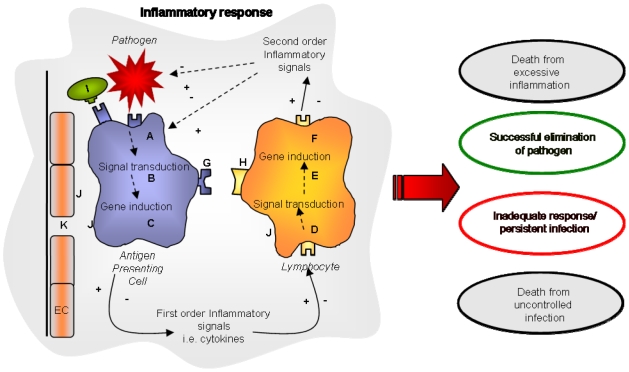
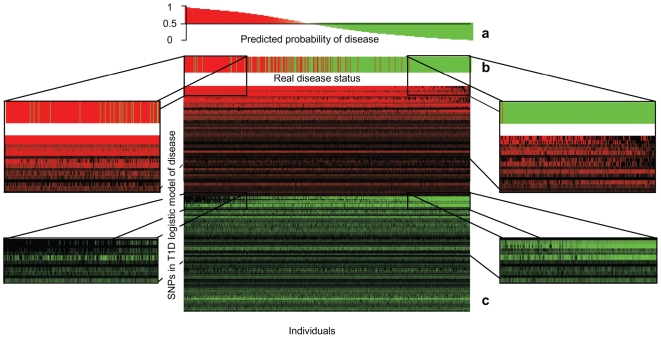
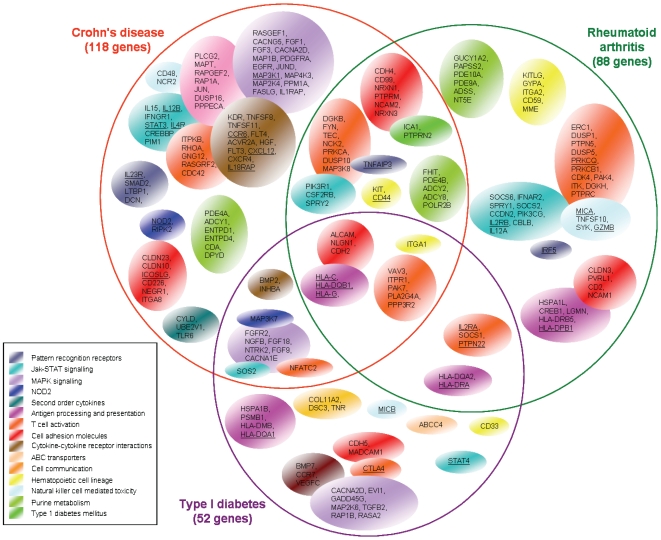
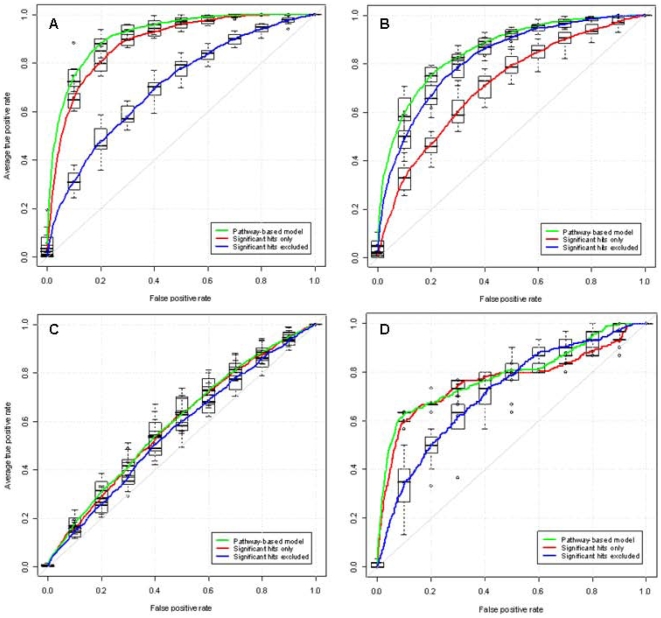
Although the introduction of genome-wide association studies (GWAS) have greatly increased the number of genes associated with common diseases, only a small proportion of the predicted genetic contribution has so far been elucidated. Studying the cumulative variation of polymorphisms in multiple genes acting in functional pathways may provide a complementary approach to the more common single SNP association approach in understanding genetic determinants of common disease. We developed a novel pathway-based method to assess the combined contribution of multiple genetic variants acting within canonical biological pathways and applied it to data from 14,000 UK individuals with 7 common diseases. We tested inflammatory pathways for association with Crohn's disease (CD), rheumatoid arthritis (RA) and type 1 diabetes (T1D) with 4 non-inflammatory diseases as controls. Using a variable selection algorithm, we identified variants responsible for the pathway association and evaluated their use for disease prediction using a 10 fold cross-validation framework in order to calculate out-of-sample area under the Receiver Operating Curve (AUC). The generalisability of these predictive models was tested on an independent birth cohort from Northern Finland. Multiple canonical inflammatory pathways showed highly significant associations (p 10(-3)-10(-20)) with CD, T1D and RA. Variable selection identified on average a set of 205 SNPs (149 genes) for T1D, 350 SNPs (189 genes) for RA and 493 SNPs (277 genes) for CD. The pattern of polymorphisms at these SNPS were found to be highly predictive of T1D (91% AUC) and RA (85% AUC), and weakly predictive of CD (60% AUC). The predictive ability of the T1D model (without any parameter refitting) had good predictive ability (79% AUC) in the Finnish cohort. Our analysis suggests that genetic contribution to common inflammatory diseases operates through multiple genes interacting in functional pathways.
尽管全基因组关联研究(GWAS)的引入大大增加了与常见疾病相关的基因数量,但到目前为止,只有一小部分预测的遗传贡献得到了阐明。研究多个基因在功能途径中多态性的累积变化可能为理解常见疾病的遗传决定因素提供一种补充方法,这种方法比更常见的单个 SNP 关联方法更为常见。我们开发了一种新的基于途径的方法来评估在经典生物学途径中起作用的多个遗传变异的组合贡献,并将其应用于来自 14000 名英国个体的 7 种常见疾病的数据。我们用 4 种非炎症性疾病作为对照,对炎症途径进行了与克罗恩病(CD)、类风湿关节炎(RA)和 1 型糖尿病(T1D)相关的关联测试。我们使用变量选择算法,确定了导致通路关联的变体,并在 10 倍交叉验证框架中评估了它们在疾病预测中的应用,以计算出样本外接收者操作特征曲线(AUC)下的面积。这些预测模型的通用性在来自芬兰北部的一个独立出生队列中进行了测试。多个经典的炎症途径与 CD、T1D 和 RA 具有高度显著的相关性(p 10(-3)-10(-20))。变量选择平均确定了一组用于 T1D 的 205 个 SNP(149 个基因)、用于 RA 的 350 个 SNP(189 个基因)和用于 CD 的 493 个 SNP(277 个基因)。这些 SNP 上的多态性模式被发现对 T1D(91% AUC)和 RA(85% AUC)具有高度预测性,对 CD(60% AUC)具有弱预测性。在芬兰队列中,无需任何参数重新拟合,T1D 模型的预测能力(79% AUC)具有良好的预测能力。我们的分析表明,常见炎症性疾病的遗传贡献是通过多个基因在功能途径中相互作用来实现的。