Department of Epidemiology and Public Health, Yale University School of Medicine, New Haven, CT, USA.
Harm Reduct J. 2009 Dec 15;6:36. doi: 10.1186/1477-7517-6-36.
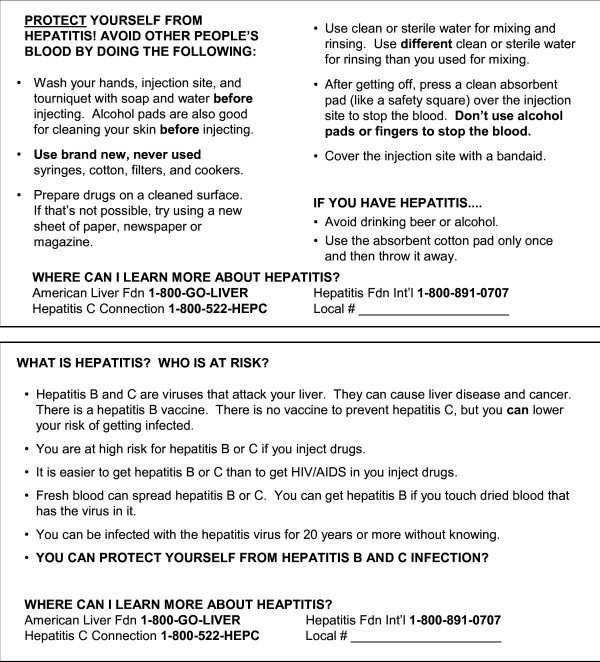
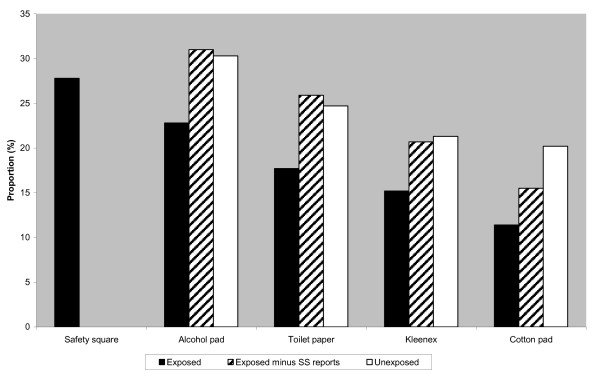
To redress gaps in injection drug users' (IDUs) knowledge about hepatitis risk and prevention, we developed a brief intervention to be delivered to IDUs at syringe exchange programs (SEPs) in three US cities. Following a month-long campaign in which intervention packets containing novel injection hygiene supplies and written materials were distributed to every client at each visit, intervention effectiveness was evaluated by comparing exposed and unexposed participants' self-reported injection practices. Over one-quarter of the exposed group began using the novel hygiene supplies which included an absorbent pad ("Safety Square") to stanch blood flow post-injection. Compared to those unexposed to the intervention, a smaller but still substantial number of exposed participants continued to inappropriately use alcohol pads post-injection despite exposure to written messages to the contrary (22.8% vs. 30.0%). It should also be noted that for those exposed to the intervention, 8% may have misused Safety Squares as part of pre-injection preparation of their injection site; attention should be paid to providing explicit and accurate instruction on the use of any health promotion materials being distributed. While this study indicates that passive introduction of risk reduction materials in injection drug users through syringe exchange programs can be an economical and relatively simple method of changing behaviors, discussions with SEP clients regarding explicit instructions about injection hygiene and appropriate use of novel risk reduction materials is also needed in order to optimize the potential for adoption of health promotion behaviors. The study results suggest that SEP staff should provide their clients with brief, frequent verbal reminders about the appropriate use when distributing risk reduction materials. Issues related to format and language of written materials are discussed.
为了弥补注射吸毒者(IDUs)在肝炎风险和预防方面知识的不足,我们开发了一种简短的干预措施,将在三个美国城市的注射器交换计划(SEP)中提供给 IDUs。在为期一个月的活动中,每个访问者都分发了装有新型注射卫生用品和书面材料的干预包,通过比较暴露组和非暴露组参与者自我报告的注射行为来评估干预效果。超过四分之一的暴露组开始使用新型卫生用品,包括在注射后止血的吸收垫(“安全方块”)。与未接触干预的人相比,接触干预的人中仍有相当数量的人继续不恰当地使用酒精垫,尽管接触了相反的书面信息(22.8%对 30.0%)。还应该注意的是,对于接触干预的人,8%的人可能错误地将安全方块用作注射部位注射前准备的一部分;应该注意提供关于分发的任何健康促进材料的使用的明确和准确的说明。虽然这项研究表明,通过注射器交换计划被动地向注射吸毒者介绍减少风险的材料可以是一种经济且相对简单的改变行为的方法,但还需要与 SEP 客户讨论关于注射卫生和适当使用新型减少风险材料的明确说明,以优化采用健康促进行为的潜力。研究结果表明,SEP 工作人员在分发减少风险的材料时,应在提供简短、频繁的口头提醒时告知客户正确使用的方法。还讨论了书面材料的格式和语言问题。