Government Office for Science, Kingsgate House, London, UK.
Philos Trans R Soc Lond B Biol Sci. 2010 Jan 12;365(1537):61-71. doi: 10.1098/rstb.2009.0201.
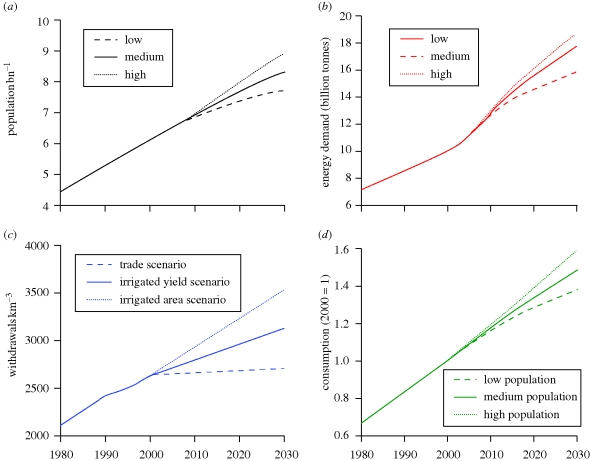
There is an intrinsic link between the challenge we face to ensure food security through the twenty-first century and other global issues, most notably climate change, population growth and the need to sustainably manage the world's rapidly growing demand for energy and water. Our progress in reducing global poverty and achieving the Millennium Development Goals will be determined to a great extent by how coherently these long-term challenges are tackled. A key question is whether we can feed a future nine billion people equitably, healthily and sustainably. Science and technology can make a major contribution, by providing practical solutions. Securing this contribution requires that high priority be attached both to research and to facilitating the real world deployment of existing and emergent technologies. Put simply, we need a new, 'greener revolution'. Important areas for focus include: crop improvement; smarter use of water and fertilizers; new pesticides and their effective management to avoid resistance problems; introduction of novel non-chemical approaches to crop protection; reduction of post-harvest losses; and more sustainable livestock and marine production. Techniques and technologies from many disciplines, ranging from biotechnology and engineering to newer fields such as nanotechnology, will be needed.
在确保 21 世纪粮食安全方面,我们面临着挑战,这与其他全球性问题存在内在联系,特别是气候变化、人口增长以及需要可持续地满足世界对能源和水日益增长的需求。我们在减少全球贫困和实现千年发展目标方面的进展在很大程度上将取决于如何协调应对这些长期挑战。一个关键问题是,我们能否公平、健康和可持续地养活未来 90 亿人口。科学技术可以通过提供切实可行的解决方案做出重大贡献。要确保这一贡献,就必须高度重视研究和促进现有技术和新兴技术的实际应用。简而言之,我们需要一场新的“绿色革命”。重点关注的重要领域包括:作物改良;更智能地利用水和肥料;新型农药及其有效管理以避免产生抗药性问题;引入新型非化学方法进行作物保护;减少收获后损失;以及更可持续的畜牧业和海洋生产。从生物技术和工程到纳米技术等新兴领域,许多学科的技术和技术都将是必要的。