Laboratório de Biologia Evolutiva e Conservação (LABEC), Instituto de Biociências - USP, Cidade Universitária, São Paulo - SP, CEP 05508-900, Brazil.
BMC Evol Biol. 2009 Dec 20;9:294. doi: 10.1186/1471-2148-9-294.
The common vampire bat Desmodus rotundus is an excellent model organism for studying ecological vicariance in the Neotropics due to its broad geographic range and its preference for forested areas as roosting sites. With the objective of testing for Pleistocene ecological vicariance, we sequenced a mitocondrial DNA (mtDNA) marker and two nuclear markers (RAG2 and DRB) to try to understand how Pleistocene glaciations affected the distribution of intraspecific lineages in this bat.
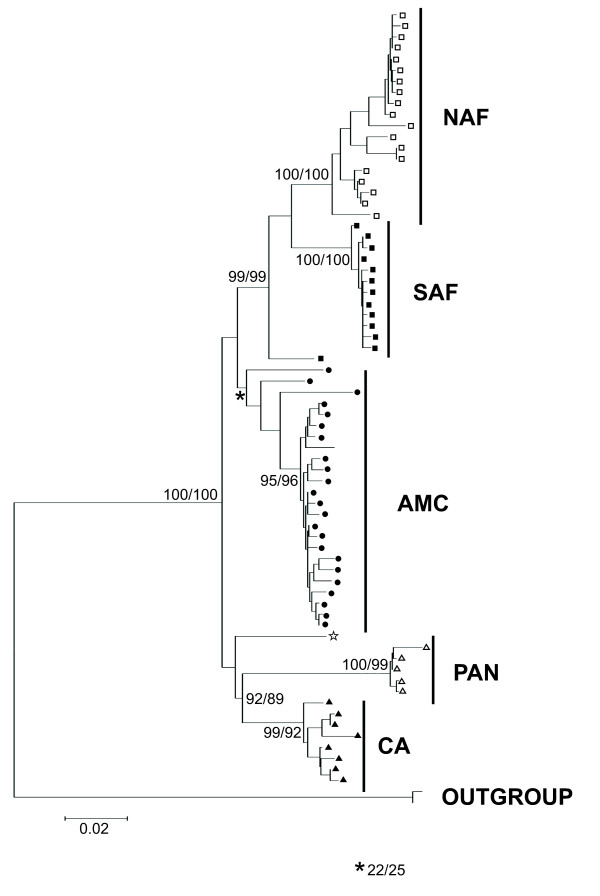
Five reciprocally monophyletic clades were evident in the mitochondrial gene tree, and in most cases with high bootstrap support: Central America (CA), Amazon and Cerrado (AMC), Pantanal (PAN), Northern Atlantic Forest (NAF) and Southern Atlantic Forest (SAF). The Atlantic forest clades formed a monophyletic clade with high bootstrap support, creating an east/west division for this species in South America. On the one hand, all coalescent and non-coalescent estimates point to a Pleistocene time of divergence between the clades. On the other hand, the nuclear markers showed extensive sharing of haplotypes between distant localities, a result compatible with male-biased gene flow. In order to test if the disparity between the mitochondrial and nuclear markers was due to the difference in mutation rate and effective size, we performed a coalescent simulation to examine the feasibility that, given the time of separation between the observed lineages, even with a gene flow rate close to zero, there would not be reciprocal monophyly for a neutral nuclear marker. We used the observed values of theta and an estimated mutation rate for the nuclear marker gene to perform 1000 iterations of the simulation. The results of this simulation were inconclusive: the number of iterations with and without reciprocal monophyly of one or more clades are similar.
We therefore conclude that the pattern exhibited by the common vampire bat, with marked geographical structure for a mitochondrial marker and no phylogeographic structure for nuclear markers is compatible with a historical scenario of complete isolation of refuge-like populations during the Pleistocene. The results on demographic history on this species is compatible with the Carnaval-Moritz model of Pleistocene vicariance, with demographic expansions in the southern Atlantic forest.
普通吸血蝙蝠(Desmodus rotundus)因其广泛的地理分布范围和对森林栖息地的偏好,成为研究新热带地区生态地理分化的理想模式生物。为了检验更新世生态地理分化,我们对线粒体 DNA(mtDNA)标记和两个核标记(RAG2 和 DRB)进行了测序,试图了解更新世冰川作用如何影响这种蝙蝠的种内谱系分布。
在线粒体基因树上,有五个互为单系的支系明显存在,大多数情况下具有较高的 bootstrap 支持:中美洲(CA)、亚马逊和塞拉多(AMC)、潘塔纳尔(PAN)、北大西洋森林(NAF)和南大西洋森林(SAF)。大西洋森林支系形成了一个具有高 bootstrap 支持的单系支系,在南美洲形成了东西向的划分。一方面,所有的合并和非合并估计都指向这些支系在更新世的分化时间。另一方面,核标记显示出遥远地点之间广泛的单倍型共享,这一结果与雄性偏倚的基因流相兼容。为了检验线粒体和核标记之间的差异是否是由于突变率和有效大小的差异造成的,我们进行了合并模拟,以检验在观察到的支系之间的分离时间的情况下,即使基因流率接近零,一个中性核标记也不会出现相互单系的可能性。我们使用观察到的 theta 值和核标记基因估计的突变率进行了 1000 次模拟迭代。模拟的结果不确定:具有或不具有一个或多个支系的相互单系的迭代次数相似。
因此,我们得出的结论是,普通吸血蝙蝠的模式是线粒体标记具有明显的地理结构,而核标记没有地理结构,这与更新世避难所种群完全隔离的历史情景是一致的。对该物种的种群历史的研究结果与更新世地理分化的狂欢-莫里茨模型一致,即南大西洋森林的种群扩张。