Stempin Cinthia C, Dulgerian Laura R, Garrido Vanina V, Cerban Fabio M
Inmunología, CIBICI-CONICET, Departamento de Bioquímica Clínica, Facultad de Ciencias Químicas, Universidad Nacional de Córdoba, 5000 Córdoba, Argentina.
J Biomed Biotechnol. 2010;2010:683485. doi: 10.1155/2010/683485. Epub 2009 Dec 9.
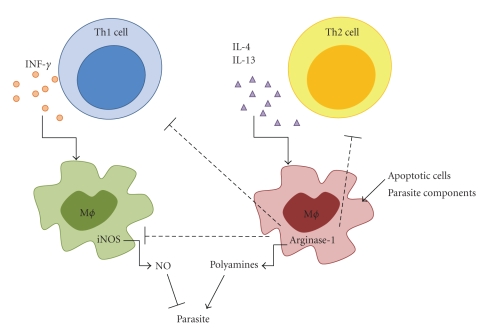
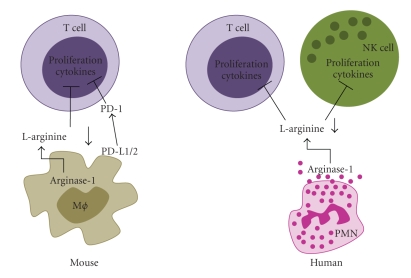
A type 1 cytokine-dependent proinflammatory response inducing classically activated macrophages (CaMvarphis) is crucial for parasite control during protozoan infections but can also contribute to the development of immunopathological disease symptoms. Type 2 cytokines such as IL-4 and IL-13 antagonize CaMvarphis inducing alternatively activated macrophages (AaMvarphis) that upregulate arginase-1 expression. During several infections, induction of arginase-1-macrophages was showed to have a detrimental role by limiting CaMvarphi-dependent parasite clearance and promoting parasite proliferation. Additionally, the role of arginase-1 in T cell suppression has been explored recently. Arginase-1 can also be induced by IL-10 and transforming growth factor-beta (TGF-beta) or even directly by parasites or parasite components. Therefore, generation of alternative activation states of macrophages could limit collateral tissue damage because of excessive type 1 inflammation. However, they affect disease outcome by promoting parasite survival and proliferation. Thus, modulation of macrophage activation may be instrumental in allowing parasite persistence and long-term host survival.
1型细胞因子依赖性促炎反应诱导经典活化巨噬细胞(CaMvarphis)对于原生动物感染期间的寄生虫控制至关重要,但也可能导致免疫病理疾病症状的发展。2型细胞因子如IL-4和IL-13拮抗CaMvarphis,诱导上调精氨酸酶-1表达的替代性活化巨噬细胞(AaMvarphis)。在几种感染过程中,精氨酸酶-1巨噬细胞的诱导通过限制CaMvarphi依赖性寄生虫清除和促进寄生虫增殖而显示出有害作用。此外,精氨酸酶-1在T细胞抑制中的作用最近也得到了探索。精氨酸酶-1也可由IL-10和转化生长因子-β(TGF-β)诱导,甚至直接由寄生虫或寄生虫成分诱导。因此,巨噬细胞替代激活状态的产生可能会限制由于过度的1型炎症引起的附带组织损伤。然而,它们通过促进寄生虫存活和增殖来影响疾病结局。因此,调节巨噬细胞活化可能有助于寄生虫持续存在和宿主长期存活。