Division of Medical Microbiology, University of Liverpool, Daulby St, Liverpool L69 3GA, UK.
Emerg Infect Dis. 2010 Jan;16(1):55-62. doi: 10.3201/eid1601.090401.
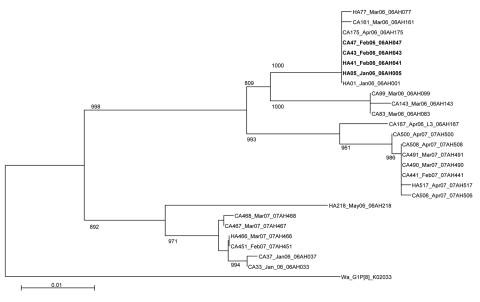
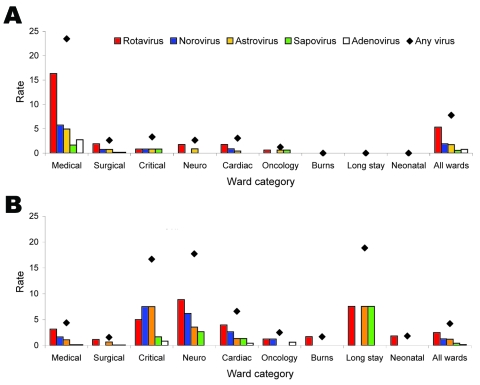
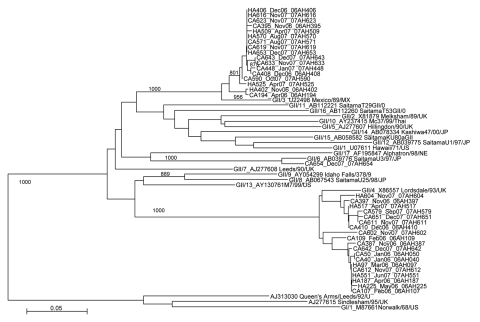
Viruses are the major pathogens of community-acquired (CA) acute gastroenteritis (AGE) in children, but their role in healthcare-associated (HA) AGE is poorly understood. Children with AGE hospitalized at Alder Hey Children's Hospital, Liverpool, UK, were enrolled over a 2-year period. AGE was classified as HA if diarrhea developed > or =48 hours after admission. Rotavirus, norovirus, adenovirus 40/41, astrovirus, and sapovirus were detected by PCR. A total of 225 children with HA-AGE and 351 with CA-AGE were enrolled in the study. HA viral gastroenteritis constituted one fifth of the diarrheal diseases among hospitalized children and commonly occurred in critical care areas. We detected > or =1 virus in 120 (53%) of HA-AGE cases; rotavirus (31%), norovirus (16%), and adenovirus 40/41 (15%) were the predominant viruses identified. Molecular evidence indicated rotaviruses and noroviruses were frequently introduced into the hospital from the community. Rotavirus vaccines could substantially reduce the incidence of HA-AGE in children.
病毒是儿童社区获得性(CA)急性胃肠炎(AGE)的主要病原体,但它们在医院获得性(HA)AGE 中的作用尚不清楚。在英国利物浦的奥尔德·希儿童医院,对住院的 AGE 患儿进行了为期 2 年的研究。如果腹泻发生在入院后≥48 小时,则将 AGE 归类为 HA。通过 PCR 检测轮状病毒、诺如病毒、腺病毒 40/41、星状病毒和肠病毒。共有 225 例 HA-AGE 患儿和 351 例 CA-AGE 患儿入组。HA 病毒性胃肠炎占住院患儿腹泻病的五分之一,常见于重症监护病房。我们在 120 例(53%)HA-AGE 病例中检测到≥1 种病毒;轮状病毒(31%)、诺如病毒(16%)和腺病毒 40/41(15%)是主要鉴定出的病毒。分子证据表明,轮状病毒和诺如病毒经常从社区传入医院。轮状病毒疫苗可显著降低儿童 HA-AGE 的发病率。